Key figures: Cristiano Ronaldo (footballer), Sir Alex Ferguson (Manchester United manager), Florentino Pérez (Real Madrid president), Sepp Blatter (FIFA president)
Summary
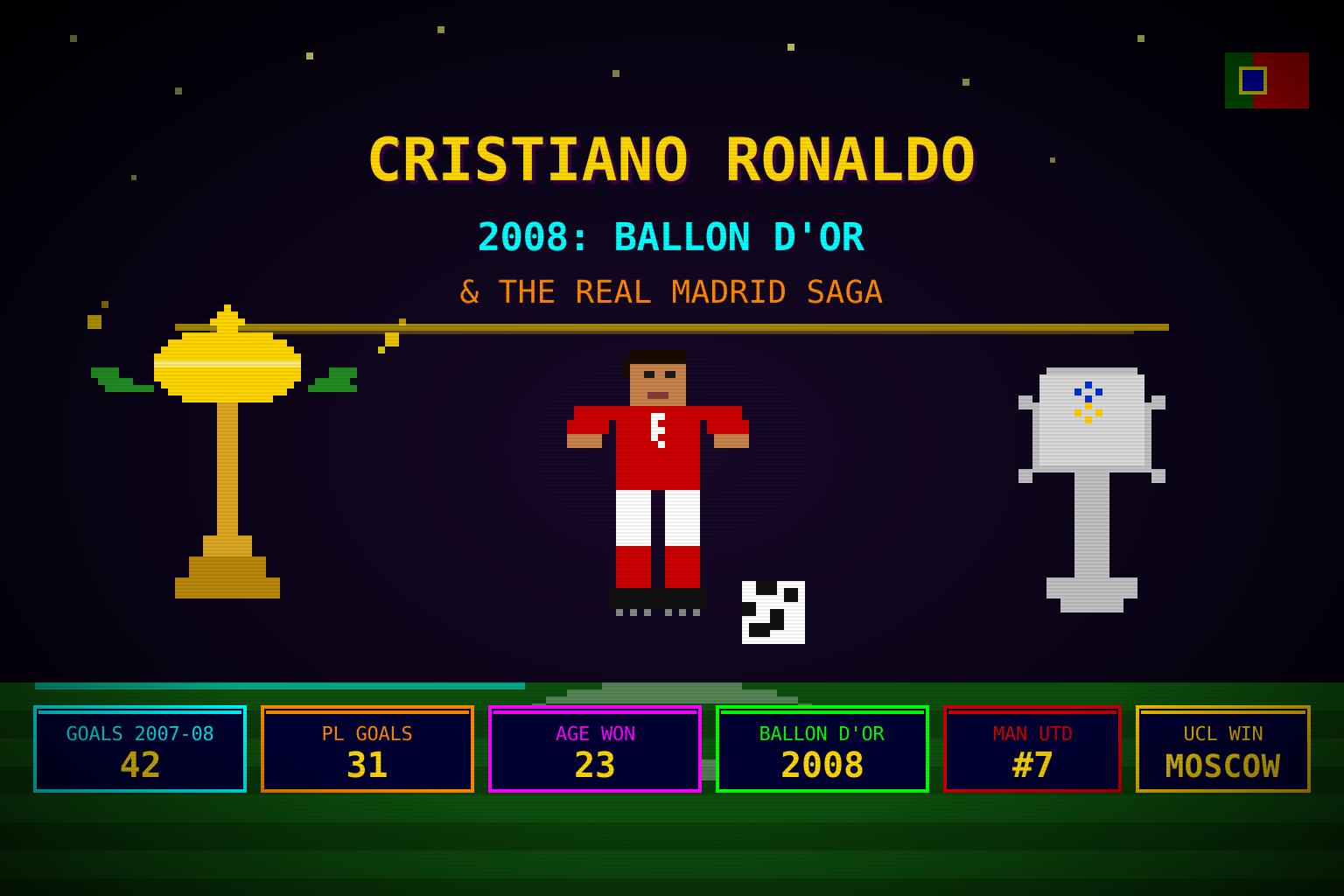
The year 2008 was Cristiano Ronaldo’s breakthrough as the best footballer in the world. Across the 2007–08 season he scored 42 goals in all competitions — including 31 in the Premier League, a record for a winger — and drove Manchester United to a Premier League and UEFA Champions League double, the club beating Chelsea on penalties in the final in Moscow on 21 May 2008. On 2 December 2008 he was awarded the Ballon d’Or by France Football magazine, winning by a then-record margin and becoming the first Portuguese player to receive the honour since Eusébio in 1965. Weeks later he was named FIFA World Player of the Year for 2008 (announced 12 January 2009), completing a clean sweep of the sport’s individual awards at the age of 23.
Ronaldo’s ascendancy also made him the object of the most public transfer pursuit in football. Throughout the summer of 2008 Real Madrid, under president Florentino Pérez’s “galáctico” strategy, courted him openly; Ronaldo signalled his desire to move, and FIFA president Sepp Blatter inflamed the standoff by likening a player being held to a contract against his will to “modern slavery.” Manchester United refused to sell, and after ankle surgery that off-season Ronaldo publicly recommitted to the club for the 2008–09 campaign. The saga was resolved only the following year, when Real Madrid agreed a world-record £80 million fee on 11 June 2009 and Ronaldo joined on 1 July 2009 — but its defining moments, and the achievements that made him worth such a sum, belonged to 2008.
Rise at Manchester United
Born on 5 February 1985 in Funchal, Madeira, Portugal, Ronaldo played for the amateur clubs Andorinha (his father’s team) and Nacional before joining Sporting Lisbon’s youth academy, moving to Lisbon at age 12 to pursue professional training. In 2003, at age 18, he signed with Manchester United after impressing in a friendly between Sporting and United at Old Trafford. He was assigned the number 7 shirt — previously worn by George Best and David Beckham — a notable vote of confidence from manager Sir Alex Ferguson.
His early years at United were marked by flashes of brilliance alongside inconsistency and disciplinary lapses. Under Ferguson’s guidance and the coaching of skills coach René Meulensteen, Ronaldo refined his technique, decision-making, and professionalism, evolving from a trickery-first winger into a ruthless goalscorer. By 2006–07 he had matured into a decisive force, and the 2007–08 season established him as the world’s pre-eminent player.
The 2007–08 Season
Playing primarily from the left in Manchester United’s fluid front line, Ronaldo scored 42 goals in 49 appearances across all competitions, including 31 in 34 Premier League matches — an unprecedented tally for a wide player, earning him the Premier League Golden Boot and the European Golden Shoe. United retained the Premier League title, and on 21 May 2008 defeated Chelsea in the UEFA Champions League final at Moscow’s Luzhniki Stadium. Ronaldo headed United ahead in the first half; the match finished 1–1 after extra time, and although he missed his attempt in the penalty shootout, United prevailed 6–5. His combination of pace, aerial power despite operating from the flank, and a distinctive knuckleball free-kick technique made him, by the season’s end, nearly impossible to contain.
The 2008 Ballon d’Or and the Transfer Saga
On 2 December 2008, France Football announced that Ronaldo had won the 2008 Ballon d’Or, then awarded to the best player in European club football, ahead of Lionel Messi and Fernando Torres. It was his first of five career Ballon d’Or wins and, at the time, the clearest possible confirmation of his standing atop the world game. The FIFA World Player of the Year award for 2008 followed on 12 January 2009.
The recognition intensified an already fevered transfer situation. Real Madrid’s pursuit of Ronaldo had been public and relentless through 2008. President Florentino Pérez — architect of the club’s earlier “galáctico” acquisitions — saw in the Portuguese a rare combination of on-field quality and global marketability. Ronaldo, for his part, made little secret of his interest in a move to the Santiago Bernabéu. In July 2008 FIFA president Sepp Blatter publicly sided with the player’s freedom of movement, describing the notion of compelling a footballer to honour a contract against his wishes as “modern slavery” — remarks that drew a sharp rebuke from Ferguson. Manchester United held firm, refused to sell, and Ronaldo — recovering from ankle surgery that summer — issued a public statement committing to the club for one more season.
Resolution in 2009: The transfer was completed the following year. On 11 June 2009 Real Madrid announced an agreement to sign Ronaldo for a world-record £80 million (about €94 million); he formally joined on 1 July 2009 and was presented at the Bernabéu on 6 July before an estimated 80,000 supporters — a record for a player unveiling. He went on to score 450 goals in 438 appearances over nine seasons at Madrid, winning four further Champions League titles, before leaving in 2018.
Significance
Ronaldo’s 2008 marked a generational shift in football and situated him within one of the most remarkable years of individual athletic achievement in modern sport.
Ascendancy to the summit: The Ballon d’Or confirmed Ronaldo as the successor to a lineage of world-best players and opened the decade-long Ronaldo–Messi duopoly that would define the sport’s individual honours through the 2010s.
A record valuation: By making Ronaldo the game’s most coveted player, 2008 set the terms for the £80 million move that followed in 2009 — then the most expensive transfer in football history — and signalled that elite attacking talent could command fees previously thought unimaginable, resetting the market’s ceiling.
A landmark year in sport: Ronaldo’s dominance unfolded alongside a series of extraordinary individual feats in 2008. At the Beijing Summer Olympics, swimmer Michael Phelps won a record eight gold medals and sprinter Usain Bolt set three world records, while on the tennis courts his Iberian contemporary Rafael Nadal swept the French Open, Wimbledon, and Olympic gold. Ronaldo’s 42-goal season and Ballon d’Or entered the same conversation about individual excellence.
Football against a darkening backdrop: The escalating wealth of elite football — soon embodied by Ronaldo’s record fee — stood in stark contrast to the collapse of Lehman Brothers in September 2008 and the global financial crisis engulfing the wider economy, underscoring how insulated the top of the sport had become from broader economic turmoil.
Ronaldo’s 2008 remains emblematic of the moment a 23-year-old became the definitive best player in the world — and of the point at which the modern football economy entered a new era.