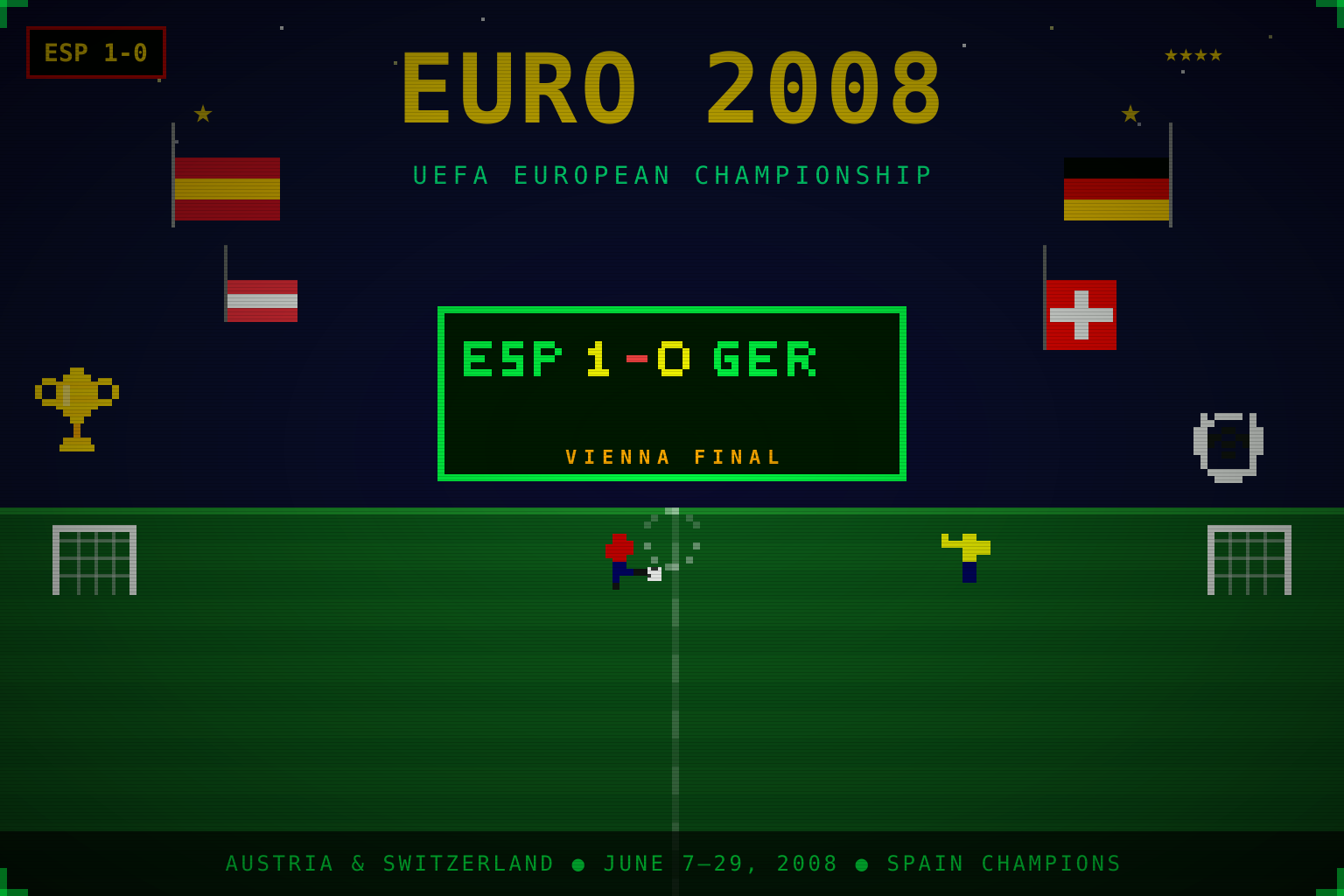
Key figures: Luis Aragonés (Spain manager), Fernando Torres (Spanish forward, scorer of the final’s only goal), Xavi Hernández (Spanish midfielder, player of the tournament), Iker Casillas (Spanish goalkeeper and captain), David Villa (Spanish forward, tournament top scorer with 4 goals), Joachim Löw (Germany manager), Michael Ballack (Germany captain), Guus Hiddink (Russia manager), Slaven Bilić (Croatia manager)
Summary
Euro 2008, the 13th UEFA European Football Championship, took place across Austria and Switzerland from June 7 to June 29, 2008. The tournament concluded with Spain defeating Germany 1–0 in the final at Vienna’s Ernst-Happel-Stadion on June 29, marking Spain’s first continental championship since 1964 and a watershed moment in European football. The victory inaugurated a four-year period of Spanish dominance that would also yield the 2010 FIFA World Cup and Euro 2012.
Tournament Structure and Context
Euro 2008 was co-hosted by Austria and Switzerland — a first for the championship — across eight venues: Vienna, Salzburg, Innsbruck, and Klagenfurt in Austria; and Basel, Geneva, Bern, and Zürich in Switzerland. The co-hosting arrangement followed the model established by Euro 2000 (Belgium and the Netherlands) and reflected UEFA’s strategy of expanding the tournament’s geographic reach.
The 16 participating nations were divided into four groups of four, with the top two from each group advancing to the knockout round. A total of 31 matches produced 77 goals (2.48 per match), and the tournament drew a large global television audience, reinforcing the European Championship’s status as one of the most-watched events in world sport.
Notable absences included England, which failed to qualify — a failure that cost manager Steve McClaren his job — along with Scotland and the Republic of Ireland. The absence of England, one of football’s historically prominent nations, was a major storyline entering the tournament.
Group Stage
Group A (Switzerland, Czech Republic, Portugal, Turkey): Portugal and Turkey advanced. Turkey, in particular, began a dramatic tournament run that would characterize the knockout stage.
Group B (Austria, Croatia, Germany, Poland): Croatia and Germany advanced. Croatia defeated Germany 2–1 in a surprise group-stage result before both progressed.
Group C (Netherlands, Italy, Romania, France): The Netherlands and Italy advanced, with the Netherlands winning all three group games — including a 4–1 defeat of France and a 3–0 defeat of Italy — to emerge as group winners.
Group D (Greece, Sweden, Russia, Spain): Spain won all three games (including 4–1 over Russia and 2–1 over Sweden), and Russia advanced in second, while defending champions Greece were eliminated in the group stage — a dramatic fall from their Euro 2004 triumph.
Knockout Stage
Quarter-finals (June 19–22):
- Portugal 2–3 Germany: Germany overcame Portugal in a tight match decided in regulation.
- Croatia 1–1 Turkey (aet); Turkey won 3–1 on penalties: Turkey survived after equalizing in the 119th minute — one of the tournament’s most dramatic moments.
- Netherlands 1–3 Russia (aet): Russia produced a stunning upset, defeating the tournament’s strongest group-stage performer with two extra-time goals.
- Spain 0–0 Italy (aet); Spain won 4–2 on penalties: Spain eliminated the defending world champions via a penalty shootout.
Semi-finals (June 25–26):
- Germany 3–2 Turkey: A depleted Turkish side twice equalized before Philipp Lahm scored a 90th-minute winner, eliminating a team that had thrilled audiences throughout the tournament.
- Spain 3–0 Russia: A comprehensive victory — goals from Xavi, Dani Güiza, and David Silva — confirmed Spain’s status as favorites and marked the limit of Russia’s run.
The Final: Spain 1–0 Germany (June 29, Vienna)
The final, played before 51,428 spectators at the Ernst-Happel-Stadion in Vienna, was decided by a single goal. In the 33rd minute, Fernando Torres ran onto a through-ball, used his pace to beat German goalkeeper Jens Lehmann to the ball, and finished into an empty net. Spain then managed the game effectively, preserving the lead through disciplined possession and resolute defending by Carles Puyol and Joan Capdevila.
Germany, managed by Joachim Löw (who had taken charge after Jürgen Klinsmann’s departure following the 2006 World Cup), created chances through Michael Ballack and Bastian Schweinsteiger but could not break down the Spanish defensive structure, with Iker Casillas making a key second-half save to preserve the clean sheet.
Spain finished the tournament having won six matches (the quarter-final on penalties) and gone unbeaten, scoring 12 goals and conceding just three across six games. Xavi Hernández was named player of the tournament; David Villa finished as top scorer with 4 goals.
Significance
The Spanish golden generation: Euro 2008 crystallized the emergence of a Spanish national team built around players developed at FC Barcelona’s La Masia academy (Xavi, Andrés Iniesta, Puyol) supplemented by talent from other Spanish clubs (Torres from Liverpool, Villa from Valencia, Casillas from Real Madrid). Manager Luis Aragonés, who stepped down as Spain manager after the tournament aged 69, had resisted public pressure to recall the veteran Real Madrid forward Raúl — a decision that prioritized collective system over individual stardom and proved correct. The victory came amid a remarkable summer for Spanish sport, which also saw Rafael Nadal win Wimbledon and Olympic gold.
The same core of players — with Aragonés replaced by Vicente del Bosque — went on to win the 2010 FIFA World Cup and Euro 2012, becoming the only international team to win three consecutive major tournaments. The Euro 2008 campaign was the foundation of that unprecedented run.
Tiki-taka’s global influence: Spain’s style of play — short, rapid passing combinations, positional discipline, a high defensive line, and collective pressing out of possession — was labeled tiki-taka by the Spanish media and became the dominant tactical influence on world football for the following decade. Pep Guardiola’s FC Barcelona (2008–2012) brought a club version of the same philosophy to multiple European trophies, amplifying its reach.
Turkey’s dramatic run and Russia’s surprise: Turkey’s knockout-round performances — including a 119th-minute equalizer against Croatia before winning on penalties — captivated audiences before the semi-final loss to Germany. Russia, coached by the Dutchman Guus Hiddink, reached the semi-finals while eliminating the highly regarded Netherlands 3–1. Andrei Arshavin, central to Russia’s campaign, parlayed his tournament form into a February 2009 transfer to Arsenal for a reported £15 million, an Arsenal club-record fee at the time.
Geopolitical symbolism: Hosted by Austria and Switzerland — politically neutral nations with strong European-integration credentials — Euro 2008 functioned as a celebration of European cooperation. The peaceful, well-organized tournament preceded a turbulent second half of 2008, in which the Russo-Georgian War erupted in August and the global financial crisis deepened in September, and it gave way to the summer’s other great sporting spectacle, the Beijing Summer Olympics, which opened on August 8.
Sources
- Wikipedia: UEFA Euro 2008
- Wikipedia: UEFA Euro 2008 knockout stage
- UEFA.com: UEFA Euro 2008 history
- The Guardian: Euro 2008 tournament coverage