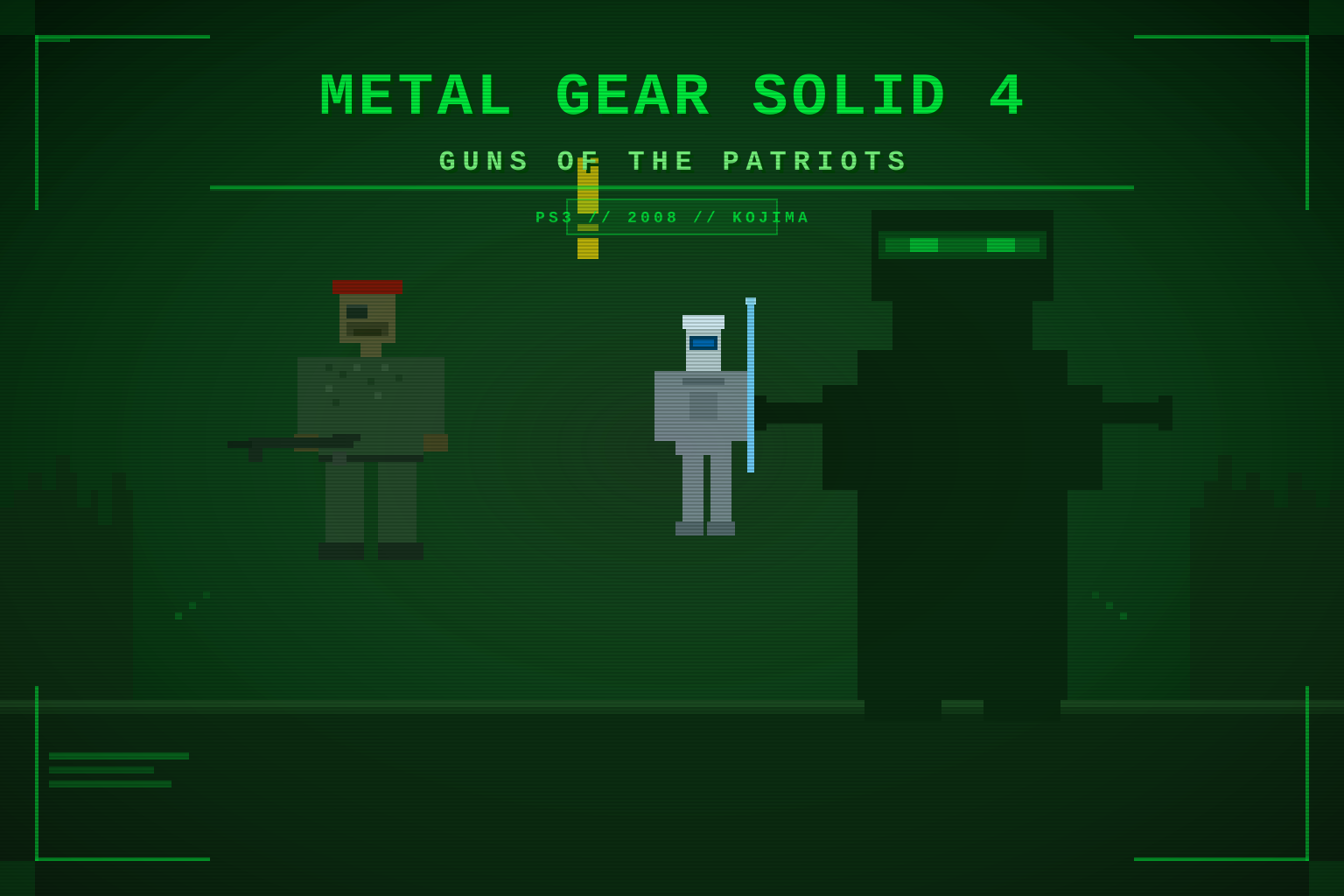
Key figures: Hideo Kojima (director, Kojima Productions), Yoji Shinkawa (art director and character designer), Harry Gregson-Williams (composer), David Hayter (voice of Solid Snake / Old Snake), Quinton Flynn (voice of Raiden)
Summary
Metal Gear Solid 4 – Guns of the Patriots (MGS4), developed by Kojima Productions and published by Konami, launched on June 12, 2008 exclusively for PlayStation 3. The game served as both the technical showcase of the PS3’s capabilities and the narrative conclusion to Hideo Kojima’s Metal Gear Solid saga, delivering a complex meditation on warfare, aging, and the cycle of conflict through stealth-action gameplay that redefined the genre. With approximately 9 hours of cinematics, groundbreaking photorealistic graphics, and a main narrative spanning five acts across multiple global locations, MGS4 demonstrated gaming’s potential as a narrative medium capable of rivaling cinema in scope and emotional ambition.
Development History
Development began in 2004 immediately after the Metal Gear Solid 3: Snake Eater team wrapped at Kojima Productions in Tokyo. Kojima publicly struggled with the project’s scope: he repeatedly stated in interviews that MGS4 would be his “final Metal Gear game” — a claim he had also made about MGS1, MGS2, and MGS3, but which carried more weight given the narrative ambition of providing definitive closure to a saga spanning three PlayStation console generations.
The game’s development coincided with the PS3’s infamously difficult Cell Broadband Engine architecture, which required Kojima Productions to re-engineer its proprietary engine from the ground up. The team used a modified version of the engine that had powered Metal Gear Online (2006) and Metal Gear Solid: Portable Ops, expanding it to support the PS3’s deferred rendering pipeline and Blu-ray’s 50 GB storage capacity — the game shipped on a single 50 GB BD-ROM. Kojima later cited the sheer data volume of the game’s high-definition, in-engine cinematics as the primary driver of the Blu-ray requirement; the game could not have been released on DVD.
The reported development cost was approximately $70 million, making it one of the most expensive game productions to that point. The team size peaked at approximately 400 contributors across Kojima Productions and contracted external studios for motion capture, recording, and localization.
Key Facts
- Release and Platform: June 12, 2008 (PlayStation 3 exclusive, 50 GB BD-ROM)
- Developer/Publisher: Kojima Productions / Konami
- Director: Hideo Kojima
- Development Cost: Estimated $70 million
- Playtime: 35–50 hours total (including ~9 hours of cinematics); main campaign ~15–20 hours
- Cinematics: Approximately 9 hours of high-fidelity in-engine cutscenes; the final act’s closing sequence runs approximately 71 minutes — among the longest uninterrupted cinematic sequences in gaming history
- Graphics: High-definition output (upscaled from a sub-1080p internal resolution), photorealistic character models, real-time deferred rendering; technically among the first major games to demonstrate the PS3’s graphical ceiling to mainstream audiences
- Voice Cast (English):
- David Hayter — Solid Snake / Old Snake (Hayter’s final performance as Snake before Kiefer Sutherland replaced him in Metal Gear Solid V, 2014)
- Quinton Flynn — Raiden (Jack)
- Paul Eiding — Roy Campbell
- Jennifer Hale — Meryl Silverburgh
- Patric Zimmerman — Revolver Ocelot / Liquid Ocelot
- Richard Doyle — Big Boss
- Gameplay: Stealth-action across five acts — Middle East, South America, Eastern Europe, Shadow Moses (Alaska), outer Heaven (at sea)
- Awards: Game of the Year (multiple outlets), BAFTA Video Games Award for Story, Spike Video Game Award for Best PS3 Game
- Sales: Approximately 6 million copies sold globally across the PS3’s lifecycle; at launch, was the PS3’s largest-selling exclusive and drove a measurable spike in hardware sales
Technical Achievement
MGS4 represented the first major demonstration of the PS3’s Cell processor being fully exploited by a first-party-level studio. Earlier PS3 titles (including launch titles in 2006–2007) had largely failed to distinguish the console visually from Xbox 360 due to the difficulty of Cell architecture; MGS4’s deferred rendering approach, which offloaded lighting calculations to the Cell’s Synergistic Processing Units (SPUs), produced character lighting and skin rendering that industry analysts at the time described as a generational advance.
The game’s use of seamless transitions between exploration, stealth, combat, and extended cinematic sequences — without loading screens visible to the player — was a technical achievement enabled specifically by the PS3’s large, fast data cache and the BD-ROM’s high sustained data rate. The same data-loading approach influenced subsequent open-world and cinematic game design.
By June 2008, the PS3 had sold approximately 14.8 million units globally (behind Xbox 360’s approximately 19 million, and significantly behind Wii’s roughly 26 million). MGS4 was credited in multiple retail analyses with driving PlayStation 3 hardware unit sales in its launch week — NPD Group reported the PS3 outsold the Xbox 360 in the United States in June 2008, an unusual reversal attributed primarily to MGS4’s PS3-exclusive status.
Narrative Scope and Thematic Design
The game’s protagonist, Old Snake, is an aged, accelerated-clone version of Solid Snake, physically deteriorating from a genetic condition that is killing him. Kojima used the aging-soldier premise to interrogate the broader Metal Gear Solid saga’s themes: whether conflict has inherent meaning, whether soldiers are instruments of geopolitical systems they cannot control, and what legacy a warrior leaves behind.
MGS4 introduced the concept of the “war economy” — a fictional geopolitical order in which private military corporations (PMCs) have replaced national armies, and war itself has become a commodified, perpetually-running system managed by an AI network called the Patriots (GW, TJ, AL, TR, and the AI-controlling the global ID system, Sons of the Patriots). This framing gave the game’s political commentary a prescience that critics connected to real 2008 concerns about private military contractors (Blackwater’s role in Iraq), mercenary warfare, and the militarization of global economic systems.
Context: The 2008 PlayStation 3 Ecosystem
MGS4’s June 2008 release came within weeks of several other landmark technology moments: the iPhone 3G Launch in July 2008 and the Apple App Store Launch in the same month were beginning to shift the broader gaming landscape toward mobile. Against this backdrop, MGS4’s release was a deliberate statement about the future of console-based, narrative-driven, high-budget game production.
Within the console gaming space of 2008, the contrast with Grand Theft Auto IV — released just six weeks earlier — was instructive: both games represented the apex of a certain model of AAA console game production (massive budget, years of development, cinematic presentation) but pursued opposite design philosophies. GTA IV prioritized emergent, player-driven narrative through an open world; MGS4 prioritized director-controlled cinematic narrative through tightly authored sequences. Together, they defined the poles of high-budget console game design in the late 2000s.
Legacy and Influence
MGS4’s influence on subsequent narrative-driven game design was significant. Naughty Dog’s The Last of Us (2013) has been directly cited by its creators as drawing on MGS4’s approach to using in-engine, real-time cinematics to advance character-driven narrative — specifically the technique of integrating cutscene-quality performance into the same gameplay environment without cuts. The game’s use of motion-captured facial performance (years before widespread industry adoption) established a visual standard that mid-budget and AAA studios spent the following decade catching up to.
Sources
- Wikipedia – Metal Gear Solid 4: Guns of the Patriots
- IGN – Metal Gear Solid 4: Guns of the Patriots Review (June 2008)
- Eurogamer – Metal Gear Solid 4 Review (June 2008)
- NPD Group – June 2008 US Console Hardware Sales — PS3 outsold Xbox 360 in June 2008, attributed to MGS4 release