Key figures: Alan Schwartz, James “Jimmy” Cayne, Jamie Dimon, Henry Paulson, Ben Bernanke, Timothy Geithner
Summary
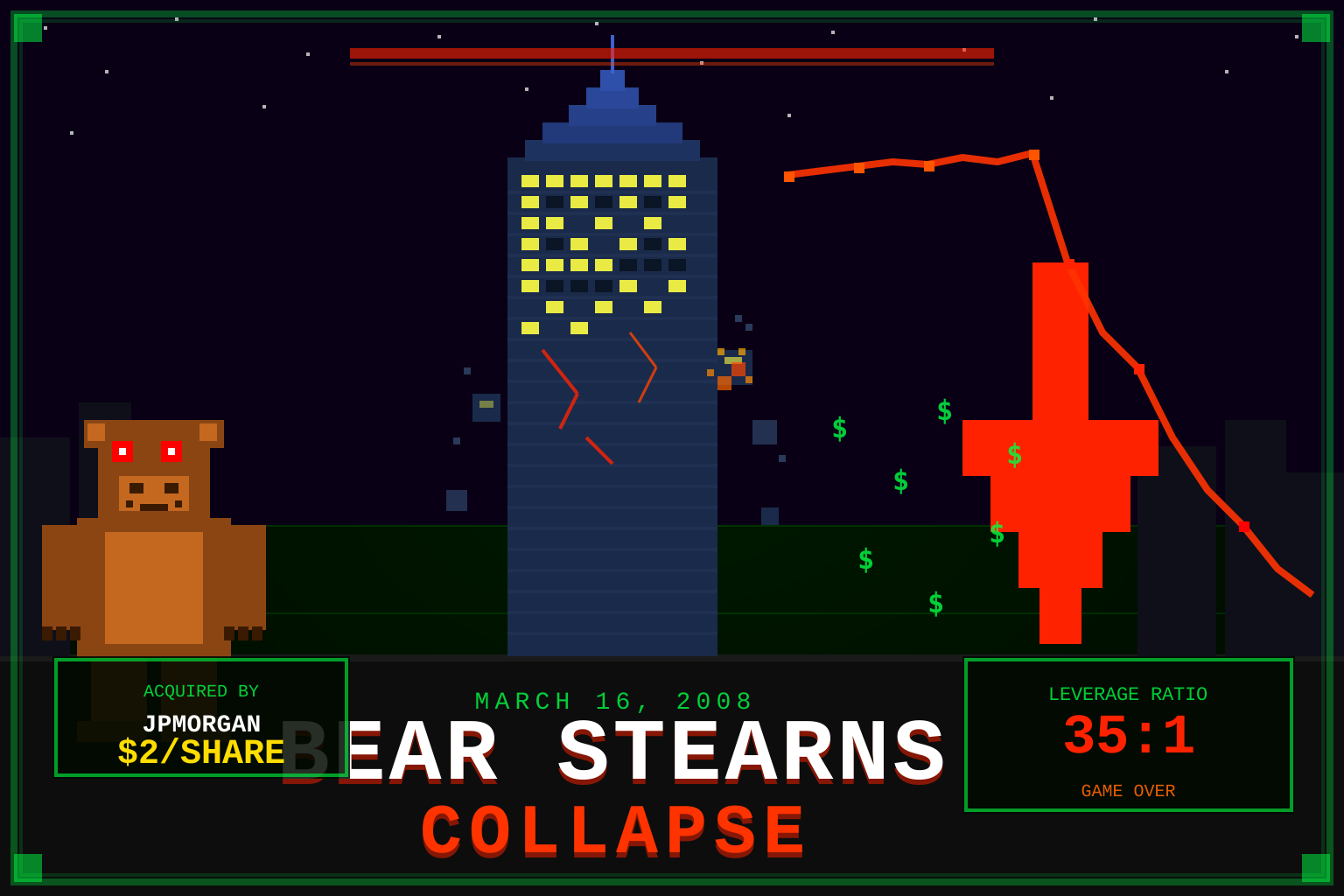
In mid-March 2008, The Bear Stearns Companies, Inc. — the fifth-largest investment bank in the United States and a Wall Street institution founded on May 1, 1923 — collapsed within days as lenders and counterparties withdrew their funding. On March 16, 2008, JPMorgan Chase agreed to acquire the firm in a rescue brokered and backstopped by the Federal Reserve, marking the first major federal intervention of the financial crisis that would culminate in the collapse of Lehman Brothers six months later. The rescue set a precedent for government support of a systemically important institution and previewed the interconnected fragility of the shadow banking system.
Bear Stearns had been among the most aggressive Wall Street firms in mortgage-backed securities, and the first cracks appeared in mid-2007 when two of its hedge funds, heavily exposed to subprime mortgage bonds, imploded. The firm pledged $3.2 billion to prop up its High-Grade Structured Credit Strategies Fund in June 2007, and by July both funds had lost nearly all of their value. In November 2007 Bear reported the first quarterly loss in its history alongside a $1.2 billion write-down. By the end of 2007 the firm carried roughly $395 billion in total assets against about $11.1 billion of equity — a leverage ratio near 35 to 1 — and financed itself heavily through short-term repurchase (“repo”) agreements that had to be rolled over daily.
That funding model proved fatal once confidence evaporated. Bear’s liquidity pool fell from $18.1 billion on March 10, 2008 to about $2 billion on March 13, when the firm notified regulators it would not be able to meet its obligations the following day. On Friday, March 14, the Federal Reserve Board, invoking its emergency authority under Section 13(3) of the Federal Reserve Act, authorized the Federal Reserve Bank of New York to extend credit to Bear Stearns through JPMorgan Chase; the New York Fed made an overnight non-recourse loan of $12.9 billion. Over the ensuing weekend, Treasury Secretary Henry Paulson, Fed Chairman Ben Bernanke, and New York Fed President Timothy Geithner pressed for a resolution before markets reopened in Asia. On March 16, JPMorgan Chase, led by CEO Jamie Dimon, agreed to buy Bear Stearns for $2 per share — roughly $236 million, a startling discount for a firm whose stock had traded above $170 in January 2007. Amid shareholder outrage and legal concerns about the original terms, the offer was revised on March 24 to $10 per share, and shareholders approved the sale on May 29, 2008. To make the deal possible, the New York Fed financed a Delaware entity, Maiden Lane LLC, which purchased roughly $30 billion of Bear’s hard-to-value mortgage assets, backed by a $29 billion Fed loan and a $1 billion subordinated loan from JPMorgan.
Significance
The Bear Stearns rescue was a watershed in the crisis because it extended the federal safety net, for the first time since the Great Depression, to a non-bank investment firm that fell outside the Federal Reserve’s traditional lending framework. By invoking Section 13(3), the Fed signaled that the failure of a large, interconnected broker-dealer posed a systemic threat — Bear had thousands of counterparties across the repo and derivatives markets, and a disorderly bankruptcy risked cascading defaults. In the days that followed, the Fed opened the Primary Dealer Credit Facility, giving investment banks direct access to central-bank liquidity for the first time. The episode demonstrated how quickly a modern financial institution could fail when it depended on short-term wholesale funding rather than stable deposits.
The intervention also framed the fierce debate over “moral hazard” and “too big to fail” that defined the rest of 2008. Critics argued that shielding Bear’s creditors — and even part of its equity — encouraged reckless risk-taking, while defenders contended that inaction would have triggered a broader panic. That tension shaped the Treasury and Fed’s fateful decision not to rescue Lehman Brothers in September 2008, whose bankruptcy then confirmed the systemic dangers the Bear rescue had been designed to avert. The contrast between the two outcomes became central to post-crisis analysis and to the regulatory response embodied in the Dodd-Frank Wall Street Reform and Consumer Protection Act of 2010, which created formal resolution authority for failing systemic firms so that future collapses could be managed without either a bailout or a destabilizing bankruptcy.
Sources
- https://en.wikipedia.org/wiki/Bear_Stearns — Wikipedia: Bear Stearns
- https://www.federalreserve.gov/regreform/reform-bearstearns.htm — Board of Governors of the Federal Reserve System: “Bear Stearns, JPMorgan Chase, and Maiden Lane LLC”
- https://elischolar.library.yale.edu/journal-of-financial-crises/vol7/iss1/22/ — Yale Program on Financial Stability: “United States: Bear Stearns Emergency Liquidity Assistance, 2008”