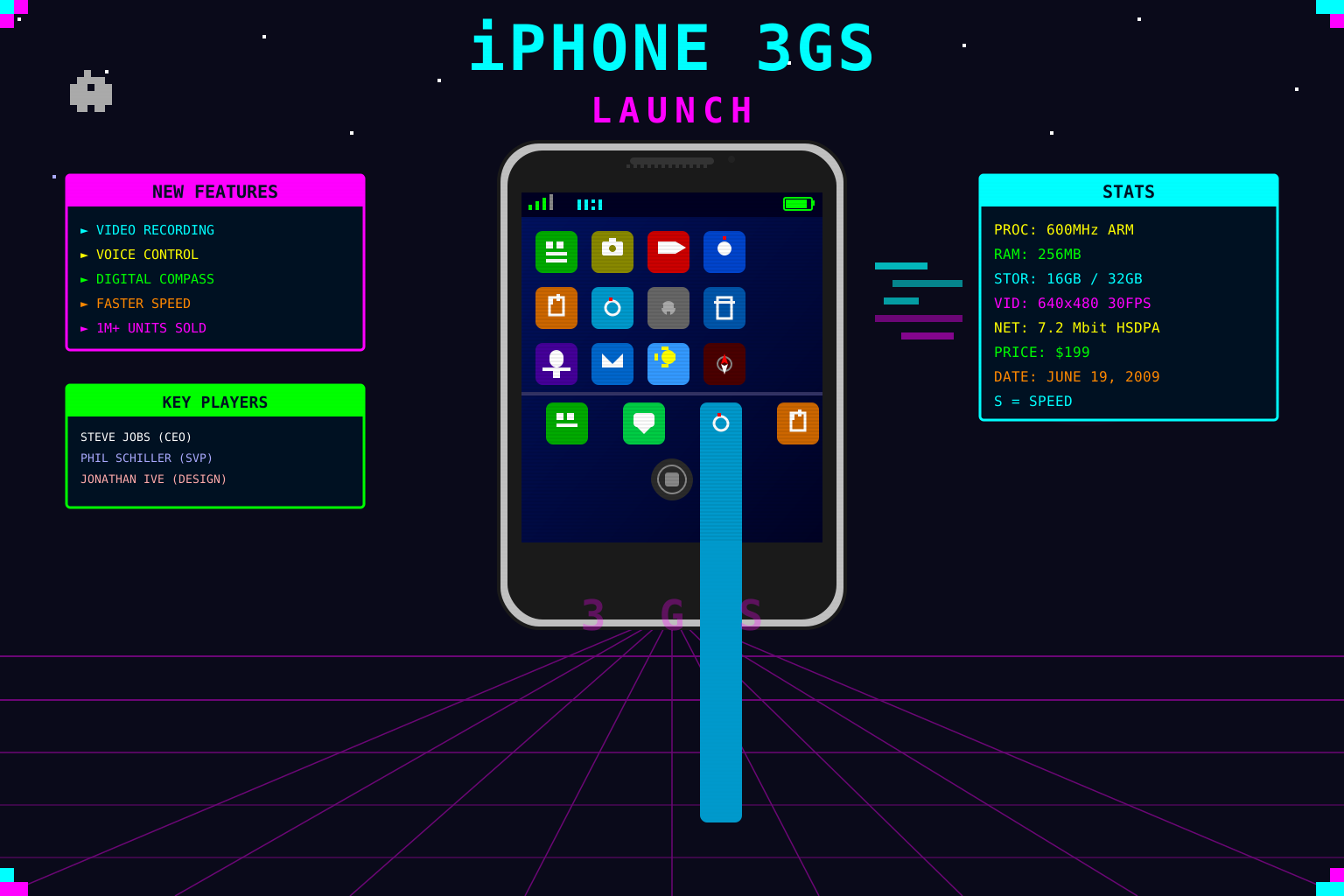
Key figures: Steve Jobs (Apple CEO), Phil Schiller (Senior Vice President), Jonathan Ive (Senior Vice President Design)
Summary
Apple unveiled and released the iPhone 3GS on June 19, 2009, positioning it as the third generation of its flagship smartphone line. The “S” designation, according to Apple executive Phil Schiller, stood for “Speed,” reflecting the device’s primary innovation: a significant performance upgrade over its predecessor, the iPhone 3G. The device featured a 3.5-inch capacitive touchscreen display (480×320 resolution), a 600 MHz ARM Cortex-A8 processor, and 256 MB of RAM — double the memory of the iPhone 3G. Storage options were 16GB and 32GB, with pricing starting at $199 for the 16GB model on a two-year carrier contract with AT&T (an entry-level 8GB model was added the following year).
The flagship innovation was the introduction of video recording capability — a feature conspicuously absent from prior iPhone models despite the growing ubiquity of mobile video. The 3GS captured video at 30 frames per second with VGA resolution (640×480). Additional notable features included Voice Control for hands-free operation (supporting voice dialing and music playback commands), a digital compass enabling turn-by-turn navigation applications, and improved 3G connectivity supporting 7.2 Mbit/s HSDPA speeds — a significant upgrade from the iPhone 3G’s 3.6 Mbit/s baseline.
The device achieved remarkable commercial success, selling over one million units during its opening weekend of June 19–21 — matching the sales trajectory of the iPhone 3G (2008) and the original iPhone (2007). The early sales velocity demonstrated sustained consumer demand for iPhone upgrades and reinforced Apple’s strong position in the fast-growing smartphone market, where competitors like BlackBerry and Android-based phones were beginning to gain traction.
iOS 3.0 and Software Features
The iPhone 3GS launched simultaneously with iOS 3.0 (then called “iPhone OS 3.0”), a major software update that Apple released for free to existing iPhone users and for $9.95 to iPod touch owners. iOS 3.0 introduced features that had been conspicuously absent from the platform since the original iPhone’s 2007 launch: copy-and-paste functionality, MMS messaging (multimedia text messages including photos), Spotlight search, and peer-to-peer Bluetooth connectivity. The combination of hardware improvements in the 3GS and the iOS 3.0 software upgrade represented Apple’s most comprehensive platform refresh since the original iPhone launch.
The App Store, launched in July 2008 alongside the iPhone 3G, had already accumulated over 50,000 applications by June 2009, with cumulative downloads exceeding 1 billion. The 3GS’s doubled RAM (256 MB vs. 128 MB in the 3G) enabled more capable third-party applications and smoother multitasking between apps — a technical constraint that developers had consistently cited as the primary limitation on App Store application ambition. The improved processor also enabled the launch of the first iPhone-native turn-by-turn GPS navigation application through third-party developers enabled by the digital compass and Core Location API updates.
Carrier Exclusivity and Pricing
In the United States, the iPhone 3GS remained exclusive to AT&T under a multi-year exclusivity agreement first signed with the original iPhone in 2007. The 16GB model was priced at $199 with a new two-year AT&T contract, and the 32GB model cost $299 — both requiring the $30/month AT&T data plan in addition to voice plan fees. (Apple introduced an entry-level 8GB model at $99 in June 2010.) Early adopters who had purchased the iPhone 3G (released July 2008) faced contract penalties of $200–$400 from AT&T if they wished to upgrade early, a pricing friction point that generated significant consumer dissatisfaction and public criticism.
Internationally, the device launched on June 19 in eight countries simultaneously — the United States, Canada, the United Kingdom, France, Germany, Italy, Spain, and Switzerland — with additional markets following within weeks; by the end of 2009 the 3GS was available in roughly 80 countries. Launch carrier partners included O2 in the UK, Rogers in Canada, and Orange and SFR in France, while Optus and Vodafone carried the device in Australia when it launched there later in 2009. The staggered multi-country rollout reflected Apple’s growing confidence in international logistics and demand forecasting.
Competitive Context
The iPhone 3GS launched into a rapidly evolving competitive landscape. Android OS, Google’s open-source mobile platform, had achieved its first commercial deployment in October 2008 with the T-Mobile G1 (HTC Dream). By June 2009, Android had grown to include the HTC Magic (G2) and the Samsung Galaxy i7500 — the latter marking Samsung’s entry into the Android ecosystem that would eventually make it Apple’s primary smartphone rival.
Research In Motion’s BlackBerry platform remained the dominant enterprise smartphone, with the BlackBerry Bold 9700 and BlackBerry Storm 9500 competing for business users. BlackBerry held approximately 20% of the U.S. smartphone market in mid-2009 versus Apple’s 17% and Android’s emerging but as-yet single-digit share. The Windows Mobile platform (Microsoft’s pre-Windows Phone smartphone OS) was in decline, losing share to both iOS and Android.
Nokia, then the world’s largest mobile phone manufacturer by volume, remained a significant competitor in international markets with its Symbian OS. Nokia’s N97, released in June 2009 simultaneously with the iPhone 3GS, featured a physical QWERTY keyboard and a 5-megapixel camera versus the 3GS’s 3.2-megapixel camera — a hardware specification battle that Nokia’s marketing emphasized. However, the N97’s software experience was widely considered inferior to the iPhone’s, illustrating the emerging gap between hardware-first and software-first approaches to smartphone design.
Significance
The iPhone 3GS represented Apple’s strategy of iterative, feature-focused improvements to its flagship product, achieving meaningful performance gains without radical design overhauls (the external appearance remained nearly identical to the iPhone 3G). Video recording, in particular, tapped into the cultural momentum of mobile video — YouTube’s 2005 launch had normalized online video sharing, and by 2009 user-generated video content was becoming a mainstream phenomenon; Apple’s inclusion of video capture on a mass-market smartphone accelerated this trend.
The device’s one-million-unit opening weekend reinforced Apple’s momentum amid growing competition from Android phones (first consumer models launched in late 2008). The 3GS demonstrated that consumers would upgrade to incrementally improved devices annually, establishing the business model that would define smartphone economics for the following decade — a model where the “S” iteration became expected every two years (iPhone 4S in 2011, 5S in 2013, 6S in 2015). The timing of the release — mid-recession, during the 2009 economic recovery — underscored the iPhone’s status as a premium consumer product that retained demand even as unemployment remained elevated and discretionary spending was constrained. The 3GS’s voice control, video recording, and compass capabilities also highlighted Apple’s strategy of abstracting complex technologies into simple, integrated features — a philosophy that differentiated the iPhone from feature-rich but less intuitive competing devices in the Android ecosystem.
The 3GS also marked a pivotal moment in the smartphone industry’s shift away from hardware keyboard dominance. Nokia’s concurrent N97 launch, with its physical QWERTY keyboard and superior camera hardware, failed to challenge the 3GS commercially — demonstrating that software user experience had begun to outweigh raw hardware specifications as the key consumer differentiator. This philosophical shift, crystallized by the 3GS’s success, would define the smartphone industry for the subsequent decade. For related context on concurrent tech industry evolution, see Microsoft Bing Launch and Amazon Kindle E-reader Expansion.
Sources
- Wikipedia — iPhone 3GS
- Apple — iPhone 3GS Specifications
- Ars Technica — iPhone 3GS Review (2009)
- Wikipedia — iOS 3