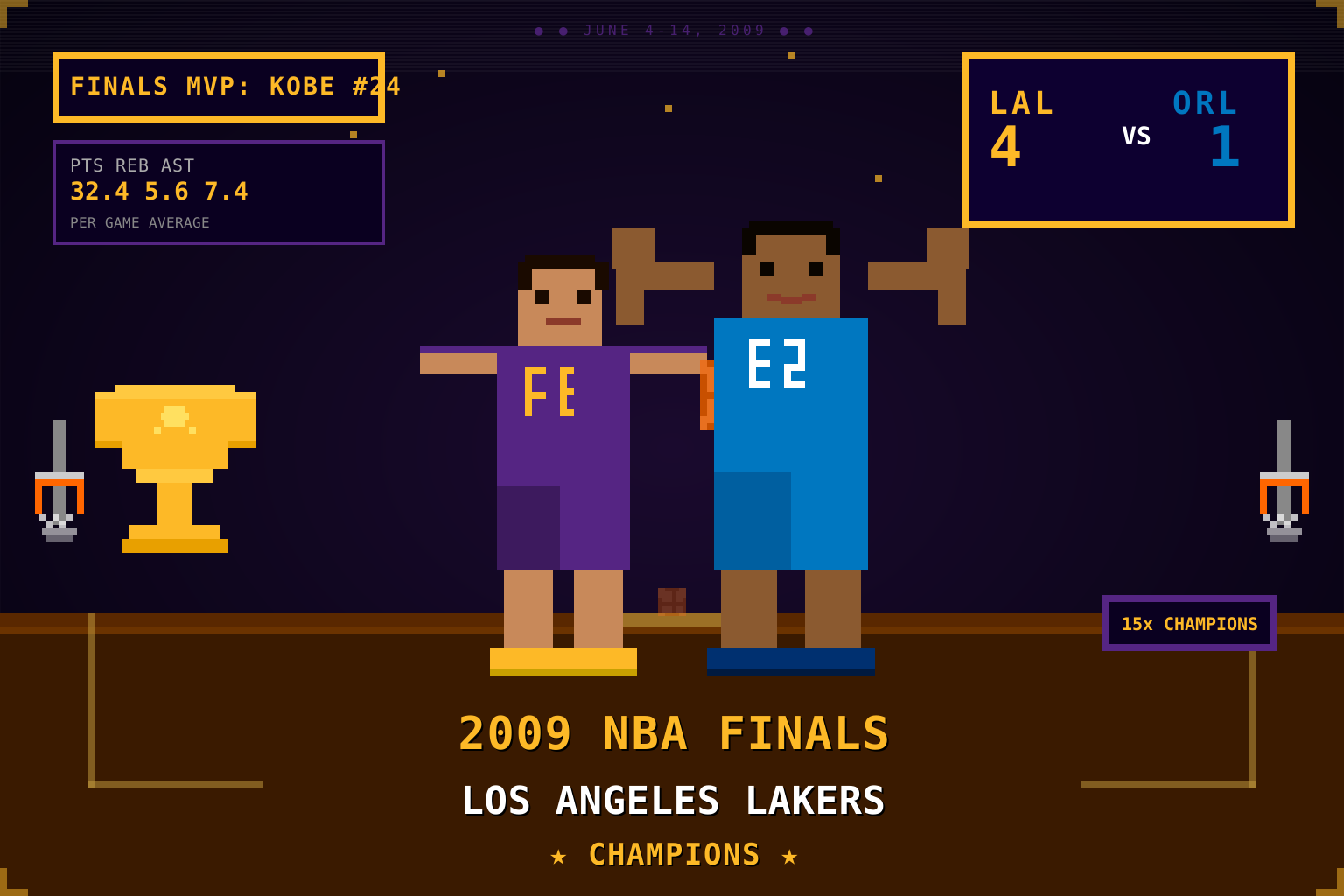
Key figures: Kobe Bryant (Los Angeles Lakers, Finals MVP), Dwight Howard (Orlando Magic), Pau Gasol (Lakers), Trevor Ariza (Lakers), Jameer Nelson (Magic)
Summary
The Los Angeles Lakers defeated the Orlando Magic 4 games to 1 in the 2009 NBA Finals, a best-of-seven series contested from June 4–14, 2009. The championship marked the Lakers’ 15th title in franchise history and their first since 2002, as well as the first of back-to-back titles in 2009 and 2010. It was Kobe Bryant’s fourth championship but his first without Shaquille O’Neal, who had anchored the Lakers’ 2000–2002 three-peat before departing in 2004. Bryant earned his first NBA Finals MVP award, averaging 32.4 points, 5.6 rebounds, and 7.4 assists per game throughout the series.
The series unfolded in five games: the Lakers won Games 1, 2, 4, and 5; the Magic captured Game 3 at the Amway Arena in Orlando, the franchise’s first-ever victory in an NBA Finals game (their only prior Finals appearance, in 1995, had ended in a four-game sweep by the Houston Rockets). Dwight Howard’s defensive presence for Orlando generated one of the Finals’ most impressive individual performances: in Game 4, Howard set an NBA Finals single-game record with 9 blocked shots, a testament to his emerging dominance as a rim protector and franchise cornerstone.
The title reasserted a dominant era of West Coast basketball, with Phil Jackson’s triangle offense and the Bryant-Gasol-Ariza core establishing Los Angeles as the decade’s premier championship franchise. The series gained the colloquial nickname “Disney Series” — a playful reference to Disney’s ownership of ESPN and ABC (the broadcast network), alongside Disney World’s proximity to Orlando and Disneyland’s proximity to Los Angeles.
Game-by-Game Results
The five-game series unfolded across ten days:
| Game | Date | Site | Score | Winner |
|---|---|---|---|---|
| 1 | June 4 | Staples Center, Los Angeles | Lakers 100, Magic 75 | Lakers |
| 2 | June 7 | Staples Center, Los Angeles | Lakers 101, Magic 96 | Lakers |
| 3 | June 9 | Amway Arena, Orlando | Magic 108, Lakers 104 | Magic |
| 4 | June 11 | Amway Arena, Orlando | Lakers 99, Magic 91 | Lakers |
| 5 | June 14 | Staples Center, Los Angeles | Lakers 99, Magic 86 | Lakers |
Game 1 established the Lakers’ defensive template: limiting the Magic to 75 points by collapsing on Dwight Howard in the post and forcing turnovers from Orlando’s perimeter shooters. Game 3, Orlando’s lone win, showcased the Magic’s capacity for explosive three-point shooting, with the team converting 42.2% of its attempts from beyond the arc. In the decisive Game 5, the Lakers closed out the series at Staples Center to secure the championship.
Key Performances and Statistics
Kobe Bryant averaged 32.4 points, 5.6 rebounds, and 7.4 assists per game and shot 40.5% from the field across the series, his volume scoring and playmaking offsetting the modest shooting efficiency. His all-around Game 4 performance is frequently cited as one of the series’ finest.
Pau Gasol averaged 18.6 points and 9.4 rebounds per game, becoming the first Spanish-born player to win an NBA championship. His mid-season arrival in the 2008 trade (from the Memphis Grizzlies, for Kwame Brown, Marc Gasol, Javaris Crittenton, and future picks) proved transformative: the Lakers went from 27–23 before the trade to 57–25 by season’s end in 2007–08.
Dwight Howard posted 15.4 points and 15.2 rebounds per game despite the Lakers’ defensive attention, setting the aforementioned Finals record of 9 blocks in Game 4. Howard’s performance highlighted both his elite interior dominance and his limitation — a 59.3% free-throw shooter who was frequently fouled and sent to the line, converting 20 of his 33 attempts across the series.
Phil Jackson’s coaching staff, including assistants Frank Hamblen and Brian Shaw, devised the defensive scheme that neutralized Orlando’s three-point attack. The Magic had shot 40.0% from three during the regular season — the second-best mark in the NBA — but were held to 33.3% in the Finals.
Broadcast and Ratings
The 2009 NBA Finals averaged 14.3 million viewers per game on ABC, a slight decline from the six-game 2008 Finals (Boston Celtics vs. Los Angeles Lakers), which had averaged 14.9 million viewers. The series nonetheless benefited from the star power of Kobe Bryant, who remained one of the NBA’s most recognizable individual brands, and from the narrative of his first championship without Shaquille O’Neal, whom Bryant had publicly feuded with before O’Neal’s 2004 departure to Miami.
Significance
The 2009 NBA Finals launched the second championship era of Kobe Bryant’s career — following the three-peat he won alongside Shaquille O’Neal in 2000–2002 — and cemented his status as the leading player of the 2000s decade, a peer to Michael Jordan in basketball discourse. The victory validated Phil Jackson’s triangle offense system and Pau Gasol’s mid-season trade acquisition, demonstrating the Lakers’ front office acumen in assembling championship-caliber rosters.
For the Orlando Magic, the Finals loss, despite Dwight Howard’s emergence as a perennial MVP-caliber center, foreshadowed the franchise’s inability to build a sustainable championship contender around him — Howard would depart for the Los Angeles Lakers in 2012, a later consolidation of the era’s two franchises. The 2009 Finals also marked a milestone in international basketball representation: Pau Gasol of Spain became the first Spanish-born player to win an NBA title, reflecting the NBA’s growing global talent pipeline.
The Lakers’ 2009 title, followed by their 2010 championship, preceded a near-decade-long drought: after 2010 the franchise would not win another title until 2020, a consequence of Bryant’s aging, injuries, and the rise of new powers such as the Miami Heat’s “Big Three.” The back-to-back championships of 2009 and 2010 thus stand as the final chapter of the Bryant-era Lakers dynasty.
The triumph also served as a direct parallel to contemporaneous sports excellence: in the same summer, Usain Bolt was establishing dominance in track and field (see Usain Bolt’s 2009 World Records) and Roger Federer was cementing his career Grand Slam at Wimbledon (see Roger Federer’s 15th Grand Slam), making the summer of 2009 exceptional for individual athletic achievement across multiple sports.
Sources
- Wikipedia — 2009 NBA Finals
- NBA.com — 2009 Finals Records and Statistics
- Basketball-Reference — 2009 NBA Finals Game Log
- Sports Media Watch — 2009 NBA Finals Ratings