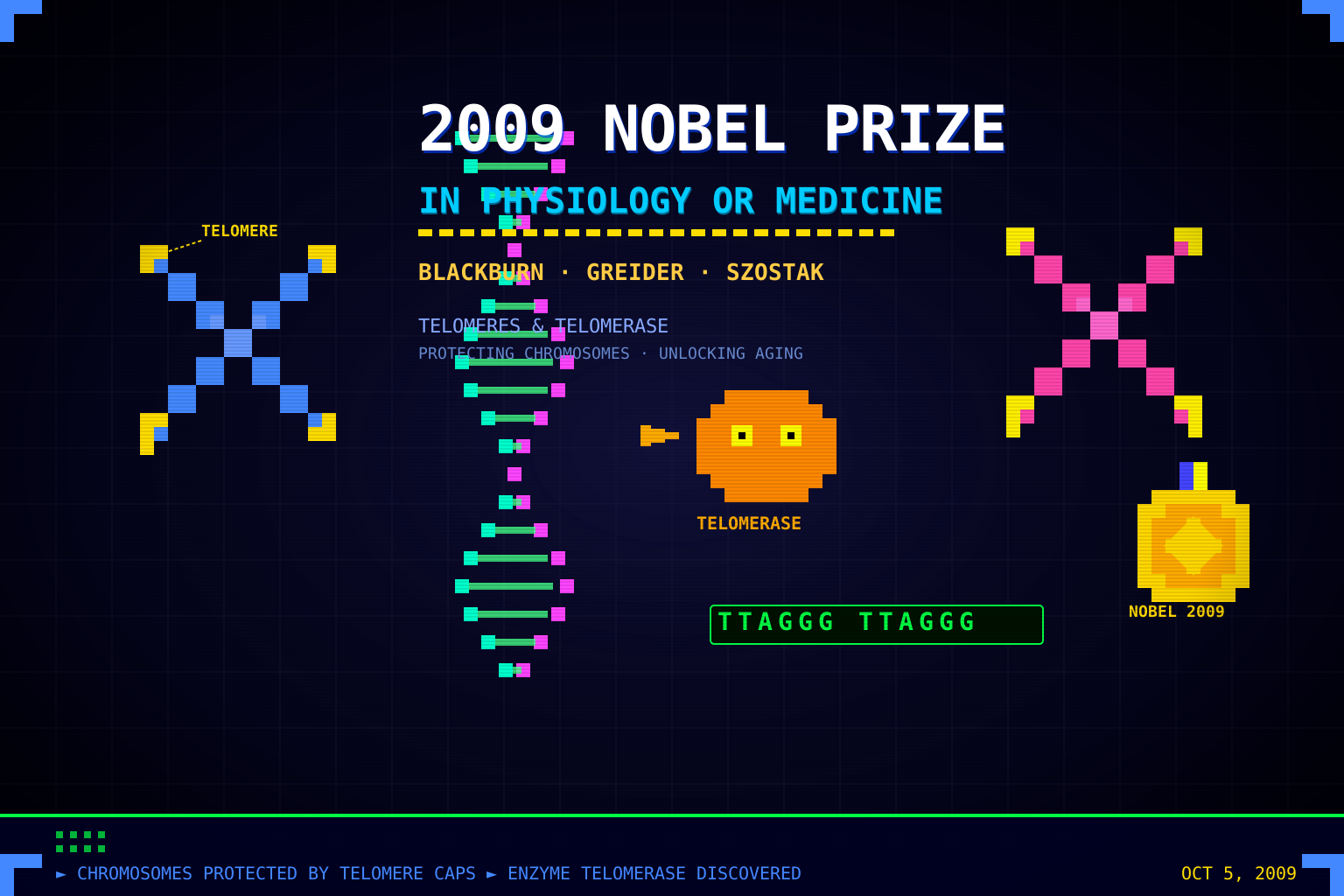
Key figures: Elizabeth Blackburn, Carol Greider, Jack Szostak; Karolinska Institute (Nobel Committee)
Summary
The 2009 Nobel Prize in Physiology or Medicine was awarded jointly to Elizabeth Blackburn (University of California, San Francisco), Carol W. Greider (Johns Hopkins University), and Jack W. Szostak (Harvard Medical School) “for the discovery of how chromosomes are protected by telomeres and the enzyme telomerase.” Announced by the Karolinska Institute in Stockholm on October 5, 2009, the prize recognized three decades of groundbreaking research into the mechanisms of cellular aging and the protection of genetic information. The discovery fundamentally altered the understanding of cellular senescence, cancer development, and the biological basis of aging itself, opening new avenues for therapeutic intervention in age-related diseases and cancer.
Telomeres are repetitive DNA sequences at the ends of chromosomes (TTAGGG in humans, repeated thousands of times) that function as protective caps, analogous to the plastic sheaths on shoelace ends. The geneticist Hermann Muller coined the term “telomere” in 1938 from his work on fruit flies, but their biological function remained unclear for decades. Each time a cell divides, the DNA replication machinery fails to fully copy the chromosome ends, causing telomeres to shorten by 50–200 base pairs per division — a process termed “end-replication problem” by James Watson in 1972.
The Laureates
Elizabeth H. Blackburn (born November 26, 1948, in Hobart, Tasmania, Australia) trained at the University of Melbourne before moving to Cambridge and then Yale, where she completed her postdoctoral work. At the University of California, San Francisco, she pioneered the use of Tetrahymena thermophila — a single-celled pond organism — as a model for chromosome-end structure research. Working with Tetrahymena, she identified the repetitive sequence TTGGGG at chromosome ends and established the foundational model of telomere structure that informed the subsequent telomerase discovery.
Carol W. Greider (born April 15, 1961, in San Diego, California) was, at the time of the Nobel announcement, a Professor of Molecular Biology and Genetics at Johns Hopkins University. She made the key telomerase discovery in December 1984 as a first-year graduate student in Blackburn’s laboratory at UC Berkeley — she was 23 years old at the time. Greider later recalled that the discovery came during a cold December morning when she developed an X-ray film showing the telomere-extension activity that confirmed telomerase’s existence. She was 48 at the time of the 2009 award.
Jack W. Szostak (born November 9, 1952, in London, England, and raised in Canada) worked as a Professor of Genetics at Harvard Medical School and a Howard Hughes Medical Institute investigator. His key contribution involved demonstrating in the early 1980s that linear yeast chromosomes capped with Tetrahymena telomeric sequences were stable and functional — proving that telomeres could substitute across species and establishing telomere protection as a general biological principle. Szostak later pivoted his research focus to the origins of life and the chemistry of early self-replicating RNA molecules, further broadening his scientific impact.
The Discovery of Telomerase
In 1984, Elizabeth Blackburn and Carol Greider, working at UC Berkeley, discovered an enzyme — subsequently named telomerase (terminal transferase) — capable of extending telomeres by adding new DNA sequences to the chromosome ends. This discovery proved revolutionary: telomerase solved the end-replication problem by synthesizing and adding telomeric DNA, compensating for the loss that occurs during cell division and thereby allowing cells to continue dividing beyond their normal lifespan limit. Jack Szostak, working independently at Harvard, contributed crucial genetic and molecular work demonstrating how telomeres function as “end-capping” structures essential for chromosome stability and cellular viability.
Telomerase contains a catalytic protein subunit (TERT — Telomerase Reverse Transcriptase) and an RNA template (TERC — Telomerase RNA Component), which serves as the blueprint for synthesizing new TTAGGG repeats. The enzyme is a reverse transcriptase — it transcribes the RNA template into DNA — a mechanism analogous to retroviruses such as HIV. This mechanistic similarity has made telomerase a fruitful model system for studying RNA-dependent DNA synthesis and anti-retroviral drug design.
The 2009 Nobel Prize in Physiology or Medicine carried a prize sum of 10 million Swedish kronor (approximately $1.4 million USD at 2009 exchange rates), shared equally among the three laureates. Blackburn became the first Australian-born woman to win the Nobel Prize. The three laureates had conducted their fundamental research over a span of decades, with the original 1984 telomerase discovery remaining a defining moment in molecular biology.
Biological Significance
The telomere-telomerase system proved critical to understanding cellular aging, cancer, and disease. Normal somatic (non-reproductive) cells have low or undetectable telomerase activity and undergo a finite number of divisions (the Hayflick limit, ~50–70 divisions in human fibroblasts) before telomeres shorten to a critical length, triggering senescence or cell death. In contrast, germ cells (sperm and eggs), stem cells, and — critically — cancer cells reactivate telomerase, allowing indefinite cell division and contributing to tumor growth and metastasis. Approximately 85–90% of human cancers harbor elevated telomerase activity, making telomerase a major target for cancer therapeutics research.
The discovery has also illuminated the cellular basis of several age-related diseases. Telomere shortening accelerates in conditions of chronic stress, oxidative damage, and inflammation, correlating with cardiovascular disease, type-2 diabetes, and neurodegeneration. Dyskeratosis congenita and aplastic anemia — rare genetic diseases — result from telomerase deficiency, further underscoring the enzyme’s essential role in cell maintenance and tissue regeneration.
Therapeutic Applications and Clinical Research in 2009
By the time of the 2009 Nobel announcement, the telomere-telomerase discovery had generated a substantial biomedical industry. At least a dozen pharmaceutical companies and academic programs were pursuing telomerase-inhibiting compounds as cancer therapies, based on the principle that blocking telomerase in cancer cells — which depend on it to avoid senescence — could selectively kill tumors. Geron Corporation’s telomerase inhibitor GRN163L (imetelstat) was in Phase I and II clinical trials for multiple cancer types by 2009. Conversely, biotechnology researchers were exploring telomerase activators — including the plant-derived compound cycloastragenol — as potential anti-aging interventions, though clinical evidence for such applications remained limited and contested.
The H1N1 swine flu pandemic of 2009 (which had been declared a global health emergency in April) also intersected with telomere research in a subtle way: epidemiological studies had begun to show that telomere length correlated with immune function, and some researchers suggested that individuals with shorter telomeres might be more vulnerable to severe viral illness — a finding that would attract greater research attention over the subsequent decade.
Research Impact and Legacy
The 2009 Nobel Prize recognized not just a historical discovery but an active and expanding field. By 2009, telomerase-targeted cancer therapies were in clinical trials, and research into the possibility of telomerase activation as an anti-aging intervention was advancing. The discovery has spawned over 15,000 scientific publications and transformed our understanding of the molecular clock underlying cellular and organismal aging.
The prize also came at a moment of broader recognition that aging itself — traditionally viewed as inevitable and outside the scope of medical intervention — might be amenable to molecular investigation and eventual therapeutic manipulation. The telomere-telomerase system became one of the central paradigms in gerontology (the study of aging), positioning Blackburn, Greider, and Szostak among the most influential figures in 21st-century biomedical science.
Significance
The 2009 Nobel Prize in Physiology or Medicine exemplified how fundamental discoveries in basic cell biology can illuminate the mechanisms underlying human disease and aging. The recognition of Blackburn, Greider, and Szostak validated decades of careful, hypothesis-driven laboratory research and demonstrated the Nobel Committee’s commitment to honoring foundational science discoveries — particularly those with broad applications across multiple disease domains. The prize also highlighted the increasing role of women in top-tier biomedical research and recognized Greider’s particular achievement as one of the youngest laureates in the prize’s history. In the broader 2009 context, the telomere discovery represented a triumph of human understanding of the molecular basis of life, announced just four days before President Obama received the Nobel Peace Prize on October 9, 2009 — making the first week of October 2009 a particularly concentrated moment of Nobel recognition. The same autumn saw other landmark scientific announcements, including the discovery of water on the Moon in November and the restart of the Large Hadron Collider for its first proton collisions — making the fall of 2009 one of the most scientifically eventful periods of the decade. The telomere research continues to shape oncology, gerontology, and regenerative medicine in the 2010s and 2020s, making the 2009 Nobel Prize a landmark recognition of transformative science.
Sources
- 2009 Nobel Prize in Physiology or Medicine — Nobel Prize Official Site
- Elizabeth Blackburn — Wikipedia
- Telomere — Wikipedia
- Telomerase — Wikipedia
- Carol Greider — Wikipedia