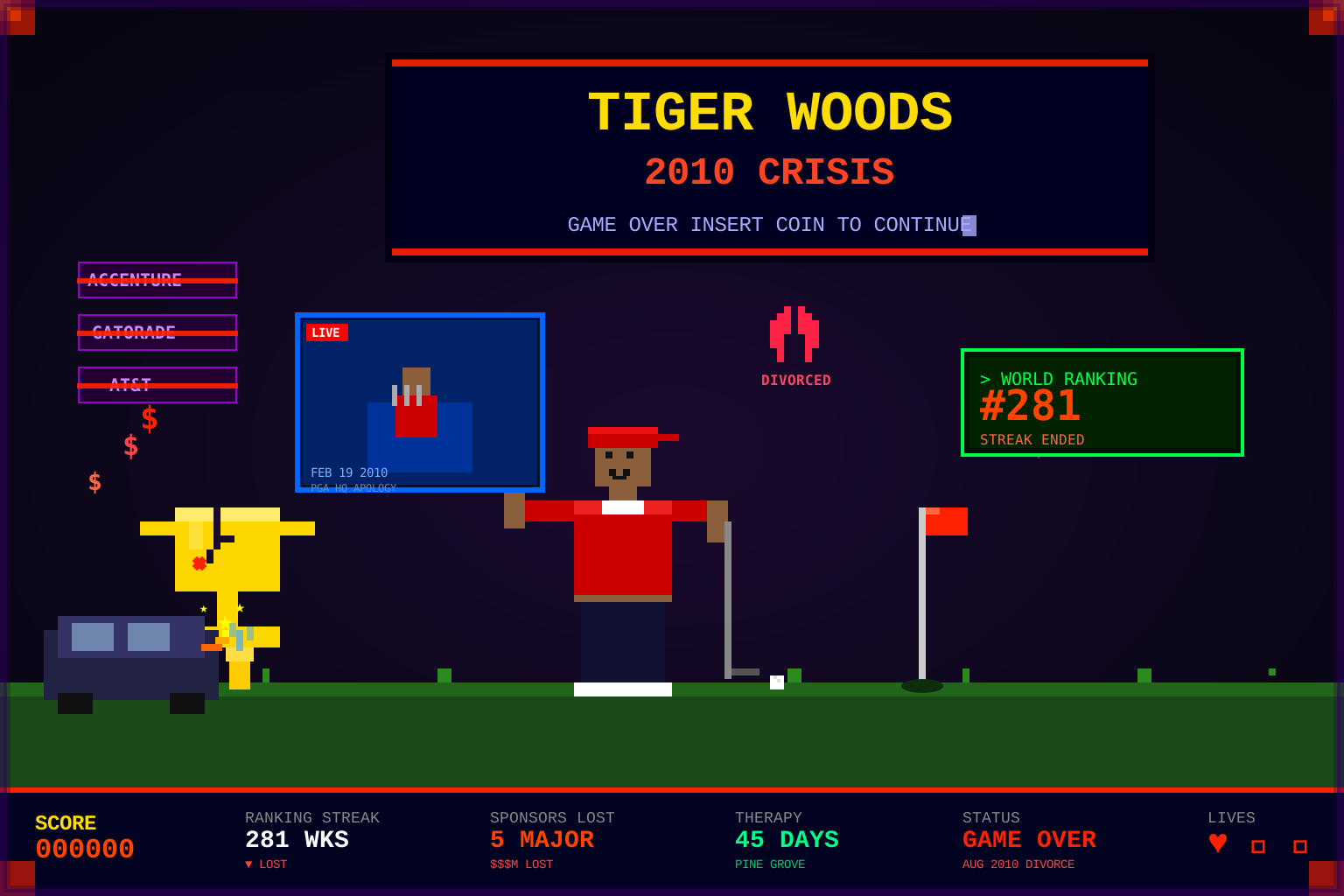
Key figures: Tiger Woods (professional golfer); Elin Nordegren (former spouse); Accenture, AT&T, Gatorade, General Motors, TAG Heuer (sponsors); PGA Tour
Summary
Tiger Woods’ personal and professional crisis unfolded across the 2009–2010 winter, beginning with a November 27, 2009 car accident (a Cadillac Escalade striking a fire hydrant and tree near Windermere, Florida) that ignited media speculation about infidelity. After nearly three months of evasion and incomplete public statements, Woods underwent roughly 45 days of inpatient therapy at the Pine Grove Behavioral Health clinic (its Gentle Path program) in Hattiesburg, Mississippi, in early 2010, emerging to deliver a televised apology on February 19, 2010 at PGA Tour headquarters in Ponte Vedra Beach, Florida. In the 13-minute address, watched by millions, Woods admitted to “selfish, foolish behavior,” infidelity, and violations of his personal values — language calibrated to invoke both contrition and accountability while stopping short of public recriminatory detail. The immediate consequences were severe: major sponsors (Accenture, AT&T, Gatorade, General Motors, TAG Heuer) severed endorsement contracts worth estimated hundreds of millions of dollars; Woods withdrew from professional competition for several months, losing his world No. 1 ranking after 281 consecutive weeks at the top; and his marriage to Swedish former model Elin Nordegren deteriorated into divorce proceedings (finalized August 2010). The 2010 crisis represents a watershed moment in how athlete misconduct, celebrity scandal, and social-media amplification converged to reshape public perception of athletic achievement and personal conduct.
The November 2009 Accident and Unfolding Crisis
The initial event — the November 27, 2009 early-morning car accident — was ostensibly routine: a traffic collision investigated by the Florida Highway Patrol, resulting in a citation for careless driving and a $164 fine. But the circumstances (early morning, residential area near Woods’ home, subsequent slow-motion revelation of the driver’s identity) triggered tabloid speculation and paparazzi attention. Woods initially offered minimal public explanation, characterizing it as a “private matter.” But as November 2009 progressed, media investigations uncovered allegations of an affair, contradictions in police accounts of the accident, and a widening rumor mill about Woods’ extramarital conduct.
By December 2009 and January 2010, the scandal had metastasized into a full-spectrum crisis. Tabloids published multiple women’s accounts of affairs with Woods; Woods’ public image as a disciplined, family-focused, racially-progressive athlete collided catastrophically with revelations of a compartmentalized private life structured around infidelity. Sponsors began distancing themselves; the PGA Tour expressed discomfort; and Woods’ silence on the personal details, initially perceived as dignified restraint, began reading as evasion and obstruction.
The February 2010 Apology and Sponsorship Fallout
Woods’ February 19 public apology was meticulously staged: a press conference at the PGA Tour headquarters (not a televised interview, which might have allowed follow-up questions), attended by selected guests (his mother, PGA Tour commissioner Tim Finchem), with Woods reading a prepared statement and declining to take questions. The statement acknowledged “selfish, foolish behavior,” infidelity, and deviation from his values, while framing the crisis partly through a therapeutic/recovery lens (mentioning his time in rehabilitation and his commitment to “working to become a better person”).
The apology’s careful language — its avoidance of naming specific individuals, its emphasis on his own moral failings rather than systemic issues, its appeal to redemption — reflected a crisis-management strategy deployed by celebrity lawyers and publicists. But it also inadvertently illustrated the asymmetry of power and accountability: Woods’ apology was couched in personal language (“I let my family down”) rather than public acknowledgment of harm to the women involved in the affairs or any systemic reflection on athlete entitlement.
The immediate sponsor response was swift. Accenture (the consulting firm that had been Woods’ marquee endorser) dropped him within days, citing reputational concerns. AT&T, Gatorade, General Motors, and TAG Heuer followed, collectively representing hundreds of millions of dollars in annual endorsement income that evaporated. Nike, by contrast, retained Woods — a strategic bet that he would rehabilitate his image and that athletic performance could ultimately overshadow personal conduct in the endorsement calculus. The sponsor exodus illustrated the fragility of celebrity economics: Woods’ commercial value had been predicated entirely on an image of discipline and moral uprightness; once that image shattered, corporate partners’ risk calculus shifted instantly.
Professional Consequences: Ranking Loss and Tournament Hiatus
Woods announced an indefinite leave from professional golf in December 2009 and withdrew from competition for roughly five months, missing the early-2010 PGA Tour season. When he returned to competition at the April 8–11, 2010 Masters Tournament at Augusta National Golf Club — his first major since the scandal broke — he finished tied for fourth — shooting rounds of 68–70–73–69 (280 total, four under par) — a respectable result but far below the dominant performances that had defined his career. The Masters crowd response was complex: boisterous galleries lined the fairways, some cheering loudly, others jeering, reflecting the polarized public opinion about his rehabilitation and return to public life.
Phil Mickelson won the 2010 Masters, and the narrative arc of Woods’ return was partly defined by the contrast: Mickelson had cultivated a warm, family-first public image throughout the same period that Woods’ carefully constructed image was collapsing. The symbolism was noted widely by commentators — Mickelson’s Masters victory felt culturally resonant beyond the golf result itself.
By October 2010, Woods had slipped from the world No. 1 ranking he had held for 281 consecutive weeks (a record for golf’s Official World Golf Ranking, surpassing Greg Norman’s previous record of 96 consecutive weeks), ending one of sport’s most dominant individual achievement streaks. Lee Westwood of England assumed the top ranking on October 31, 2010, marking the first time Woods was not ranked first since June 1997. His 2010 season yielded no PGA Tour victories — the first full calendar year since 1998 without a tour win, and a stark contrast to his pre-crisis 2009 record of five wins.
The decline was partly attributable to ring rust (Woods had minimal competitive activity during his therapy and rehabilitation period) and partly to psychological fallout: the intense media scrutiny, the erosion of his personal support system, and the reputational damage appear to have affected his competitive focus and mental resilience. The image of Woods as invincible had been shattered; competitors no longer faced a tiger in full command of his faculties, but a player psychologically destabilized and professionally diminished.
Social Media and Celebrity Accountability in 2010
Woods’ crisis occurred at a threshold moment in celebrity culture: Twitter (launched 2006, but reaching critical mass in 2009–2010) provided a real-time distributed commentary system, and Facebook, YouTube, and blogs amplified scandal narratives beyond traditional media gatekeeping. Unlike prior sports scandals (which might have been confined to sports sections and tabloids), the Woods affair became a 24/7 global topic, with millions of individuals sharing, analyzing, and moralizing about his conduct. The distributed nature of social media meant there was no single “official” narrative: Woods’ apology competed with women’s accounts, tabloid investigations, and grassroots commentary, each finding its own audience and amplification pathway.
This fragmentation of media authority had political and gendered dimensions. While Woods’ apology was widely circulated, so were critiques noting that he had not engaged directly with the women involved, that his therapeutic language deflected accountability, and that his wealth and privilege insulated him from consequences ordinary individuals would face. Feminist discourse noted the erasure of women’s agency in mainstream coverage that centered Woods’ narrative. Conversely, some commentary framed his crisis as excessive media intrusion into private matters, defending his right to rehabilitation without permanent public pillorying.
The social-media ecosystem — which had not yet developed the algorithm-driven radicalization and misinformation dynamics of the late 2010s — was primarily functioning as an amplifier and commentary layer on traditional media, but it nonetheless represented a new form of collective cultural processing distinct from pre-digital celebrity scandals.
The Divorce and Long-Term Impact
Woods’ divorce from Elin Nordegren (finalized August 2010) was negotiated through lawyers and publicists; the settlement (reportedly $110 million) was kept confidential. The divorce symbolically confirmed what the affair allegations had suggested: the collapse of the personal stability that had defined Woods’ public persona. For a golfer who had built his brand on discipline, focus, and family values, the divorce represented the definitive break between image and reality.
The longer-term impact extended across the 2010s: Woods’ attempts to rehabilitate his public image were complicated by subsequent injuries, surgery, and continued personal complications. His return to dominance did not fully materialize until 2019 (15 major championships later); the intervening decade saw a player of still-extraordinary skill competing against a backdrop of eroded cultural capital and diminished endorsement leverage. The Woods crisis became a cautionary case study in the fragility of athletic celebrity built on carefully cultivated personal image, and in the irreversibility of reputation damage in the social-media age.
Significance for 2010
Tiger Woods’ 2010 crisis marked a watershed in athlete accountability and celebrity culture: the moment when social media, distributed gossip networks, and rapid-cycle scandal amplification collided with an individual whose previous invincibility had seemed unassailable. The scandal illustrated the power of public scrutiny to topple even the most dominant figures, the capacity of social media to fragment official narratives, and the economic fragility of celebrity endorsements. For professional golf, women’s golf, and the broader sports-entertainment complex, the Woods crisis opened debates about masculinity, entitlement, and the relationship between personal conduct and professional achievement that persisted throughout the decade. Most broadly, 2010’s Woods crisis prefigured the #MeToo era (which would crystallize nearly a decade later) by demonstrating that celebrity men’s personal conduct, once presumed private and irrelevant, was increasingly subject to public judgment and material consequence.
Sources
- Tiger Woods apologizes for extramarital affairs (HISTORY.com) — Official historical timeline and aftermath analysis
- Wikipedia — Tiger Woods, 2009 Tiger Woods car accident, 2010 in golf
- Britannica — Tiger Woods biography
Related
- LeBron James’ “The Decision” — parallel 2010 case study in athlete agency, public image management, and social-media amplification of sports decisions
- 2010 US Midterm Elections — the broader 2010 political and media landscape, shaped by the same social-media fragmentation of narrative authority
- Twitter and Social Media Growth in 2010 — the platform infrastructure that amplified and fragmented the Woods scandal narrative
- YouTube in 2010 — video platform carrying Woods’ apology and commentary worldwide in real time
- 2010 Winter Olympics (Vancouver) — Woods’ absence from the public stage during the games, a contrast with sports as spectacle