Summary
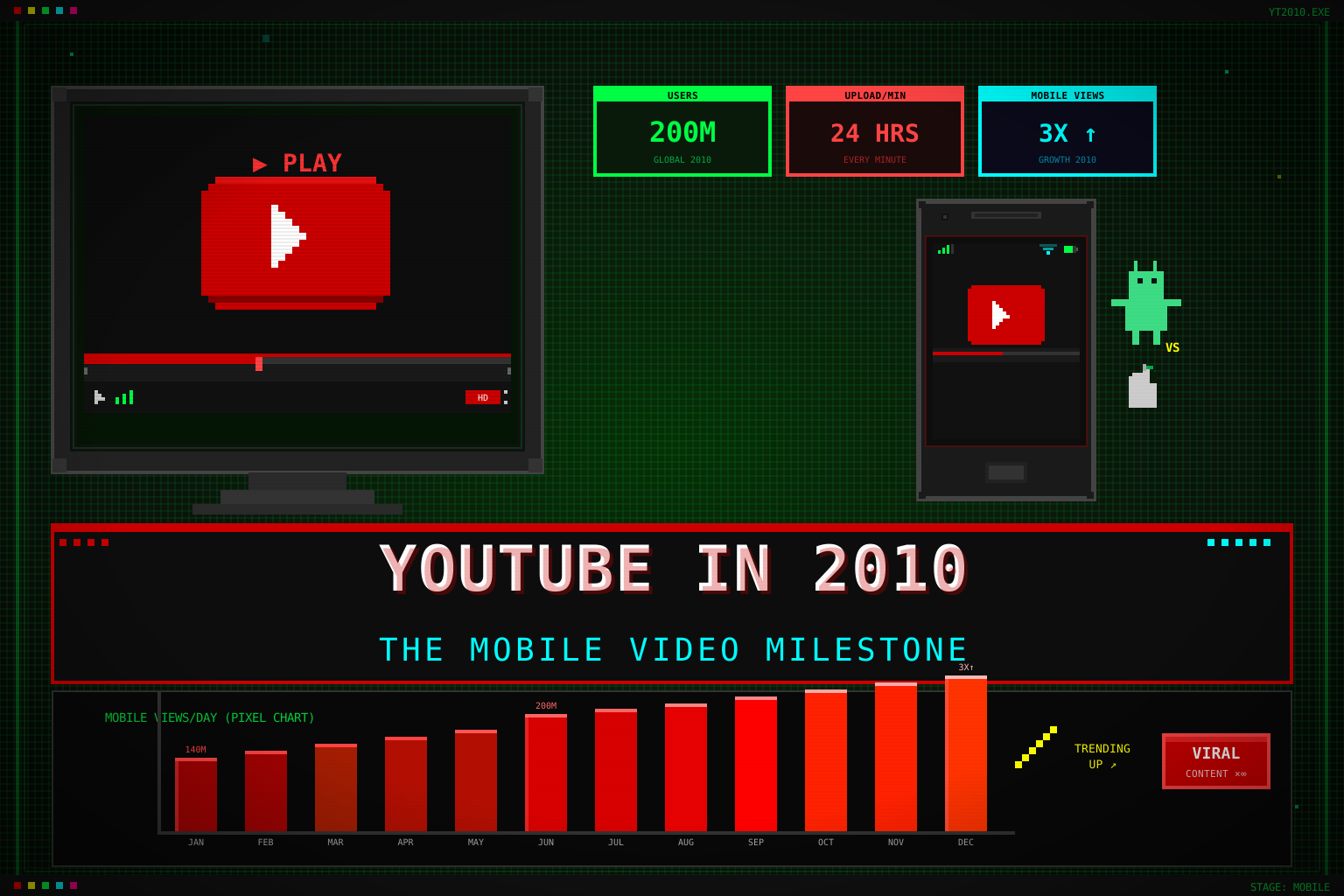
YouTube entered 2010 as a dominant but still-maturing video platform owned by Google (since 2006). By mid-2010, the platform had reached 200 million users globally and was processing 24 hours of video content uploaded every minute — a staggering volume that reflected the year’s explosion in user-generated video creation. More significantly, mobile video consumption tripled in 2010, establishing YouTube as the leading platform driving the shift from desktop-bound web to mobile-first internet. Viral moments dominated popular culture — from Gregory Brothers’ “Bed Intruder” remix (the most-watched video of 2010) to Justin Bieber’s “Baby” music video (which accumulated 426 million views by year’s end) — demonstrating YouTube’s unprecedented role in manufacturing cultural phenomena and launching celebrities through algorithmic exposure rather than traditional media gatekeeping.
The Mobile Transition
YouTube’s 2010 significance lies primarily in its mobile transformation. At the January 2010 mark, YouTube had approximately 140 million mobile video views per day. By June 2010, that figure had more than doubled to 200 million views per day across iOS (iPhone, iPad) and Android devices. By October 2010, mobile accounted for a substantial (though not yet majority) fraction of overall YouTube traffic, with Android and iOS each competing for smartphone market dominance. The proliferation of smartphones with capable cameras and reliable data connectivity — driven by the June 2010 iPhone 4 launch (with its 5-megapixel rear camera and FaceTime capabilities) and the rapid expansion of Android handsets (HTC, Samsung, Motorola, LG models throughout 2010) — meant that video creation and consumption were no longer tethered to computers.
This mobile-first trajectory had profound implications: video became as portable and spontaneous as photography or text messaging. Users could record, edit (using iOS and Android apps), and upload content from their pockets. YouTube’s mobile experience, while still rudimentary compared to its desktop iteration, capitalized on the immediacy of smartphone video. By 2010’s end, the platform had fundamentally shifted from “a website you visit on your computer” to “an always-on mobile service,” anticipating the post-2012 landscape where mobile video would dominate aggregate internet traffic.
Viral Culture and Celebrity Emergence
The year’s viral moments crystallized YouTube’s role in democratizing celebrity creation. Gregory Brothers’ “Bed Intruder Song” (a remix of a local Orlando news report featuring Antoine Dodson) became the platform’s most-watched video of 2010, accumulating tens of millions of views and launching Dodson into unexpected fame. “Double Rainbow” (a yodeling reaction to a Californian double rainbow phenomenon) similarly captured viral attention. These viral hits were fundamentally different from pre-2010 celebrity: they were not manufactured by studios or record labels, but rather discovered and amplified through algorithmic recommendation and user sharing on YouTube and social networks like Twitter and Facebook.
Justin Bieber’s case illustrated a new celebrity pipeline: the Canadian teenager posted amateur performance videos on YouTube, was discovered by talent manager Scooter Braun, and by 2010 was transitioning from YouTube sensation to mainstream recording artist — his “Baby” music video becoming a cultural touchstone (and lightning rod for polarized opinion). YouTube’s recommendation algorithm and front-page promotion had become the new arbiter of cultural relevance, displacing traditional MTV-era music-video gatekeeping.
Monetization and Platform Economics
By 2010, YouTube’s revenue model had matured beyond its uncertain post-2006-acquisition status. The platform’s AdSense revenue share (giving content creators a cut of advertising revenue) had incentivized the creation of professional and semi-professional channels. YouTube’s Partner Program, launched in 2007 and expanded significantly in 2009–2010, allowed any creator meeting a threshold of views and subscribers to monetize content through pre-roll and overlay advertisements. By mid-2010, YouTube had tens of thousands of monetizing partners, with top channels earning incomes in the tens of thousands of dollars monthly — a precedent for the influencer and creator economies that would dominate the 2010s.
Google’s investment in YouTube infrastructure (data centers, bandwidth, encoding capacity) reflected its confidence that video-driven advertising and user engagement would become central to online media. Google’s 2010 annual report valued YouTube’s advertising contribution at over $450 million, with analysts projecting it would exceed $1 billion within two years.
Content ID and Copyright Enforcement
A parallel infrastructure story in 2010 was YouTube’s Content ID system, launched in 2007 and scaled through 2009–2010. Content ID allowed rights-holders (record labels, film studios, sports organizations) to upload reference files; YouTube’s system then automatically scanned all uploads against these fingerprints and allowed rights-holders to choose whether to block, monetize, or track matched content. By 2010, over 1,000 rights-holder partners were using Content ID, and the system was processing over 20,000 hours of claimed video daily.
Content ID resolved a structural tension: rights-holders wanted their music and video in YouTube (for exposure and ad revenue), but feared uncontrolled distribution. By automating the identification and commercial capture of infringing content, YouTube transformed potential copyright liability into a revenue stream — for both rights-holders and Google. Universal Music Group, Sony Music, and Warner Music Group all signed Content ID agreements by 2010, meaning that most major-label music played over user videos triggered monetization rather than takedown. This model — rather than the litigious DMCA takedown battles of the Napster era — established the commercial framework for streaming music and video in the 2010s.
Engineering Scale
The platform’s ability to absorb 24 hours of video per minute of upload globally required extraordinary engineering — server farms, content delivery networks (CDNs) including Akamai and Google’s own edge network, real-time transcoding to multiple resolutions and bitrates (from 240p to 1080p high definition), and recommendation algorithms processing petabytes of user engagement data. YouTube served video from datacenters across North America, Europe, and Asia, using adaptive bitrate streaming to match delivery quality to each user’s connection speed. By 2010, YouTube was delivering approximately 2 billion video views per day — up from roughly 700 million per day in mid-2009 — making it among the highest-bandwidth services on the internet, comparable in aggregate delivery volume to the entire internet of 2000.
Cultural and Sociological Impact
YouTube’s 2010 status represented the maturation of user-generated content (UGC) as a primary cultural medium. Traditional media industries — television networks, studios, record labels — were no longer the exclusive creators of mass-audience content. A teenager in Nigeria could upload a music performance, a satirist in California could create comedy sketches, a scientist could post educational explanations, and each could reach millions without corporate mediation. This democratization had profound implications for authoritarianism and censorship: governments’ inability to control YouTube uploads (despite Chinese and Iranian filtering efforts) meant that dissent, documentation, and counter-narrative could propagate globally at unprecedented scale.
The downside of this democratization — misinformation, harassment, copyright infringement, and algorithm-driven radicalization — had not yet become the dominant narrative in 2010, but YouTube’s trajectory toward these challenges was already visible in debates over takedowns, nation-state cooperation, and content moderation.
Significance for 2010
YouTube in 2010 marked the year that video consumption decisively shifted from passive (television, cinema) to interactive and mobile (smartphones, social sharing). The platform’s role in amplifying viral culture, launching new forms of celebrity, and driving mobile internet adoption makes it central to understanding how 2010 accelerated the post-industrial, creator-economy transformation of media. YouTube was no longer a novelty or secondary platform; by mid-2010, it was the planet’s dominant video service, embedding itself into how billions would consume and create cultural content for the decade ahead.
Sources
- YouTube Statistics for 2026 — Historical data on 2010 user milestones and 24-hour upload volume
- YouTube Mobile Traffic Tripled In 2010 (TechCrunch) — Mobile adoption statistics and platform metrics
- Wikipedia — YouTube, Justin Bieber, Bed Intruder Song
Related
- iPhone 4 Launch — the 5-megapixel camera and FaceTime driving mobile video creation in 2010
- iOS 4 and the App Store Ecosystem — the app platform enabling third-party video editing and uploading tools
- Android 2.2 Froyo — the competing mobile OS enabling YouTube’s expanded Android user base
- Instagram Launch — parallel mobile-visual media phenomenon launched in October 2010
- Twitter and Social Media Growth — the social sharing infrastructure amplifying YouTube virality
- Stuxnet — parallel 2010 technology milestone illustrating the internet’s dual uses in the same year of YouTube’s ascent