Key figures: Sergey Brin (Google co-founder, promoter); Bradley Horowitz (VP of Product); Eric Schmidt (CEO, later acknowledged the failure)
Background
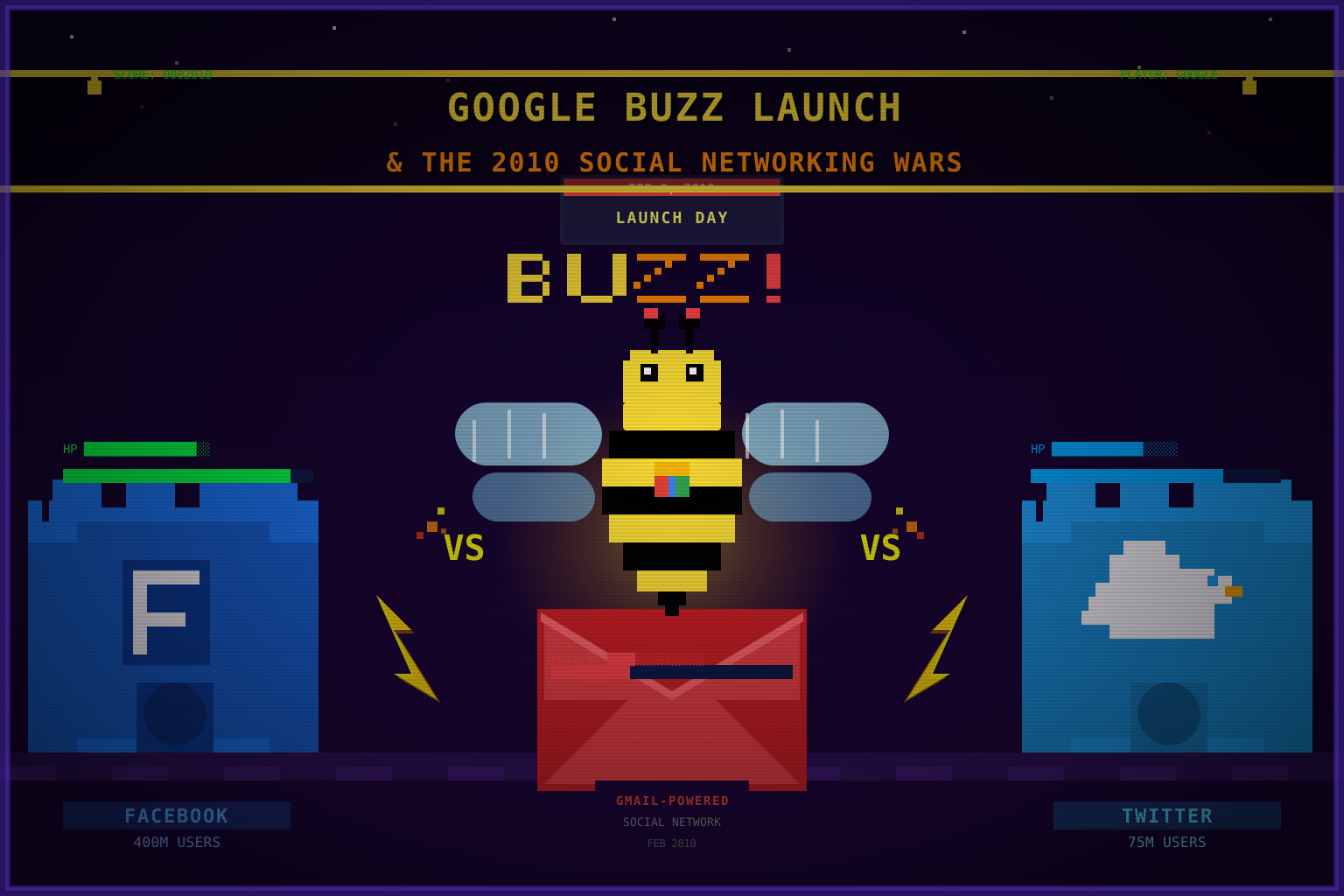
By early 2010, the social-media landscape had consolidated around two dominant platforms: Facebook and Twitter. Facebook had grown from 150 million users in January 2009 to over 400 million by February 2010—adding roughly 700,000 new users per day—and had just surpassed Google as the most-visited website in the United States on Christmas Day 2009. Twitter, while far smaller, was generating outsized cultural influence: the platform’s user base had surged from 6 million to over 75 million registered accounts between 2008 and early 2010, driven by the 2009 Iranian election protests and celebrity adoption. Google, dominant in search and advertising but absent from social networking, watched Facebook’s trajectory with alarm. Several internal Google social projects—Orkut (2004), Friend Connect (2008)—had failed to gain meaningful traction in the U.S. or Europe. Google Buzz was the company’s most ambitious attempt yet to compete in social media by leveraging Gmail’s existing user base rather than building a standalone destination.
Summary
Google launched Buzz on February 9, 2010, as a social networking and microblogging platform integrated directly into Gmail. Aimed at competing with Facebook and Twitter, Buzz allowed users to share links, photos, videos, status messages, and comments in threaded conversations visible alongside email. The service attracted over 9 million posts and comments in its first 56 hours—but a massive privacy scandal erupted within 72 hours, exposing users’ most-emailed Gmail contacts publicly without consent and automatically sharing location data. The backlash led to an immediate FTC investigation, a class-action lawsuit filed on February 16, and a consent decree in March 2011. Google shut down Buzz on December 15, 2011, replacing it with Google+, which itself failed in April 2019. Buzz became a defining example of corporate social-media miscalculation and privacy engineering failure.
Key Facts
- Launch date: February 9, 2010, at Google’s Mountain View headquarters; automatically enabled for all ~176 million Gmail users worldwide without opt-in.
- Rapid uptake: 9+ million posts and comments within the first 56 hours of launch—roughly 160,000 posts and comments per hour—plus hundreds of mobile posts per minute and over 300,000 mobile check-ins per day.
- Core features: Social layer integrated into Gmail with public and private sharing, @mentions, threaded comments, real-time following, photo/video sharing, and mobile check-ins.
- Privacy default — contact exposure: Google automatically populated users’ Buzz “follow” lists from their 50 most-emailed Gmail contacts, then publicly displayed these lists on user profiles without explicit consent or opt-in notification.
- Privacy default — location data: Posts automatically embedded users’ precise geographic coordinates by default, creating potential safety risks especially for users who had sought anonymity (journalists, domestic-abuse survivors, and others).
- Specific harms documented: Domestic violence survivors reported that Buzz had exposed their ex-partners’ email addresses to them and vice versa; a Harvard Law School student filed a class-action suit on February 16, 2010, citing specific harm to abuse survivors as a central claim.
- FTC complaint: The Federal Trade Commission opened a formal investigation within days; the consent decree, approved March 30, 2011, marked the first time the FTC had cited a company for violating its own privacy promises related to a social product.
- Settlement fund: Google agreed to pay $8.5 million into a fund distributed to privacy-advocacy and education organizations; the settlement was finally approved by a federal judge on June 2, 2011.
- Emergency patches: Google released three rapid patches in the 48 hours following launch to address the most critical privacy defaults; the changes were described internally as “emergency rollbacks.”
- Shutdown: Buzz was officially discontinued on December 15, 2011—less than 22 months after launch.
- Successor: Google launched Google+ in June 2011 as Buzz’s replacement; that platform was shut down for consumers in April 2019 after a second major privacy breach.
The Privacy Scandal in Detail
The core privacy failure stemmed from an architectural decision made in the name of rapid network growth: Google seeded each user’s social graph by automatically following their 50 most-emailed Gmail contacts and making those follow lists publicly visible on Google Profile pages. The decision conflated frequency of email contact with a desire for public social association—a fundamentally flawed assumption. The practical consequences were severe:
- Outing of relationships: Users found that confidential professional contacts (therapists, lawyers, physicians), private acquaintances, and past relationships were publicly visible to anyone viewing their Google Profile.
- Safety risks for vulnerable users: Domestic violence organizations, LGBTQ+ advocacy groups, and journalists’ safety networks documented within 24 hours of launch that Buzz had exposed the identities and relationships of people who had specifically sought anonymity in their online lives.
- Location leakage: The automatic embedding of GPS coordinates in mobile posts meant that users who had enabled the Buzz mobile interface were broadcasting their precise location in every post by default—without any setup prompt or warning.
Google’s VP of Product Bradley Horowitz acknowledged the failures publicly within 48 hours, posting that “we’ve been humbled and haven’t handled [this] well.” Google pushed three rounds of patches within the first week to remove the automatic public follow-list display, make location sharing opt-in, and simplify the opt-out process.
FTC Action and Regulatory Fallout
The Federal Trade Commission’s investigation of Buzz marked a regulatory milestone. In its March 2011 consent decree, the FTC found that Google had violated Section 5 of the FTC Act by deceiving users about the extent to which their personal information would be shared publicly—essentially, by launching a social product that contradicted privacy representations in Gmail’s existing terms of service. The decree required Google to:
- Implement a comprehensive privacy program subject to independent auditing every two years for 20 years.
- Obtain users’ express affirmative consent before sharing their personal information in a manner inconsistent with previously stated privacy policies.
- Refrain from misrepresenting its privacy practices in any future product launch.
The Buzz consent decree was the first major FTC action against Google and established legal precedents that would later inform the FTC’s approach to Facebook, WhatsApp, and other social platforms. Privacy scholars noted that the two-decade audit requirement set a template for behavioral-consent enforcement that regulators in Europe and the U.S. would use for years.
Significance
Google Buzz stands as one of the most consequential social-media launch failures in tech history, illustrating three critical lessons:
-
Privacy-by-default failures: Buzz’s automatic exposure of email contact networks and location data violated fundamental user expectations and became a textbook case for FTC action on “unfair or deceptive” practices. The incident accelerated regulatory scrutiny of tech platforms’ default privacy settings globally and directly informed the design principles behind the European GDPR framework enacted in 2018.
-
Integration risk and forced adoption: By bundling Buzz into Gmail—a service with 176 million users by 2010—Google forced adoption at a scale that amplified both the benefits and harms. The involuntary network effect proved counterproductive when privacy issues erupted: users had no meaningful way to avoid exposure because Buzz was ON by default in their existing inboxes. This stood in sharp contrast to Instagram (launched October 2010), which built its network through entirely voluntary sign-up.
-
The Facebook-Twitter wars: Buzz arrived amid the “social media wars” of 2010, when Facebook (400+ million users) and Twitter (75+ million registered users) dominated social networking. Buzz’s failure illustrated that neither market dominance in one domain (Gmail) nor brand trust automatically translated to social-network success; cultural fit, user agency, and voluntary adoption mattered more. The Social Network (October 2010) would dramatize Facebook’s ruthlessness during this period.
CEO Eric Schmidt later described the Buzz launch as illustrating Google’s deficit in understanding “what it means for a product to feel social.” The incident also catalyzed broader discussions about privacy, consent, and the regulation of social platforms—themes that would dominate the 2010s and accelerate through the Cambridge Analytica scandal in 2018.
Sources
- Google Buzz (Wikipedia) — Comprehensive overview of launch, features, privacy controversies, legal action, and shutdown.
- Google Kills Off Buzz (CNN Money) — Coverage of the service’s discontinuation and lessons learned.
- In re Google Buzz (EPIC) — Electronic Privacy Information Center documentation of privacy violations and regulatory response.
- FTC Consent Decree: In the Matter of Google Inc. (FTC.gov, March 2011) — Official FTC consent decree documenting findings and requirements.
Related
- Mark Zuckerberg and Facebook’s 2010 Emergence as a Global Platform — Facebook’s dominant position during the social-media wars; Buzz was aimed directly at Facebook’s expanding social graph.
- Twitter and Social Media Growth in 2010 — Twitter’s scaling during the same period, representing the competing microblogging model Buzz also targeted.
- Instagram Launch (October 2010) — Instagram’s voluntary opt-in model offered a stark contrast to Buzz’s forced adoption strategy.
- Foursquare and Location-Based Social Networking — Location check-ins were a core contested feature in 2010’s social media wars.
- The Social Network (film) — October 2010 film dramatizing Facebook’s competitive rise during exactly the period Buzz tried to challenge it.
- Google China Withdrawal (January 2010) — Another Google crisis in 2010 that illustrated the company’s strained relationship with users and regulators.