Key figures: Steve Ballmer (Microsoft CEO), Andy Lees (President, Mobile Communications Business), Joe Belfiore (Corporate VP, Windows Phone Program Management), Terry Myerson (VP Engineering)
Summary
Microsoft launched Windows Phone 7 on October 21, 2010, in Europe and Australia, with a United States release following on November 8, 2010, on AT&T and T-Mobile. The platform was a complete rewrite that abandoned the aging Windows Mobile 6.x line—Windows Phone 7 was not backward-compatible with Windows Mobile applications or devices, representing one of the most decisive clean breaks a major software vendor had made with its own installed base. Microsoft first unveiled the system as “Windows Phone 7 Series” at Mobile World Congress in Barcelona on February 15, 2010, later dropping “Series” from the name.
On October 11, 2010, CEO Steve Ballmer announced ten launch handsets built by four manufacturers—HTC, Dell, Samsung, and LG—to ship on 60 carriers across more than 30 countries. Launch devices included the HTC HD7, HTC 7 Surround, Samsung Focus, LG Optimus 7, and the portrait-slider Dell Venue Pro.
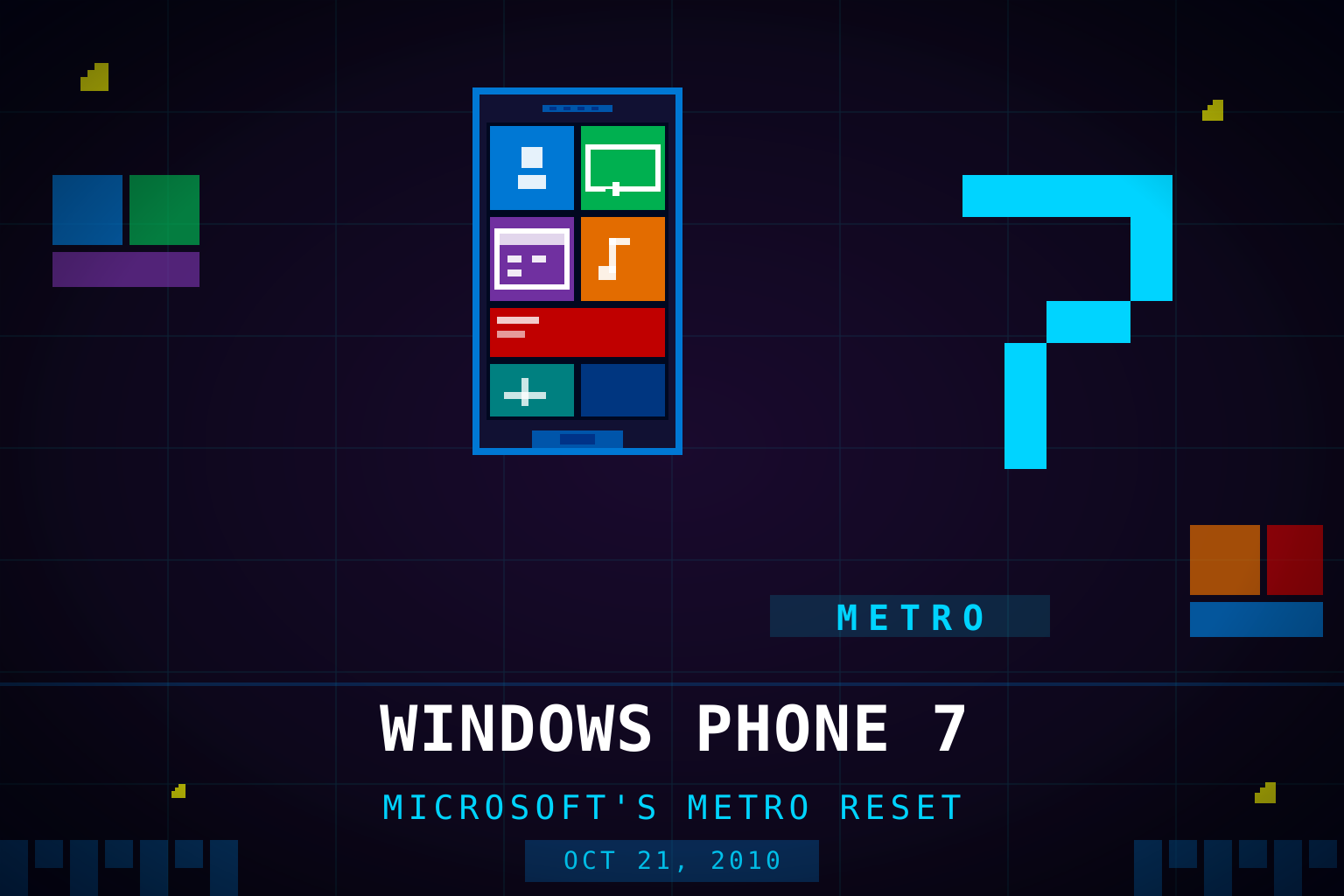
The defining characteristic of Windows Phone 7 was its Metro design language: a flat, typography-driven interface built around a Start screen of “Live Tiles”—dynamic rectangular shortcuts that surfaced real-time information (unread counts, photos, calendar items) without opening the underlying application. The aesthetic drew on transit signage and Microsoft’s Zune and Windows Media Center work, prioritizing bold Segoe typography and motion over the skeuomorphic textures then common on rival platforms.
Design and Software Architecture
Windows Phone 7 organized functionality into hubs—aggregated views that combined local device content with cloud services. The People hub merged contacts with Facebook, Twitter, and Windows Live feeds; the Pictures, Music + Videos (powered by the Zune software), Games (integrated with Xbox Live), Office, and Marketplace hubs followed the same pattern. Xbox Live integration was a differentiator no competitor matched: users carried a gamer profile, avatar, and Achievements across console and phone. Bing served as the default search engine, tied to a dedicated hardware search button, with integrated Maps and TellMe voice recognition. Internet Explorer Mobile provided browsing.
Applications were written in Microsoft’s Silverlight framework (for standard apps) or XNA (for games) and distributed exclusively through the Windows Phone Marketplace. To guarantee consistent performance, Microsoft imposed a strict hardware “chassis” specification on all licensees: a capacitive four-point multi-touch WVGA (480×800) display, an ARM v7 processor (in practice Qualcomm’s Snapdragon), a DirectX 9–capable GPU, at least 512 MB of RAM and 4 GB of flash storage, an accelerometer, proximity and light sensors, assisted GPS, an FM radio, and three dedicated capacitive buttons—Back, Start, and Search. This control over hardware was a deliberate contrast to the fragmentation of the Android ecosystem, and closer to the tightly integrated approach of Apple’s iOS 4.
Launch Limitations
Despite favorable reviews of its interface, Windows Phone 7 shipped with conspicuous gaps relative to established rivals:
- No copy and paste. Text selection was absent at launch and was added only in the “NoDo” update, which began rolling out in March 2011.
- No third-party multitasking. Applications from outside Microsoft could not run in the background; this arrived with the “Mango” update (Windows Phone 7.5) in late 2011, well after Apple’s iOS 4 and Android 2.2 Froyo had shipped background execution.
- No CDMA support at launch. Initial devices were GSM-only, delaying availability on major US carriers Verizon and Sprint into 2011.
- No custom ringtones, no visible file system, and limited enterprise management features compared with the outgoing Windows Mobile.
Reception and Market Impact
Reviewers broadly praised Metro as the most original mobile interface of its generation while criticizing the missing baseline features. In the six weeks after launch, Microsoft reported that it had sold roughly 1.5 million Windows Phone 7 units to carriers and retailers (a sell-in figure rather than sales to consumers), a modest start against the momentum of Apple’s iPhone and the rapidly expanding Android field. The platform never achieved more than single-digit global smartphone market share during its lifetime.
Windows Phone 7’s strategic significance outlasted its commercial performance. Its Metro design language became the visual foundation of Windows 8 (2012), extending the tile motif to desktop and laptop PCs—one of the most consequential and contested interface decisions in Microsoft’s history. The phone platform itself was superseded by Windows Phone 8 in 2012, which switched to the Windows NT kernel and, controversially, could not be installed on existing Windows Phone 7 hardware. Microsoft’s mobile ambitions continued through Windows 10 Mobile before being wound down by 2017. Windows Phone 7 is remembered as a bold, well-designed, but strategically late and feature-incomplete attempt to establish a viable third mobile ecosystem.
See also: iOS 4 and the App Store Ecosystem · Android 2.2 Froyo · iPhone 4 Launch