Key figures: Wen Jiabao (Premier of China), Naoto Kan (Prime Minister of Japan), Yoshihiko Noda (Japanese Finance Minister).
Summary
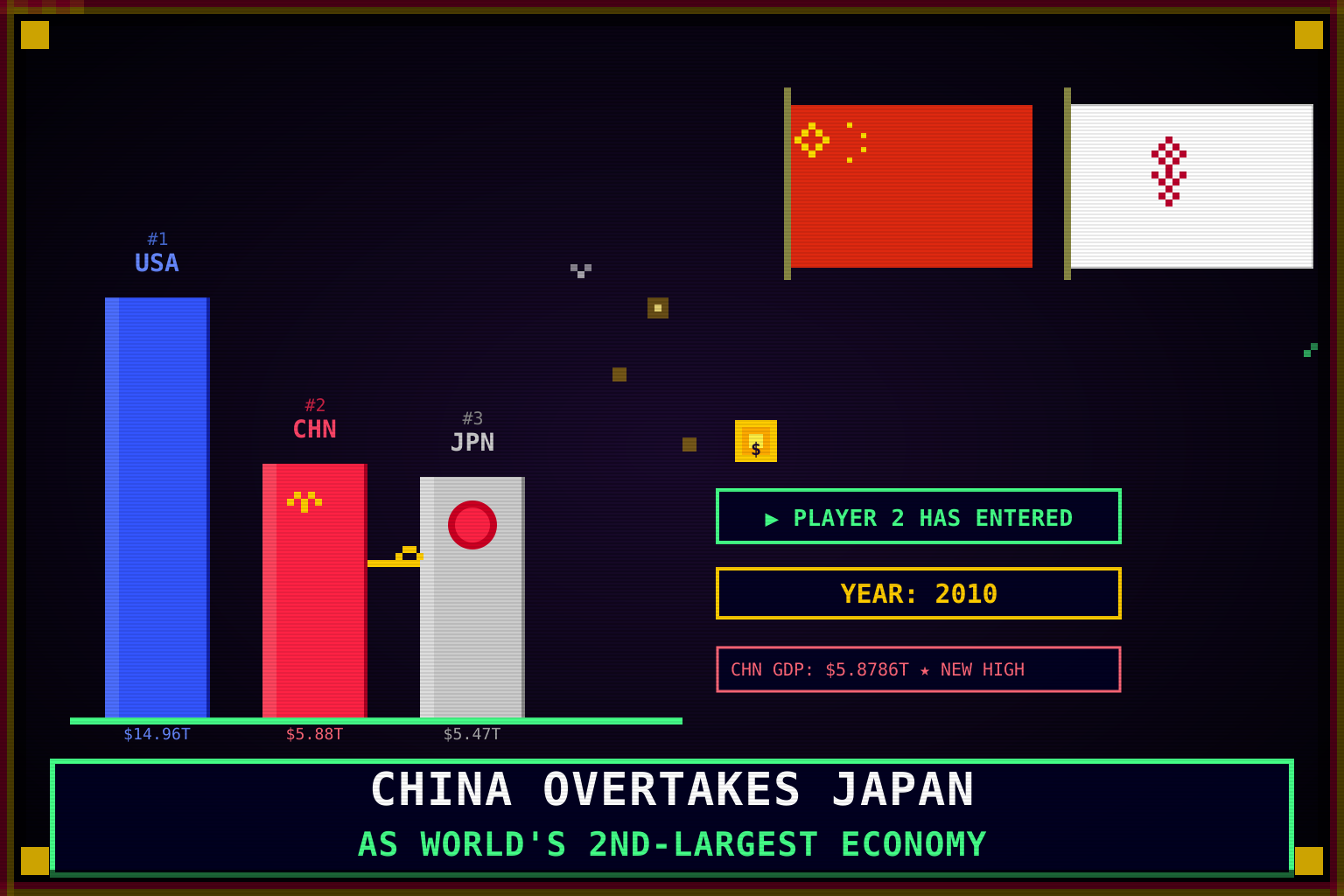
On August 16, 2010, Japan reported that its nominal gross domestic product for the second quarter totaled $1.288 trillion, below China’s $1.337 trillion — the point at which China surpassed Japan to become the world’s second-largest economy, behind the United States. The milestone capped roughly three decades of rapid Chinese expansion since the market reforms begun in 1978 and ended Japan’s 42-year run as the world’s second-biggest economy, a position it had held since overtaking West Germany in 1968.
The quarterly figure was not immediately conclusive: Japan remained larger over the first half of 2010, and in the third quarter it briefly regained the lead. The change became definitive when full-year 2010 data, released in February 2011, showed China’s nominal GDP at $5.8786 trillion against Japan’s $5.4742 trillion.
Background
China’s rise reflected decades of double-digit and high-single-digit annual growth driven by manufacturing exports, urbanization, and heavy fixed-asset investment. Even after the 2008–2009 global financial crisis, China’s economy rebounded quickly, aided by a large government stimulus program, while Japan continued to struggle with weak domestic demand, deflation, and a strong yen that eroded the dollar value of its output.
The comparison was measured in nominal U.S.-dollar terms. On a per-capita basis China remained far poorer than Japan — its roughly 1.3 billion people gave it a per-capita GDP a fraction of Japan’s — and by the purchasing-power-parity measures used by some economists China had drawn level with or passed Japan somewhat earlier. The 2010 milestone nonetheless marked the first time the aggregate nominal ranking changed.
Significance
The overtaking was widely treated as a symbolic marker of a shifting global economic order: the transfer of the second-largest-economy title from a mature industrial democracy to a still-developing state under one-party rule. It reinforced expectations, common by 2010, that China was on a trajectory to challenge the United States for the top position within a generation, and it heightened attention to China’s growing weight in trade, commodity demand, and international finance.
For Japan, the change underscored two decades of stagnation following the collapse of its asset-price bubble in the early 1990s — the so-called “lost decades” — and intensified domestic debate over demographic decline and economic reform. For the wider world, China’s ascent to second place foreshadowed its increasingly central role in global supply chains and in the institutions of the international economy.
Related
- European Sovereign Debt Crisis — The 2010 crisis that weakened the developed economies against which China’s growth was measured.
- Global Unemployment and Economic Recovery in 2010 — The uneven post-crisis recovery that accelerated the relative rise of emerging economies.
- Shanghai Expo 2010 — The record-setting world’s fair that served as a showcase of China’s economic emergence the same year.