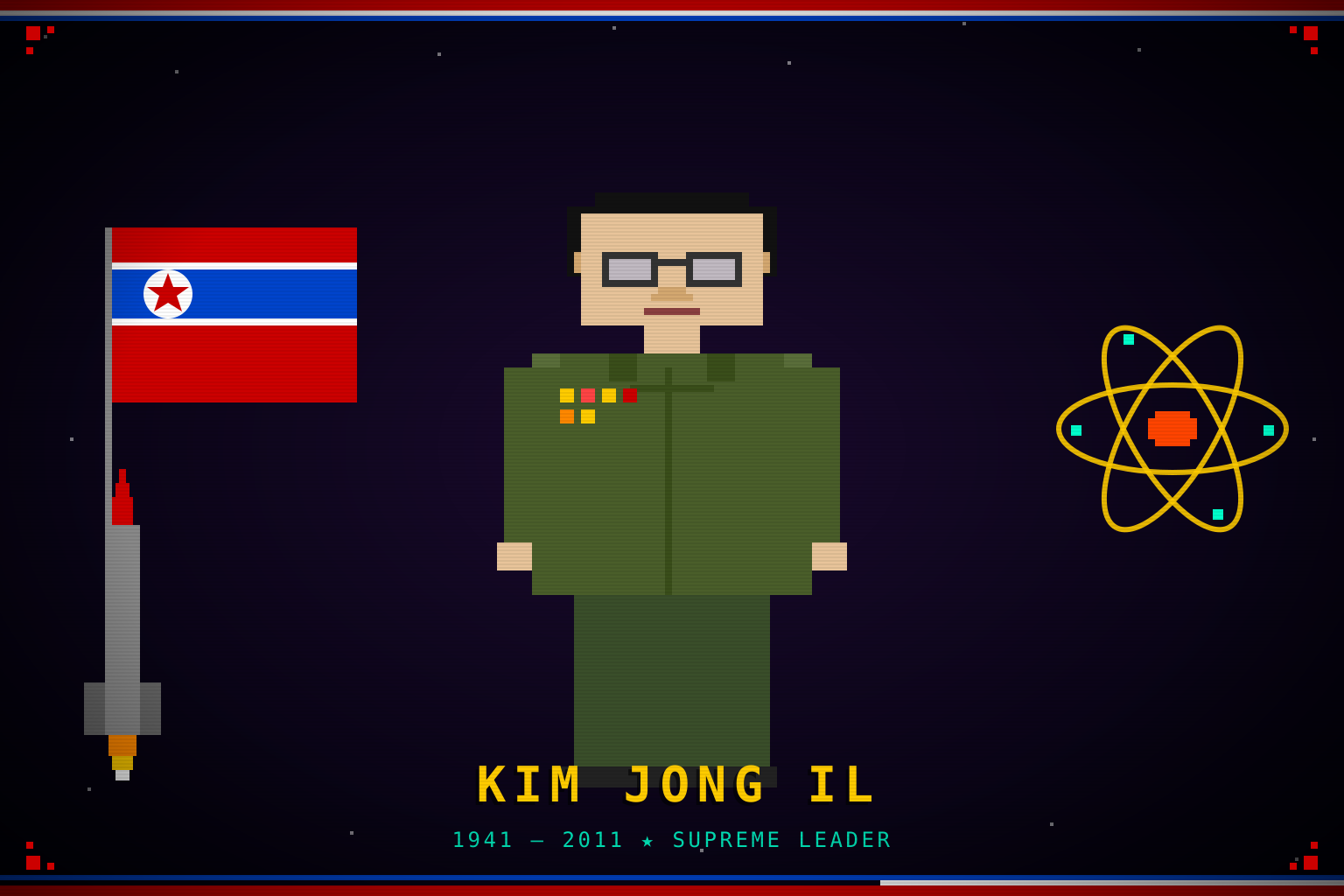
Key figures: Kim Il-sung (father, founder of North Korea), Kim Jong Un (youngest son and successor), Kim Jong Nam (eldest son, exiled), Jang Song-thaek (brother-in-law, regime power broker), South Korean presidents Kim Dae-jung and Lee Myung-bak, U.S. Presidents George W. Bush and Barack Obama, Chinese President Hu Jintao (key external patron)
| Related events: Death of Kim Jong Il (December 17, 2011) | Arab Spring (2011) |
Summary
Kim Jong Il (February 16, 1941 – December 17, 2011) was the supreme leader of the Democratic People’s Republic of Korea (North Korea) from 1994 until his death on December 17, 2011. He inherited power from his father Kim Il-sung, the nation’s founder who had ruled since 1948, and presided over the country during its most isolated and economically stagnant decades, even as he pursued nuclear weapons capability and maintained one of the world’s most repressive totalitarian systems. His death at age 70—announced two days after the fact, on December 19—shocked the international community and triggered immediate succession concerns, as power passed to his young, untested youngest son Kim Jong Un (estimated age 27–28), reshaping East Asian geopolitics and raising critical questions about North Korea’s stability and nuclear intentions.
Early Life and Path to Power
Born on February 16, 1941, in Vyatskoye, a Soviet Far East village near Khabarovsk, during his father Kim Il-sung’s exile in the Soviet Union, Kim Jong Il was raised in Pyongyang after the family’s return in 1945. The regime officially rewrote his birthplace to Mount Paektu—a sacred site in Korean nationalism—claiming he was born there in a log cabin in the snows of 1942, a propagandistic mythologization reinforced by official biographies and state media.
Kim Jong Il attended Kim Il-sung University in Pyongyang and began working within the Korean Workers’ Party apparatus in the 1960s. He rapidly advanced through propaganda and cultural affairs, overseeing the production of hundreds of films (he would later claim personal credit for some 11,000 books and 1,500 works of art). By the early 1970s, he had begun consolidating control over the party’s organizational department—the critical apparatus for appointments and loyalty. At the Sixth Party Congress in October 1980, he was publicly introduced as successor and entered the Politburo Standing Committee, making him the only leader in history to have staged a dynastic succession within a communist state.
Kim Il-sung died on July 8, 1994. Despite expectations of collapse, Kim Jong Il consolidated power over a three-year mourning period before formally assuming the title of General Secretary in October 1997. He rejected the traditional title “President”—which he designated “eternal” for his father—and ruled instead as Chairman of the National Defense Commission.
The succession occurred against severe economic crisis. Annual GDP contracted by 3–5% per year in the mid-1990s. Soviet subsidies, which had provided approximately 40% of North Korea’s energy imports, ended abruptly in 1991 when the USSR demanded payment in hard currency. The result was a cascading collapse: factories halted, farmland went unfertilized, and food distribution networks failed.
Years in Power (1994–2011)
Kim Jong Il’s rule was defined by four major characteristics:
Nuclear Weapons Development
Kim Jong Il prioritized nuclear weapons as a means of regime survival, deterrence against U.S. invasion, and leverage in international negotiations. North Korea withdrew from the Nuclear Non-Proliferation Treaty in January 2003. Kim’s regime conducted its first nuclear test on October 9, 2006—a plutonium device with an estimated yield of approximately 1 kiloton, detonated underground in North Hamgyong Province. A second nuclear test on May 25, 2009, yielded approximately 2–6 kilotons, demonstrating significant technical progress. These developments triggered repeated international crises, tightening U.S. and UN sanctions (UN Security Council Resolutions 1718 and 1874), and intercontinental ballistic missile tests that alarmed South Korea, Japan, and the United States. By 2011, analysts estimated North Korea possessed 8–12 nuclear warheads and had developed functional Nodong medium-range ballistic missiles capable of reaching Japan.
Economic Collapse and Famine (Arduous March, 1994–1998)
The loss of Soviet subsidies, combined with chronic mismanagement, collectivized agriculture, and the Songun (military-first) ideology that diverted resources to the armed forces, created a humanitarian catastrophe. The Great Famine of 1994–1998—which North Koreans call the Arduous March (고난의 행군)—killed between 600,000 and 3 million people out of a population of approximately 22 million, according to various scholarly estimates; South Korean demographer Daniel Goodkind estimated approximately 600,000–1 million excess deaths from official statistics analysis. Conditions remained dire throughout Kim Jong Il’s rule: roughly 40% of the population was chronically malnourished by the late 2000s according to UN World Food Programme assessments, electricity reached Pyongyang for only a few hours per day in provincial areas, and the formal economy was largely supplanted by informal market activity that the regime simultaneously tolerated and criminalized.
Totalitarian Control
Kim Jong Il maintained and elaborated the songbun class classification system—a hereditary caste system dividing citizens into 51 subcategories based on family political loyalty. Citizens were subject to neighborhood surveillance through the inminban (people’s unit) system, mandatory ideological study sessions, and restricted movement. An estimated 150,000–200,000 political prisoners were held in six kwanliso (political prison camps) throughout his rule, according to Human Rights Watch and the UN Commission of Inquiry on Human Rights in the DPRK (2014). The regime operated a cult of personality that described Kim Jong Il as possessing supernatural qualities, including the ability to control weather.
Isolation and Limited Engagement
Despite periodic diplomatic openings—notably South Korean President Kim Dae-jung’s “Sunshine Policy” (1998–2008), which included the June 2000 inter-Korean summit in Pyongyang (the first ever), and the Kaesong Industrial Complex joint project launched in 2004—North Korea remained fundamentally isolated. The Bush administration’s 2002 designation of North Korea as part of the “axis of evil” derailed the Clinton-era Agreed Framework (1994) and bilateral negotiations. Six-Party Talks (2003–2009) among the United States, North Korea, South Korea, China, Japan, and Russia produced a brief 2007 agreement for denuclearization steps in exchange for energy aid, but North Korea withdrew from talks in 2009. Kim Jong Il’s most provocative late-period actions included the March 2010 torpedo attack sinking the South Korean corvette ROKS Cheonan (46 sailors killed) and the November 2010 artillery shelling of South Korea’s Yeonpyeong Island (4 killed).
Health Decline and Death
By the late 2000s, Kim Jong Il suffered a series of health crises. On August 14, 2008, he suffered a stroke that temporarily incapacitated him; subsequent appearances showed him with visibly diminished mobility and a thinner frame. French neurosurgeon François-Xavier Roux reportedly traveled to Pyongyang to treat him. In September 2010, Kim formally elevated Kim Jong Un to Four Star General and membership in the central party leadership—the clearest public signal yet of succession plans. He died of a heart attack on December 17, 2011, while traveling by personal train; state media announced his death on December 19, 2011, two days later. Official North Korean media reported that loyal subjects across the country collapsed from grief; photographs and video of mass weeping were broadcast internationally, though their authenticity and spontaneity were disputed.
For full coverage of the immediate circumstances and succession, see Death of Kim Jong Il (December 17, 2011).
Legacy and Significance
Kim Jong Il’s death in December 2011 represented a critical inflection point in East Asian geopolitics:
- Succession uncertainty: The transition to his untested, youngest son Kim Jong Un raised immediate questions about regime stability and potential internal power struggles.
- Nuclear proliferation: North Korea retained nuclear weapons and ballistic missile technology, making leadership succession in a nuclear state a critical strategic concern for the U.S., South Korea, China, and Japan.
- Regional tension: Kim Jong Il’s provocations (the 2010 sinking of the South Korean naval vessel ROKS Cheonan, the 2010 shelling of Yeonpyeong Island) had created an atmosphere of heightened military tension that persisted into his successor’s reign.
- Human rights catastrophe: International assessments documented crimes against humanity during Kim Jong Il’s rule, though his death provided no immediate relief to the North Korean population, which remained isolated and economically devastated.
Historiographically, Kim Jong Il represents a key figure in the persistence of Stalinist totalitarianism into the late twentieth and early twenty-first centuries—a reminder that despite the Cold War’s end, authoritarian state control and isolation persisted in parts of the world, with devastating humanitarian consequences.
See Also
- Death of Kim Jong Il — Succession to Kim Jong Un (December 17, 2011)
- Arab Spring (2011) — regional democratic uprisings that contrasted sharply with North Korea’s isolation
- Death of Osama bin Laden (May 2, 2011) — another 2011 landmark marking the end of an adversarial era
Sources
- Kim Jong Il - Wikipedia
- North Korea - U.S. State Department Country Profile
- Human Rights Watch: North Korea Country Profile
- UN Commission of Inquiry on Human Rights in the DPRK (2014)
- Andrei Lankov, The Real North Korea: Life and Politics in the Failed Stalinist Utopia (Oxford University Press, 2013)
- Kenneth E. Gause, North Korean Civil-Military Relations (U.S. Army War College, 2011)
- Victor Cha, The Impossible State: North Korea, Past and Future (Ecco Press, 2012)