Key figures: Ayman al-Zawahiri (deputy and successor), Mohamed Atta (9/11 lead operative), U.S. Presidents George W. Bush and Barack Obama, CIA Director Leon Panetta, SEAL Team Six Commander William McRaven, Mullah Omar (Taliban), Muhammad bin Laden (father), Khalid Sheikh Mohammed (9/11 mastermind)
| Related events: Operation Neptune Spear — Death of Osama bin Laden (May 2, 2011) | Arab Spring (2011) |
Summary
Osama bin Laden (March 10, 1957 – May 2, 2011) was a Saudi-born jihadist militant and the founder of al-Qaeda, the transnational extremist network responsible for numerous terrorist attacks, most notably the September 11, 2001, attacks on the United States that killed nearly 3,000 people. For nearly a decade after 9/11, bin Laden evaded capture, while his network orchestrated bombings in Madrid (2004, 191 dead), London (2005, 52 dead), and dozens of other locations worldwide. On May 2, 2011, U.S. Navy SEAL Team Six conducted a raid on a walled compound at 8 Kakul Road in Abbottabad, Pakistan, where bin Laden had been hiding for at least five years, killing him in a firefight. His death marked a symbolic turning point in the War on Terror and provided the Obama administration with a major strategic victory, even as al-Qaeda and its affiliates continued to pose security threats globally.
Early Life and Radicalization
Osama bin Laden was born in Riyadh, Saudi Arabia, on March 10, 1957, to Muhammad bin Laden, a Yemeni-born construction magnate whose firm (the Saudi Binladen Group) held exclusive rights to renovate Mecca and Medina. Osama was one of at least 52 children from Muhammad bin Laden’s multiple marriages. He was raised in wealth within Saudi Arabia’s royal-connected elite but developed strong Wahhabi Islamic convictions at an early age through teachers influenced by the Muslim Brotherhood ideology. He attended King Abdulaziz University in Jeddah, where he studied civil engineering and Islamic theology.
By the late 1970s, bin Laden became radicalized by the Soviet invasion of Afghanistan (December 27, 1979). In 1984, he traveled to Afghanistan to participate in the anti-Soviet jihad, drawing on his personal wealth and his family’s construction expertise to help organize and finance mujahideen fighters. (Popular accounts of a $300 million personal fortune are widely repeated but disputed; the 9/11 Commission found his inheritance provided roughly $1 million per year.) He founded Maktab al-Khidamat (Services Bureau) alongside Palestinian cleric Abdullah Azzam to facilitate the recruitment and funding of jihadists from across the Muslim world. During the 1980s, bin Laden worked in the same theater as American CIA operatives who were also supporting Afghan mujahideen against Soviet forces under Operation Cyclone—a historical irony that later fueled conspiracy theories, though direct CIA collaboration with bin Laden personally was disputed by intelligence officials.
Ideology
Bin Laden synthesized three strands of Sunni Islamist thought: Salafi doctrinal orthodoxy, the revolutionary political theory of Sayyid Qutb, and the pan-Islamic mobilization model of Abdullah Azzam. He rejected Azzam’s purely defensive jihad and embraced offensive global jihad targeting all perceived enemies of Islam, including secular Muslim governments, the United States, and Israel. This ideological departure from his mentor Azzam set al-Qaeda apart from other jihadist organizations of the era.
Formation of al-Qaeda (1988–1998)
By August 1988, as Soviet withdrawal from Afghanistan became imminent, bin Laden and Egyptian Islamic Jihad leader Ayman al-Zawahiri founded al-Qaeda (“The Base”), initially conceived as a network of jihadist fighters and a repository of ideological training and veteran fighters. Unlike the localized Afghan jihad, al-Qaeda was designed as a transnational organization capable of conducting global operations against perceived enemies of Islam—primarily the United States and apostate Muslim governments. The founding meeting took place in Peshawar, Pakistan, and was attended by eleven senior jihadist figures.
After the Soviet withdrawal, bin Laden returned to Saudi Arabia, where his anti-Western and anti-royal rhetoric increasingly disturbed the Saudi government. In 1991, following the First Gulf War (in which approximately 500,000 U.S. troops were deployed to Saudi Arabia to liberate Kuwait), bin Laden publicly condemned the presence of “infidel troops” in the land of the two holy mosques. He was expelled from Saudi Arabia in 1992 and stripped of his citizenship in 1994. He moved to Khartoum, Sudan (1991–1996), where he ran businesses and coordinated global jihadist cells. Under U.S. pressure, Sudan expelled him in May 1996; he relocated to Afghanistan, where he forged a close alliance with Taliban supreme leader Mullah Omar.
In August 1996, bin Laden issued his first formal declaration of war against the United States—a 30-page Fatwa calling on Muslims to kill Americans. In February 1998, he issued a second fatwa through the al-Qaeda-affiliated newspaper Al-Quds Al-Arabi, explicitly calling for attacks on American civilians worldwide.
On August 7, 1998—the eighth anniversary of U.S. troops entering Saudi Arabia—al-Qaeda orchestrated simultaneous truck bombings of U.S. embassies in Nairobi, Kenya, and Dar es Salaam, Tanzania. The attacks killed 224 people (12 Americans and 212 Africans) and injured over 4,500. The U.S. responded with cruise missile strikes on Afghanistan and Sudan. This attack marked al-Qaeda’s emergence as a major terrorist threat to U.S. interests and prompted the creation of a dedicated CIA unit—”Alec Station”—tasked exclusively with tracking bin Laden.
The 9/11 Attacks and Its Aftermath (2001–2011)
On September 11, 2001, al-Qaeda operatives hijacked four commercial airplanes and crashed them into the World Trade Center towers in New York City, the Pentagon in Washington D.C., and rural Pennsylvania, killing 2,977 people. The attacks transformed global geopolitics, triggering the U.S. War on Terror, the invasion of Afghanistan, and the subsequent war in Iraq.
In the immediate aftermath, bin Laden evaded capture as the Taliban regime provided him sanctuary. A U.S.-led military campaign drove al-Qaeda and Taliban forces from major urban centers by late 2001, but bin Laden escaped and disappeared for years. In 2004 and 2007, he released videotaped messages and audio recordings in which he taunted U.S. leaders and outlined al-Qaeda’s ideology and grievances. These releases, often timed to coincide with anniversaries of 9/11 or major news events, maintained bin Laden’s profile and contributed to ongoing security concerns.
The hunt for bin Laden spanned two presidencies (George W. Bush and Barack Obama) and involved the CIA, the Pentagon, and international intelligence agencies. Multiple false leads and supposed sightings in Tora Bora (Afghanistan) and the Pakistan-Afghanistan border region prolonged the search. Bin Laden’s hiding location—a compound in Abbottabad, a Pakistani military garrison town—was discovered through a combination of intelligence work, including information obtained from detainees in U.S. custody.
Death and Legacy (May 2, 2011)
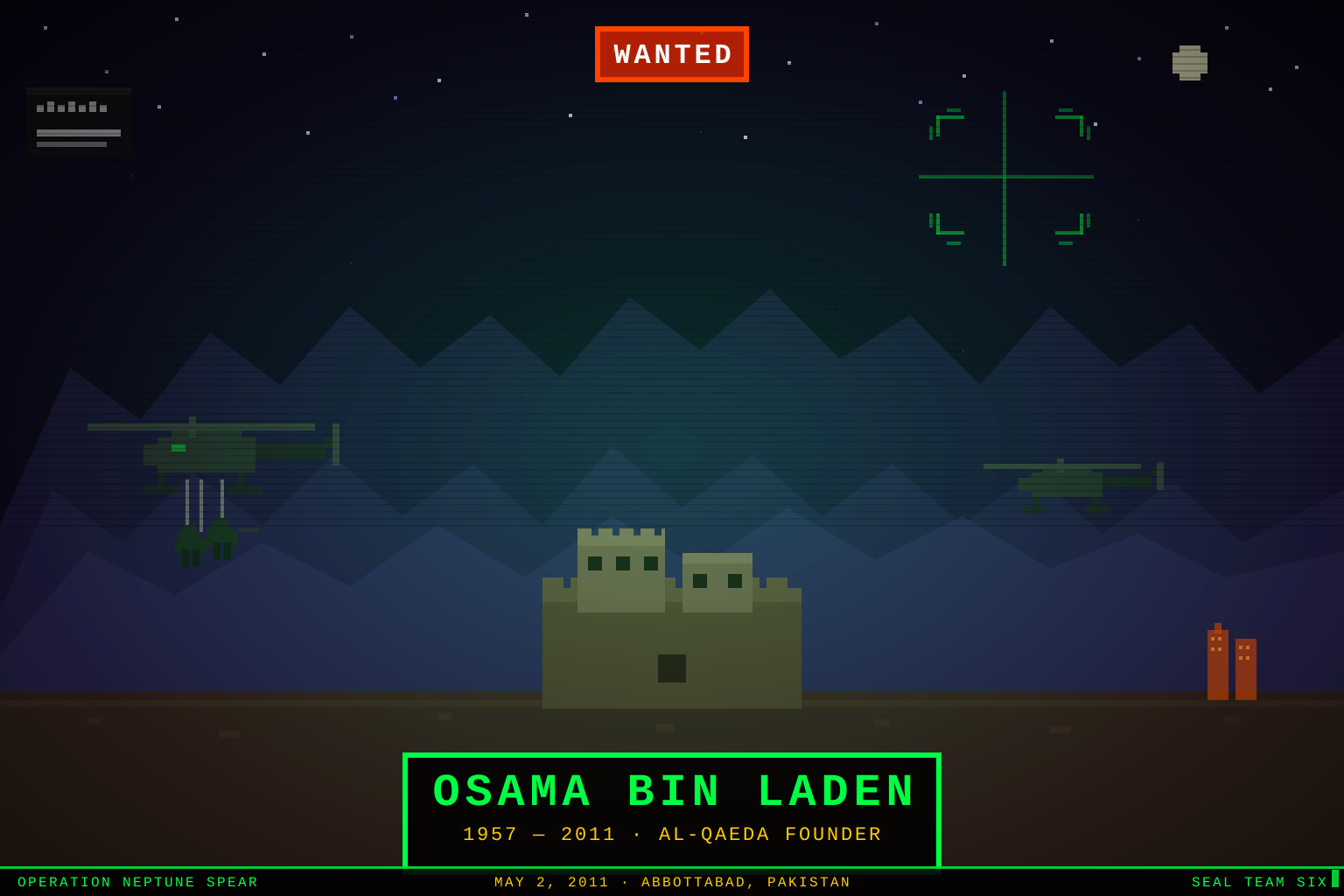
On May 2, 2011, U.S. President Barack Obama ordered “Operation Neptune Spear”—a raid by SEAL Team Six (officially Naval Special Warfare Development Group, DEVGRU) on the Abbottabad compound. The raid was authorized after a compound near the Pakistani Military Academy was identified in August 2010 through a courier network traced to a detainee code-named “Abu Ahmed al-Kuwaiti.” CIA Director Leon Panetta and JSOC Commander Admiral William McRaven coordinated the operation, which used two modified Black Hawk helicopters and two Chinook helicopters in support. One Black Hawk crashed inside the compound walls during the assault.
In a firefight lasting approximately 38 minutes, SEAL operators located bin Laden on the third floor of the compound’s main building, shot him twice (once in the chest and once above his left eye), and killed him along with his son Khalid, courier Abu Ahmed al-Kuwaiti, and al-Kuwaiti’s brother. His body was removed from the compound, positively identified by DNA comparison against samples from bin Laden’s sister (who had died at a Boston hospital), and subsequently buried at sea from the USS Carl Vinson in the North Arabian Sea within 24 hours, on May 2, 2011—in accordance with Islamic tradition that burial occur within 24 hours.
President Obama addressed the nation from the East Room of the White House at 11:35 p.m. on May 2, declaring: “Justice has been done.” The news triggered spontaneous celebrations outside the White House, in Times Square, and in cities across the United States. For full details of the operation itself, see Death of Osama bin Laden — Operation Neptune Spear.
Historical Significance
Osama bin Laden’s death in 2011 represented a symbolic, though incomplete, victory in the War on Terror:
- End of a decade-long hunt: His death provided a formal closure to the immediate post-9/11 narrative and the personal vendetta pursued by the Bush and Obama administrations.
- Ideological symbol: Bin Laden had become the face of jihadist terrorism for millions; his death diminished, though did not eliminate, his propagandistic power.
- Unresolved legacy: al-Qaeda persisted and evolved under Ayman al-Zawahiri’s leadership; affiliated groups (al-Qaeda in the Arabian Peninsula, al-Qaeda in the Islamic Maghreb, al-Shabaab) continued conducting operations. The rise of the Islamic State (ISIS) in the 2010s demonstrated that bin Laden’s death did not resolve the underlying ideological and geopolitical conditions that spawned global jihadism.
- Geopolitical questions: Bin Laden’s decade of hiding in Pakistan raised hard questions about Pakistani complicity or negligence, straining U.S.-Pakistan relations.
- War on Terror trajectory: The operation marked a brief moment of strategic clarity; within weeks, the focus shifted to Libya (where NATO intervention was underway) and the Arab Spring uprisings. By 2011, the War on Terror’s original objectives had morphed into broader questions of counterterrorism, nation-building, and global security.
Osama bin Laden remains one of the most consequential figures of the early twenty-first century: a wealthy ideologue whose embrace of global jihadism reshaped international security architecture, precipitated two decades of warfare, and affected the lives of millions.
See Also
- Death of Osama bin Laden — Operation Neptune Spear (May 2, 2011)
- Arab Spring (2011) — the regional uprisings that reshaped the Middle East in the same year bin Laden died
- Muammar Gaddafi (October 20, 2011) — another authoritarian leader who fell in 2011
Sources
- Osama bin Laden - Wikipedia
- al-Qaeda - U.S. State Department Designations
- The 9/11 Commission Report (2004)
- Peter Bergen, The Osama bin Laden I Know: An Oral History of al Qaeda’s Leader (Free Press, 2006)
- Operation Neptune Spear - Wikipedia
- Mark Bowden, The Finish: The Killing of Osama bin Laden (Atlantic Monthly Press, 2012)
- Lawrence Wright, The Looming Tower: Al-Qaeda and the Road to 9/11 (Knopf, 2006)