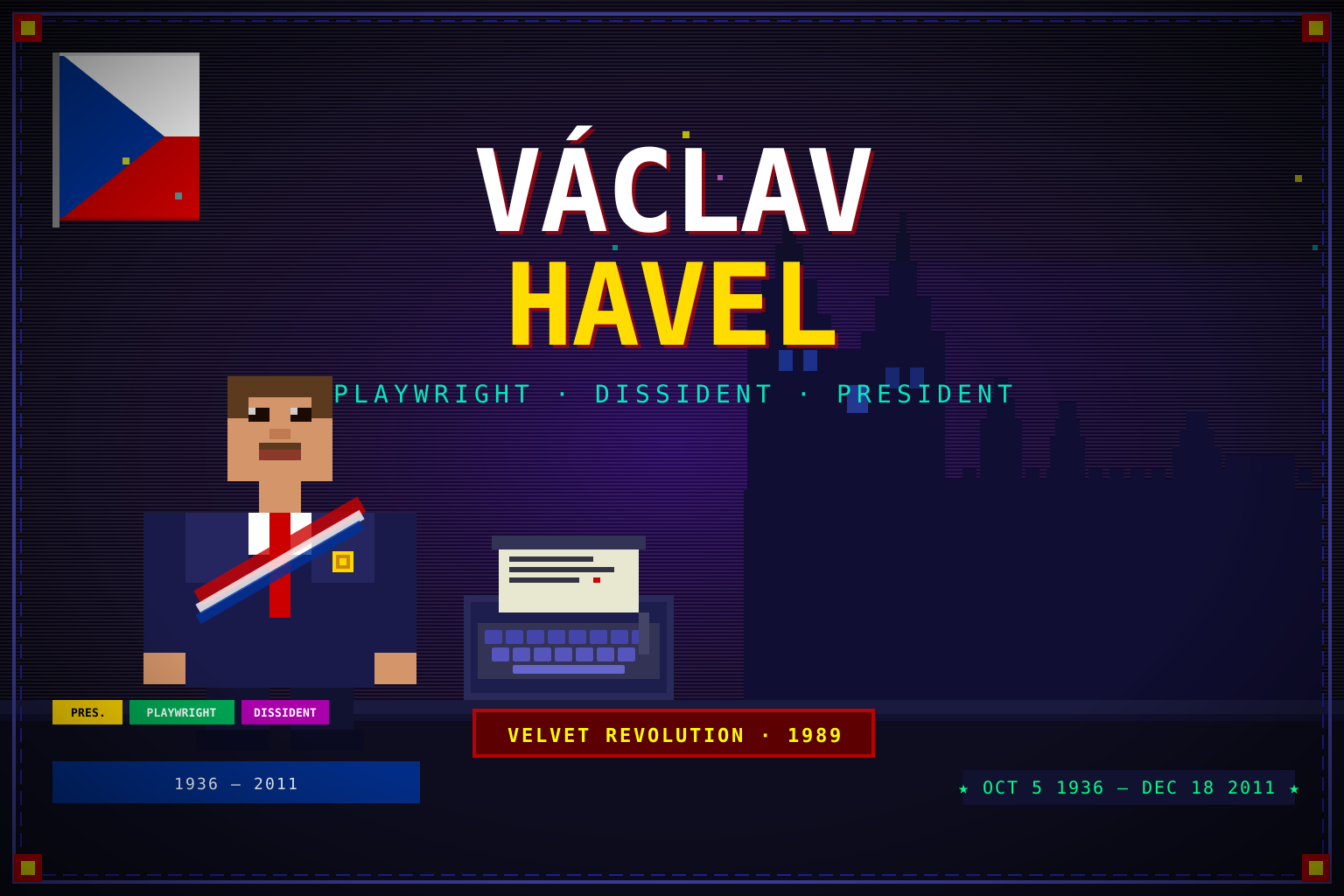
Key figures: Olga Šplíchalová Havlová (first wife), Dagmar Veškrnová Havlová (second wife), Alexander Dubček (Prague Spring leader), Jan Patočka (Charter 77 co-founder), Lech Wałęsa (Polish Solidarity), U.S. Presidents Reagan, Clinton, Bush, Czech PM Václav Klaus (political rival)
| Related events: Death of Václav Havel (December 18, 2011) | Arab Spring (2011) | Christopher Hitchens (December 15, 2011) | Literary and Intellectual Deaths of 2011 |
Summary
Václav Havel (October 5, 1936 – December 18, 2011) was a Czech playwright, essayist, and statesman whose life embodied the struggle against communism and totalitarianism in Central Europe. He rose from persecuted dissident intellectual to become the first elected president of a free post-communist Czechoslovakia (December 1989–July 1992) and subsequently the first president of the independent Czech Republic (January 1993–February 2003). Havel died on December 18, 2011, at age 75 from respiratory failure at his country home in Hradecek, Bohemia, marking the end of an era in European political thought and moral leadership during the Cold War and its aftermath. His death in the same month as Kim Jong Il (December 17) and Christopher Hitchens (December 15) closed a chapter in twentieth-century intellectual and political life—three figures who in radically different ways shaped the era’s moral debates.
Early Life and Literary Career
Havel was born on October 5, 1936, in Prague to a prominent, well-to-do bourgeois family: his grandfather, Václav Maria Havel, had built the Lucerna Palace entertainment complex in Prague; his father, Václav Maria Havel Jr., was a civil engineer and property developer; his uncle Miloš Havel was one of Czechoslovakia’s leading film producers. The family’s upper-class status made Václav politically suspect under the communist regime that took power in the February 1948 coup, denying him admission to arts and humanities programs; he initially studied economics at the Czech University of Technology.
After completing mandatory military service, he worked as a stagehand and eventually a playwright at the Divadlo Na zábradlí (Theater on the Balustrade) in Prague, where director Jan Grossman mentored him. In the 1950s and 1960s, he emerged as a leading figure in Prague’s avant-garde theatrical and literary scene, writing absurdist plays deeply influenced by Ionesco, Beckett, and Kafka.
His early plays, including The Garden Party (Zahradní slavnost, 1963) and The Memorandum (Vyrozumění, 1965), used darkly comic language games and bureaucratic absurdity to critique systems of power and control. The Memorandum premiered in New York’s Public Theater in 1968, earning international recognition. The language of these plays was remarkably prescient: they depicted individuals trapped in formal, dehumanizing systems—a subtle but unmistakable parallel to communist ideology and practice. The Memorandum introduces “Ptydepe,” a fictional artificial bureaucratic language invented to eliminate ambiguity, only to create impenetrable opacity—a metaphor for totalitarian discourse.
International Recognition Before Exile
By the mid-1960s, Havel was internationally regarded as one of Central Europe’s most important dramatists, a position earned entirely outside official cultural channels. His plays were translated into over twenty languages and performed across Western Europe and North America—even as his works were suppressed inside Czechoslovakia after 1968.
Dissident Years (1968–1989)
Following the Soviet-led Warsaw Pact invasion of Czechoslovakia on August 20–21, 1968—which crushed the Prague Spring’s brief liberalization under Alexander Dubček—Havel became increasingly political. The normalization regime under Gustáv Husák banned his works from all Czechoslovak theaters and publishing houses. His plays could only be read in underground samizdat (self-published) format or performed in private apartments and cellars.
In January 1977, he co-founded Charter 77 (Charta 77), a civic manifesto initially signed by 242 Czech and Slovak intellectuals, artists, and workers—including philosopher Jan Patočka, who died in police custody shortly after signing—that demanded the government honor its own constitution and the Helsinki Accords (1975) it had signed. The charter was neither a political party nor a program; it was a moral appeal. The Czechoslovak government responded with a massive campaign of harassment, dismissal from employment, and imprisonment.
Between 1977 and 1989, Havel was arrested and imprisoned four times. His longest imprisonment—from May 1979 to March 1983—resulted from his participation in the Committee for the Defense of the Unjustly Prosecuted (VONS). He spent approximately 5 years total in communist prisons. During his 1979–1983 imprisonment, he wrote the Letters to Olga (published 1983, banned in Czechoslovakia), a remarkable philosophical correspondence with his wife that explored personal responsibility and the nature of identity under coercion.
His essay The Power of the Powerless (Moc bezmocných, 1978)—written as a philosophical response to the communist normalization period—argued that totalitarian “post-totalitarian” systems depend on the participation and complicity of every citizen, and that each individual who refuses to “live within the lie” weakens the system’s foundations. The essay circulated in samizdat throughout Central Europe and was credited by Polish Solidarity leaders, including Lech Wałęsa, with articulating the ethical framework of their resistance.
His marriage to actress and social worker Olga Šplíchalová in 1964 proved to be a foundation of mutual intellectual support and political solidarity; Olga managed his underground networks during his imprisonments. After Olga’s death from cancer on January 27, 1996, Havel struggled with depression. He married actress Dagmar Veškrnová on January 4, 1997.
The Velvet Revolution and Presidency (1989–2003)
In November 1989, as the Berlin Wall fell on November 9 and Eastern European regimes collapsed in rapid succession, Havel became the symbolic leader of the Velvet Revolution (Sametová revoluce)—the peaceful, ten-day civic uprising that toppled Czechoslovakia’s communist government with remarkably little violence. Beginning November 17, 1989, when police violently dispersed a student march in Prague, Havel and Civic Forum (a loose coalition he helped organize) coordinated nationwide strikes and mass demonstrations. By November 29, the Federal Assembly deleted the Communist Party’s guaranteed “leading role” from the constitution. Prime Minister Ladislav Adamec resigned; a “Government of National Understanding” was formed.
On December 29, 1989, Havel was elected president by the Federal Assembly, becoming the first non-communist president of Czechoslovakia since 1948. At his New Year’s Day 1990 inaugural address, he declared: “People, your government has returned to you!”—addressing a nation of 15 million with an unsparing moral reckoning of what four decades of communist rule had done.
As president, Havel oversaw:
- The transition to multiparty democracy and a market economy, including mass privatization
- Expulsion of Soviet troops from Czechoslovakia: the last 73,500 Soviet soldiers left by June 1991
- The peaceful dissolution of Czechoslovakia (“Velvet Divorce”) into the Czech Republic and Slovakia on January 1, 1993—negotiated between Havel and Slovak Prime Minister Vladimír Mečiar despite Havel’s opposition to the split
- Czech Republic’s admission to NATO on March 12, 1999 (signed under his presidency)
- Laying the groundwork for EU accession, completed on May 1, 2004 (after his presidency ended)
Havel was re-elected twice—first in 1993 by the new Czech parliament and again in 1998—and served until February 2, 2003, when he was constitutionally barred from a third consecutive term. His ten-year presidency was marked by persistent political tension with free-market economist and Prime Minister Václav Klaus, who disagreed with Havel on the pace and nature of post-communist transition.
He remained an influential public intellectual and advocate for democracy worldwide until his death, speaking at international forums, supporting human rights activists in Belarus, Cuba, and China, and publishing essays and memoirs.
Intellectual Legacy
Havel’s essays—Living in Truth (1986), Disturbing the Peace (1990), and others—articulated a philosophy of “living in truth” that rejected the compartmentalization of official versus private life and insisted that moral integrity extends into all spheres, including politics. He was skeptical of ideology on all sides, including Western liberalism, and warned against consumerism and the loss of meaning in post-communist societies.
He was nominated for the Nobel Peace Prize multiple times and received numerous international honors, including the U.S. Presidential Medal of Freedom (2003). His books remain widely read in academic and philosophical circles.
Significance
Václav Havel’s death in December 2011 symbolized the passing of the Cold War generation—the intellectuals and dissidents who had endured Soviet oppression and helped liberate Eastern Europe through moral example and nonviolent resistance. His trajectory from banned playwright to elected president demonstrated the transformative power of personal conscience and artistic resistance to totalitarianism.
His legacy influenced democratic movements globally and remains a touchstone for activists, writers, and philosophers concerned with the relationship between ethics and politics. The “power of the powerless” principle—that ordinary citizens refusing to cooperate with injustice can topple even powerful regimes—inspired resistance movements from Central Europe to the Middle East and remains relevant to contemporary debates on civil disobedience and conscience.
See Also
- Death of Václav Havel (December 18, 2011) — immediate circumstances and global response
- Christopher Hitchens (December 15, 2011) — another towering intellectual figure who died three days earlier
- Literary and Intellectual Deaths of 2011 — broader context of the year’s losses
- Arab Spring (2011) — contemporary democratic uprisings that drew comparisons to the 1989 Velvet Revolution
Sources
- Václav Havel - Wikipedia
- Biography - The Václav Havel Library
- Václav Havel, The Power of the Powerless (1978)
- Charter 77 - Documents and Archive
- Václav Havel - First President of Czech Republic (1993–2003)
- Michael Zantovsky, Havel: A Life (Grove Press, 2014)
- Václav Havel, To the Castle and Back (Knopf, 2007)