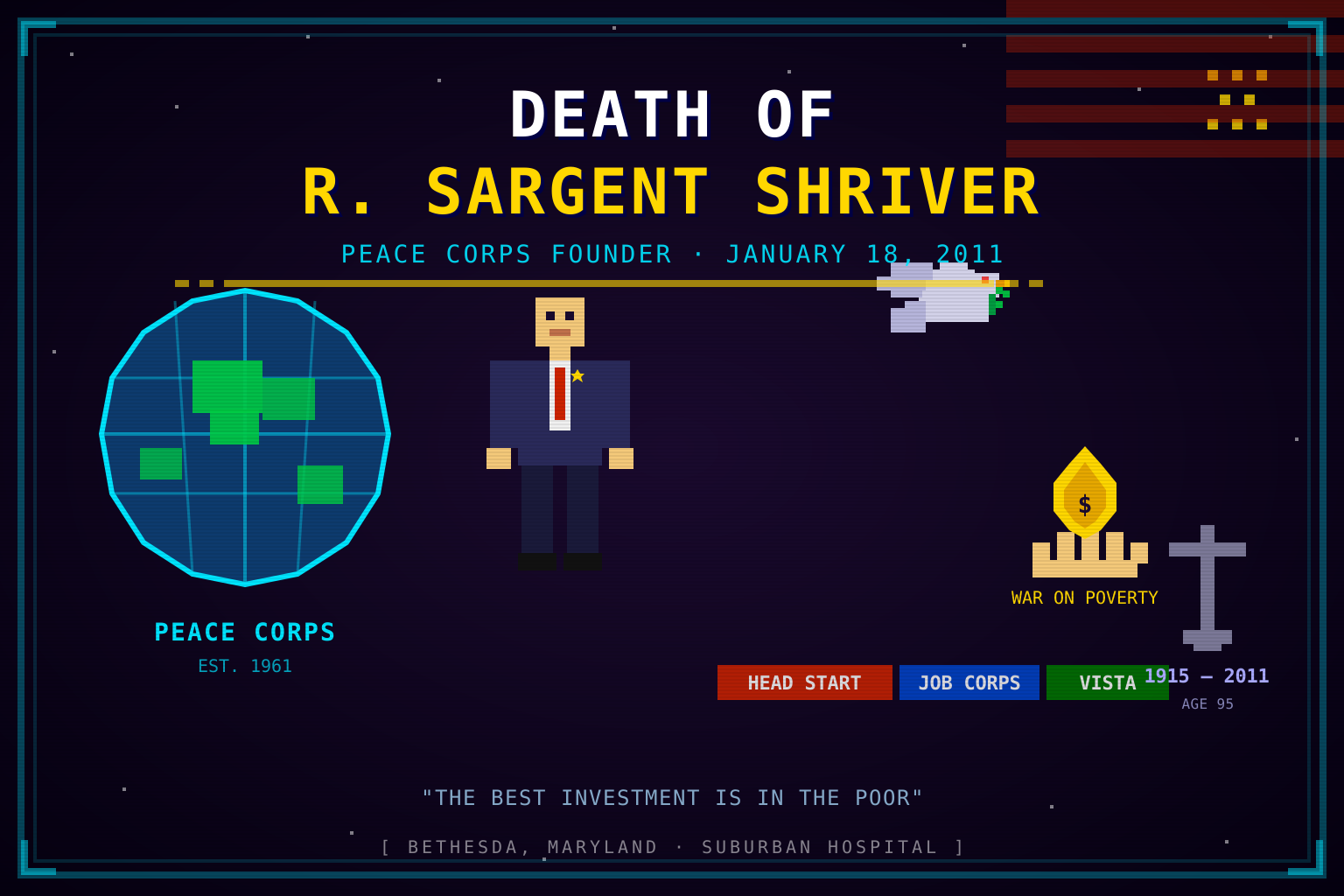
Key figures: R. Sargent Shriver, John F. Kennedy, Eunice Kennedy Shriver, Lyndon B. Johnson, George McGovern, Maria Shriver
Summary
Robert Sargent Shriver Jr. died on January 18, 2011, at Suburban Hospital in Bethesda, Maryland, at age 95, after a long decline from Alzheimer’s disease, with which he had been diagnosed in 2003. Born November 9, 1915, in Westminster, Maryland, Shriver was the founding director of the Peace Corps (1961–1966), established at the direction of his brother-in-law, President John F. Kennedy. He later directed President Lyndon B. Johnson’s Office of Economic Opportunity (1964–1968), the agency at the center of the War on Poverty, where he launched Head Start, VISTA, Job Corps, Upward Bound, and the Legal Services program.
Shriver married Eunice Kennedy, sister of President Kennedy, in 1953; the couple remained married for 56 years until her death in 2009. He later served as U.S. Ambassador to France (1968–1970) and, in 1972, became the Democratic Party’s vice-presidential nominee alongside George McGovern after the original running mate, Thomas Eagleton, withdrew from the ticket. Shriver was the father of journalist and former California First Lady Maria Shriver.
Early Life and Education
Born into a Catholic family in Westminster, Maryland, Shriver attended the Canterbury School in Connecticut before entering Yale University, where he earned an undergraduate degree in 1938 and a law degree in 1941. At Yale he was editor of the Yale Daily News. He then served as a naval officer during World War II, commanding PT boats in the Pacific and seeing combat before being discharged in 1945. After the war, he worked at Newsweek magazine and later joined Joseph P. Kennedy Sr.’s business enterprises in Chicago, managing the Merchandise Mart — the largest privately owned commercial building in the United States at the time. It was through this work for the Kennedy family that he met Eunice Kennedy, whom he married in 1953 at St. Patrick’s Cathedral in New York.
Peace Corps and the War on Poverty
Shriver was tasked by President Kennedy in 1961 with turning the Peace Corps from a campaign proposal into a functioning federal agency, serving as its first director from March 1961 to February 1966. Under his leadership the agency sent thousands of American volunteers to serve in developing countries. By the time Shriver left the directorship, the Peace Corps had approximately 15,000 volunteers active in 55 countries — a scale reached in under five years from the agency’s founding. Over the program’s first decades the cumulative total of volunteers exceeded 200,000, serving in more than 140 countries.
In 1964, President Johnson appointed Shriver to lead the newly created Office of Economic Opportunity, the central agency of the War on Poverty. Shriver simultaneously held the Peace Corps directorship from 1964 to 1966, leading two major federal agencies at the same time. Under his direction the Office of Economic Opportunity launched or oversaw a wide range of antipoverty initiatives:
- Head Start (1965): early childhood education program for low-income families, initially enrolling approximately 561,000 children in its first summer of operation
- Job Corps: residential vocational and educational training for disadvantaged youth
- VISTA (Volunteers in Service to America): a domestic counterpart to the Peace Corps, placing volunteers in low-income communities
- Upward Bound: college-preparatory program for first-generation college students
- Legal Services program: federally funded civil legal aid for those who could not afford attorneys
Several of these programs continue to operate as federal programs more than five decades after their creation.
Later Career
Shriver served as U.S. Ambassador to France from 1968 to 1970 under President Johnson and briefly into the Nixon administration. In 1972, he was selected as George McGovern’s running mate after Thomas Eagleton withdrew from the Democratic ticket following disclosures about his psychiatric treatment history; the McGovern-Shriver ticket lost decisively to Republican incumbents Richard Nixon and Spiro Agnew, carrying only Massachusetts and the District of Columbia. Shriver also mounted an unsuccessful bid for the Democratic presidential nomination in 1976, withdrawing before the convention.
After leaving elective politics Shriver remained active in public service. He co-founded the Special Olympics with his wife Eunice Kennedy Shriver, who formally launched the organization in 1968; Shriver remained connected to the organization through his family for the remainder of his life. He also practiced law in Washington, D.C., at the firm Fried, Frank, Harris, Shriver & Jacobson.
Alzheimer’s Advocacy
After his Alzheimer’s diagnosis became public in 2003, both Shriver and his family — including daughter Maria Shriver — became advocates for Alzheimer’s disease research and awareness. Maria Shriver published the Shriver Report: A Woman’s Nation Takes on Alzheimer’s (2010) and subsequently helped create the HOPE for Alzheimer’s Act. Shriver spent his final years in declining health and died in Bethesda surrounded by family members.
Significance
Shriver is credited as one of the principal architects of the federal government’s mid-20th-century antipoverty and volunteer-service infrastructure. The Peace Corps, which he built from a campaign pledge into a lasting institution, became a model for volunteer public service that other nations later emulated, while Head Start and Legal Services remain in operation as core components of the U.S. social safety net more than five decades after their creation. His death in January 2011 — the same month that marked the fiftieth anniversary of President Kennedy’s inauguration — was widely marked as the passing of one of the last major figures of the Kennedy-Johnson era of American liberal governance.
Sources
- Sargent Shriver - Wikipedia
- Sargent Shriver, founding director of Peace Corps, dies at 95 - The Washington Post
- Peace Corps Mourns the Loss of Founder and Visionary Father, Sargent Shriver - Peace Corps
- Sargent Shriver, Kennedy In-Law, Peace Corps Founder, Dies at 95 - Bloomberg
- Office of Economic Opportunity - Wikipedia
- Head Start program - History - Wikipedia
Related
- Death of Václav Havel — another statesman of the era who died in 2011
- Death of Wangari Maathai — a fellow 2011 death of a globally recognized figure in public service and humanitarian work
- Death of Joe Frazier — another prominent American who died in 2011