Key figures: Scott Bolton (principal investigator, Southwest Research Institute), NASA Jet Propulsion Laboratory (mission management), Lockheed Martin Space Systems (spacecraft manufacturer), United Launch Alliance (launch provider), NASA New Frontiers program
Summary
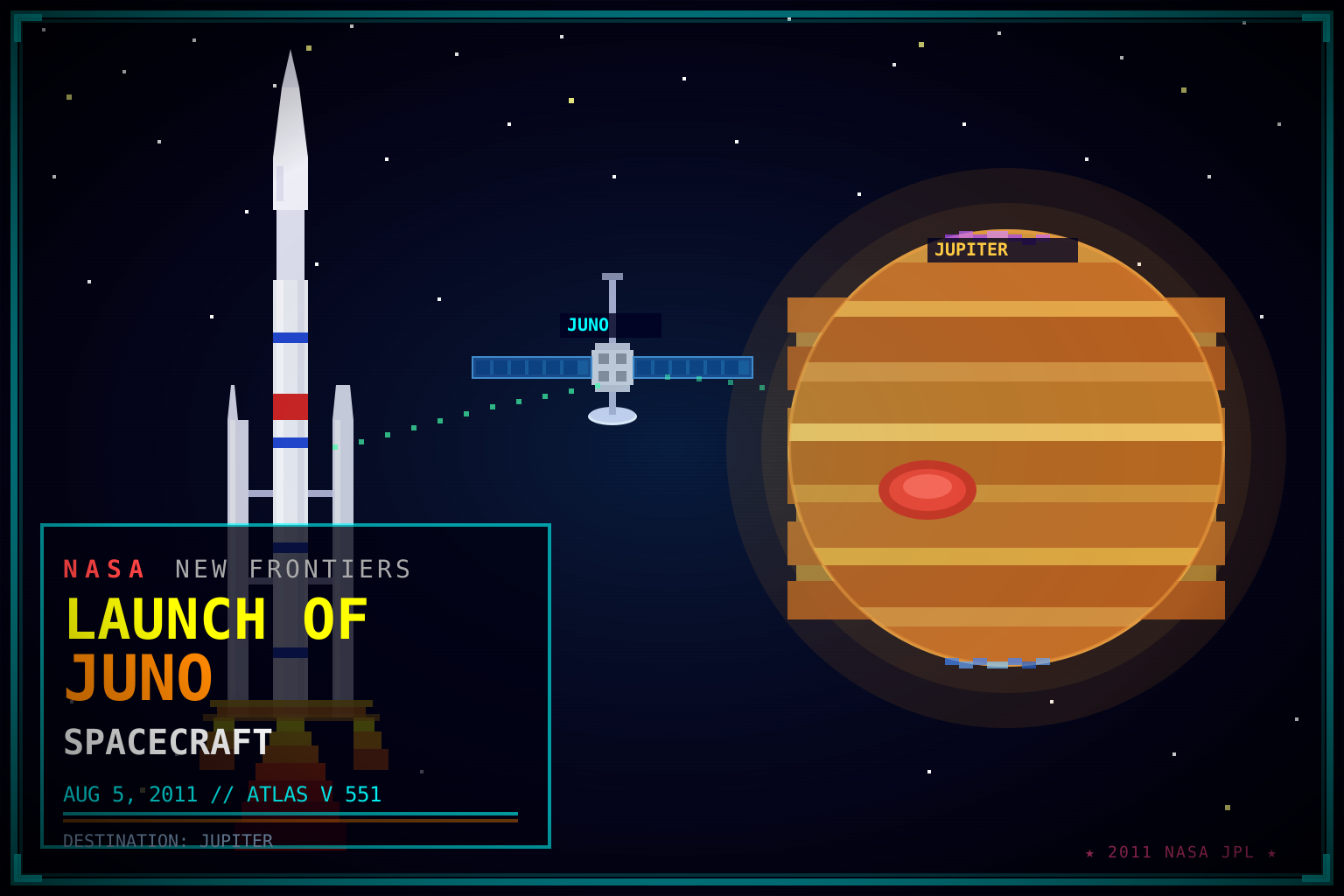
Juno, the second mission in NASA’s New Frontiers program, launched toward Jupiter at 16:25 UTC on August 5, 2011, aboard an Atlas V 551 rocket from Space Launch Complex 41 at Cape Canaveral Air Force Station, Florida. Managed by NASA’s Jet Propulsion Laboratory and built by Lockheed Martin, the spacecraft was designed to study Jupiter’s origin and evolution by mapping the giant planet’s gravitational and magnetic fields, probing its deep atmosphere and interior structure, and investigating its polar magnetosphere and powerful auroras. The mission’s principal investigator was Scott Bolton of the Southwest Research Institute in San Antonio, Texas.
Because it would operate roughly five times farther from the Sun than Earth, Juno was the first spacecraft designed by NASA to reach such a distance using solar power rather than the radioisotope thermoelectric generators that had powered earlier outer-planet probes such as Galileo. Three large solar arrays and a titanium radiation vault protecting its electronics allowed the spinning, three-axis-stabilized craft to survive Jupiter’s intense radiation environment.
After a cruise of nearly five years and about 2.8 billion kilometers — which included two deep-space maneuvers and a gravity-assist flyby of Earth on October 9, 2013 — Juno entered a polar orbit around Jupiter on July 4, 2016 (July 5 UTC), beginning a detailed survey of the solar system’s largest planet.
Mission Design and Objectives
Juno was selected as the second New Frontiers mission, following New Horizons to Pluto. Its total cost was estimated at roughly US$1.1 billion at launch, a figure that rose to approximately $1.46 billion including operations and data analysis through 2022. Its principal science objectives were to:
- Measure the abundance of water and oxygen in Jupiter’s atmosphere to constrain competing theories of how the planet — and by extension the solar system — formed
- Map Jupiter’s gravitational and magnetic fields to reveal its internal structure and determine whether it has a solid core
- Characterize atmospheric dynamics, composition, and deep circulation beneath the visible cloud tops
- Explore Jupiter’s magnetosphere near the poles and the physics driving its auroras, the most powerful in the solar system
Spacecraft and Solar Power
Juno carried three solar arrays, each measuring about 2.7 by 8.9 meters and together providing roughly 50 square meters of active cells — the largest solar arrays NASA had flown on a deep-space probe. To shield its command and data-handling electronics from Jupiter’s radiation belts, the spacecraft housed them inside a roughly 200-kilogram titanium vault. Its science payload comprised nine instruments, including a microwave radiometer (MWR) to sound the deep atmosphere, the Jovian Infrared Auroral Mapper (JIRAM), a magnetometer (MAG), a Gravity Science experiment, the JADE and JEDI particle detectors, the Waves radio and plasma sensor, an ultraviolet spectrograph (UVS), and JunoCam, a visible-light camera included largely for public engagement.
Journey to Jupiter
The Atlas V placed Juno on an initial trajectory that carried it beyond the orbit of Mars before two main-engine deep-space maneuvers in late August and early September 2012 set up a return to Earth. On October 9, 2013, Juno swung about 559 kilometers above Earth’s surface, using the planet’s gravity to boost its speed enough to reach Jupiter. It arrived on July 4, 2016, firing its main engine for 35 minutes to slow into a polar orbit — a maneuver that had to succeed autonomously amid Jupiter’s radiation. The mission, alongside the same year’s MESSENGER Mercury orbit insertion and the launch of the Curiosity rover, made 2011 a landmark year for American planetary science even as the Space Shuttle program drew to a close.
Significance
Juno’s launch advanced a central goal of planetary science: understanding how Jupiter, and therefore the early solar system, took shape. As the first mission designed to peer beneath the planet’s clouds and probe its deep interior, it promised measurements that earlier flybys and the Galileo orbiter could not provide. Its success also validated the use of solar power at Jupiter’s distance, demonstrating that missions to the outer solar system need not depend on scarce plutonium-based generators. The spacecraft’s flight — beginning in the same year that the United States retired the Space Shuttle and lost the Russian Phobos-Grunt interplanetary probe — underscored a shift in spacefaring toward robotic exploration of the solar system’s origins. Juno went on to far outlast its original mission plan, with NASA repeatedly extending its operations well into the following decade.
Sources
- Juno (spacecraft) - Wikipedia
- Juno - NASA Science
-
[Juno NASA Jet Propulsion Laboratory](https://www.jpl.nasa.gov/missions/juno/) - New Frontiers program - Wikipedia
Related
- MESSENGER Mercury Orbit — another 2011 NASA planetary mission milestone
- NASA Curiosity Rover — a fellow interplanetary probe launched in the same year
- Space Shuttle Final Mission — the 2011 close of the shuttle era that reframed U.S. spaceflight
- Phobos-Grunt Mars Mission — a contrasting 2011 interplanetary launch that failed