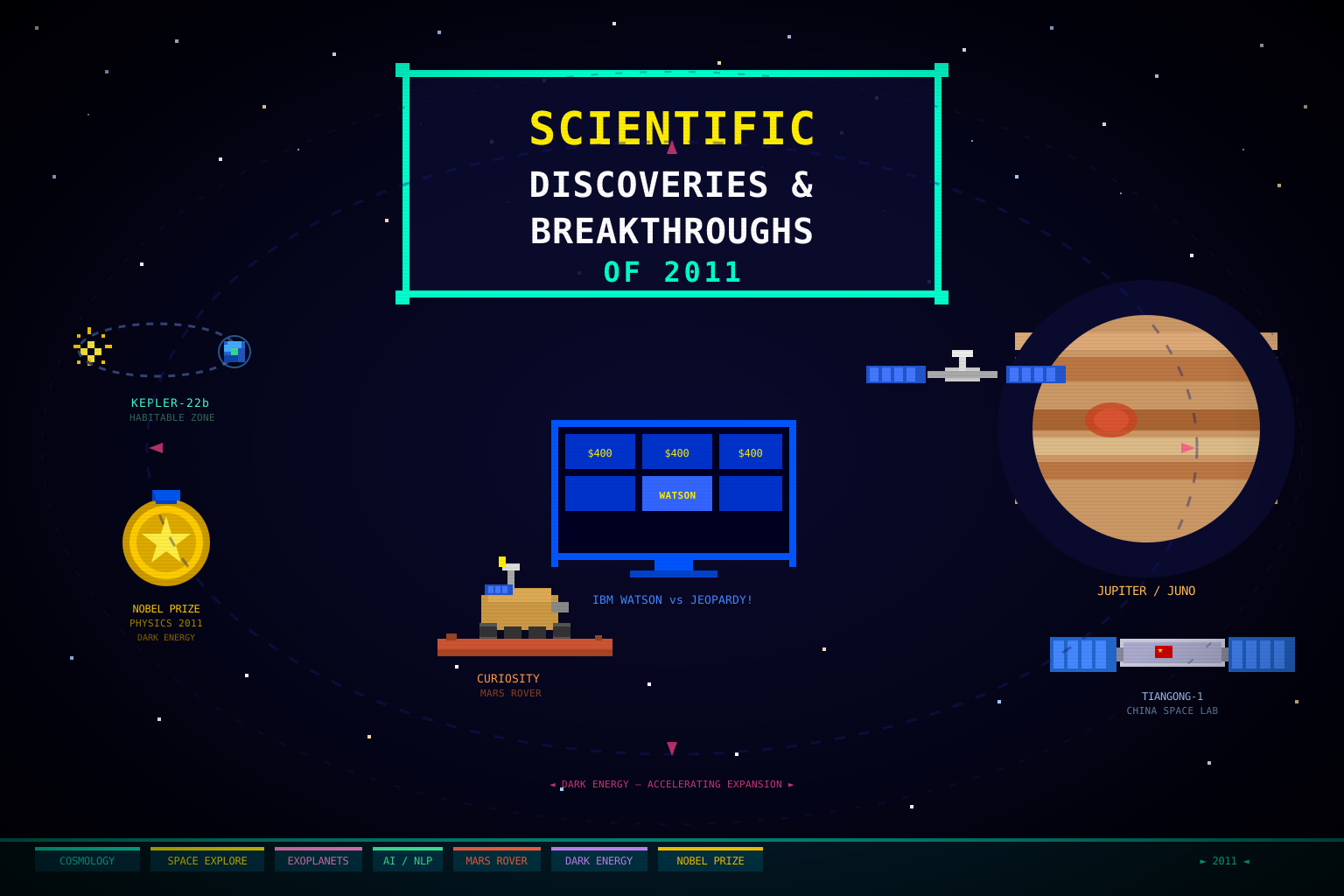
Key figures: Saul Perlmutter, Brian Schmidt, Adam Riess (Nobel Prize, Physics); Kepler space telescope team; IBM Watson researchers; MESSENGER, Curiosity, Juno mission teams; Tōhoku earthquake researchers; Large Hadron Collider physicists
Summary
2011 was a landmark year for scientific discovery and technological achievement, marked by major advances in cosmology, planetary science, artificial intelligence, and space exploration. The 2011 Nobel Prize in Physics honored Saul Perlmutter, Brian Schmidt, and Adam Riess for their 1998 observations of an accelerating universe expansion driven by “dark energy”—a discovery that overturned assumptions about gravity’s dominance and redefined twentieth-century cosmology. NASA’s Kepler space telescope confirmed the first exoplanet orbiting within a star’s habitable zone (Kepler-22b, December 5), a milestone in the search for potentially Earth-like worlds. IBM’s DeepQA system (“Watson”) defeated Jeopardy! champions Ken Jennings and Brad Rutter, demonstrating dramatic advances in natural-language processing and open-domain AI. Three major space missions launched or achieved critical milestones: NASA’s Curiosity rover (November 26 launch) en route to Mars, NASA’s Juno orbiter (August 5 launch) bound for Jupiter, and China’s Tiangong-1 space laboratory (September 29), its first step toward an independent human spaceflight program. The Fukushima Daiichi nuclear disaster (March 11), triggered by the Tōhoku earthquake and tsunami, became the worst nuclear incident since Chernobyl and raised urgent questions about nuclear safety, energy policy, and climate adaptation. The year thus crystallized both humanity’s expanding scientific reach and its vulnerability to natural catastrophe and technological risk.
Physics and Cosmology
The Accelerating Universe and Dark Energy (Nobel Prize)
The 2011 Nobel Prize in Physics recognized Saul Perlmutter, Brian Schmidt, and Adam Riess for their 1998 discovery that the universe’s expansion is accelerating, driven by a mysterious “dark energy” comprising roughly 68% of the universe’s total mass-energy density. Perlmutter (Lawrence Berkeley National Laboratory) led the Supernova Cosmology Project, while Schmidt (Australian National University) and Riess (then at the Space Telescope Science Institute) led the competing High-z Supernova Search Team; both groups observed Type Ia supernovae in distant galaxies and found them dimmer than expected if the universe’s expansion were slowing under gravity’s dominance. The unexpected dimness indicated acceleration—the universe’s expansion rate was increasing over time, a result most naturally accommodated by reviving Einstein’s cosmological constant (lambda), the term he had reportedly once called his greatest blunder. This finding—reported in close succession by the two teams (Riess and colleagues in 1998, Perlmutter and colleagues in 1999)—was described as among the most profound discoveries in twentieth-century physics. The 2011 Nobel citation, announced thirteen years after the original papers, reflected the scientific community’s acceptance of the result and its foundational importance. Dark energy remains one of cosmology’s deepest unsolved puzzles; understanding its nature is central to questions of the universe’s fate and the possibility of a “Big Rip” scenario in which accelerating expansion eventually tears apart all structure (stars, galaxies, atoms) in the infinitely distant future.
Faster-Than-Light Neutrino Anomaly (OPERA)
On September 23, 2011, the OPERA (Oscillation Project with Emulsion-tRacking Apparatus) collaboration announced the discovery of apparently superluminal neutrinos—particles traveling faster than light—a result that would violate Einstein’s special relativity if true. The result came from neutrinos produced by CERN’s accelerator complex near Geneva (via the CNGS beam, generated from the Super Proton Synchrotron rather than the Large Hadron Collider) and detected at the Gran Sasso Laboratory near L’Aquila, Italy, a distance of 732 km. OPERA reported that the neutrinos arrived 60 nanoseconds earlier than light would have taken to traverse the same distance. If confirmed, the result would overturn fundamental physics and trigger a revolution in understanding relativity, causality, and the speed-of-light barrier. The announcement triggered immediate skepticism from the physics community; many suspected systematic error (miscalibrated timing, GPS satellite errors, instrumental artifacts). By late 2011, independent checks of OPERA’s data were underway. The collaboration ultimately identified a culprit in 2012: a loose fiber-optic cable that had not properly connected the GPS-synchronized atomic clock to the neutrino-detection apparatus, introducing a ~60 nanosecond error. OPERA’s mistake and self-correction became a canonical example of the scientific method’s self-policing—an error caught and corrected transparently, not suppressed. The incident also revealed how robust scientific claims must withstand high scrutiny and how even prestigious collaborations can make mistakes.
Planetary Science and Exobiology
Kepler-22b: First Confirmed Habitable-Zone Exoplanet
On December 5, 2011, NASA announced the confirmation of Kepler-22b, the first exoplanet orbiting within the “habitable zone” (roughly 0.95 AU to 1.37 AU from a Sun-like star, where liquid water could exist on a planet’s surface) of a Sun-like star. Kepler-22b orbits an unnamed G-type star in the constellation Cygnus, approximately 600 light-years from Earth. The planet is about 2.4 times Earth’s radius, placing it between Earth and Neptune in size (a “super-Earth” or mini-Neptune), with an orbital period of 290 days. The confirmation relied on the Kepler space telescope’s detection of periodic dimming as Kepler-22b transits its host star—the primary method for exoplanet discovery since Kepler’s 2009 launch. The 2011 confirmation represented a major milestone in the search for potentially habitable worlds and raised renewed optimism about the prevalence of Earth-like planets and the possibility of extraterrestrial life. Although Kepler-22b’s exact composition remained unknown (it could be a dense super-Earth or a gaseous mini-Neptune), the discovery symbolized humanity’s emerging ability to detect potentially habitable worlds among the galaxy’s multitudes of stars. By 2011, over 500 exoplanets had been confirmed; Kepler-22b was among the first to fall explicitly within the habitable zone, a distinction that elevated it to iconic status in the public imagination and in astrobiology discussions.
MESSENGER Orbits Mercury
On March 18, 2011, NASA’s MESSENGER spacecraft (MErcury Surface, Space ENvironment, GEochemistry, and Ranging) entered orbit around Mercury, becoming the first spacecraft to orbit the innermost planet. Launched in August 2004, MESSENGER conducted three flybys of Mercury (2004, 2005, 2007) before the orbital insertion that took it through one of the solar system’s harshest thermal environments. Mercury’s proximity to the Sun, lack of atmosphere, and extreme temperature variations (−173°C on the night side to 427°C on the day side) made the mission technically challenging. MESSENGER’s instruments mapped Mercury’s surface, measured the planet’s magnetic field, and, crucially, confirmed the presence of water ice in permanently shadowed polar craters—a surprising discovery suggesting that water, despite Mercury’s hellish environment, could exist in the solar system’s innermost reaches. The ice is thought to be delivered by ancient asteroid impacts and preserved by the planet’s lack of atmosphere and constant rotation orientation toward the Sun. MESSENGER’s findings refined understanding of planetary formation and the distribution of water throughout the solar system, suggesting that even Mercury was not exempt from water delivery. The mission concluded with an intentional impact into Mercury’s surface on April 30, 2015, after four years of orbital science.
Space Exploration
NASA’s Curiosity Rover Launch
On November 26, 2011, NASA launched the Curiosity rover (formally the Mars Science Laboratory, or MSL) from Cape Canaveral, Florida aboard an Atlas V rocket. Curiosity is a SUV-sized rover equipped with cameras, spectrometers, and a sample-analysis laboratory—far more sophisticated than earlier rovers like Spirit and Opportunity. The rover’s primary mission: investigate whether Mars ever had environmental conditions suitable for microbial life. Curiosity’s journey to Mars took eight months; it entered the Martian atmosphere and executed a complex landing sequence (the “seven minutes of terror”) on August 6, 2012 (PDT) or August 5, 2012 (UTC), using a novel “sky crane” descent system—a hovering platform that lowered the rover on cables. The landing in Gale Crater and subsequent exploration of Mount Sharp (Aeolis Mons) yielded discoveries of organic compounds, methane fluctuations, and geological evidence of ancient water. Curiosity far exceeded its planned two-year mission; as of 2024, it remains operational, having become a primary source of data on Mars’s habitability and geology.
China’s Tiangong-1 Space Laboratory Launch
On September 29, 2011, China launched Tiangong-1 (“Heavenly Palace 1”), its first space-laboratory module, from the Jiuquan Satellite Launch Center. Tiangong-1 was a 8.5-ton unmanned module designed to serve as a testbed for China’s developing human spaceflight program and a step toward China’s goal of building an independent space station. The launch was a major milestone for the Chinese space program; Tiangong-1 hosted two crewed missions (Shenzhou 9 in June 2012 and Shenzhou 10 in June 2013) and two uncrewed docking tests (Shenzhou 8 in November 2011 and January 2012). Tiangong-1’s docking capabilities enabled China to master the critical technology of autonomous orbital rendezvous and docking—necessary for multi-module space stations. The successful Tiangong-1 missions accelerated China’s trajectory toward its full space station, which would be completed in 2022. The 2011 launch thus represented China’s emergence as a major spacefaring power with independent human-spaceflight capability and long-term ambitions in orbital infrastructure.
NASA’s Juno Spacecraft Launch
On August 5, 2011, NASA launched the Juno spacecraft toward Jupiter aboard an Atlas V 551 rocket from Cape Canaveral. Juno is a polar-orbiting spacecraft designed to study Jupiter’s internal structure, magnetic field, and atmosphere. At the time of its 2011 launch, Juno was the most distant solar-powered spacecraft NASA had ever flown—relying on three large solar panels rather than the radioisotope thermoelectric generators (RTGs) typically used for deep-space probes. The mission’s eight-month cruise to Jupiter would culminate in a July 4/5, 2016 (depending on time zone) arrival and orbital insertion. Juno’s science objectives included measuring Jupiter’s internal gravitational and magnetic fields to infer the planet’s internal structure (the distribution of dense core material vs. gas), investigating whether Jupiter has a solid rocky core, and characterizing the planet’s atmospheric dynamics and composition. The mission represented an ambitious effort to use solar power in the outer solar system and to gather data crucial for understanding giant-planet formation throughout our galaxy.
Artificial Intelligence
IBM Watson Defeats Jeopardy! Champions
On February 14–16, 2011, IBM’s artificial intelligence system “Watson” defeated two of Jeopardy!’s greatest champions—Ken Jennings (74-game winning streak) and Brad Rutter (highest all-time earnings)—in a televised three-game match broadcast on ABC. Watson, built on IBM’s DeepQA (Deep Question Answering) architecture, represented a landmark achievement in natural-language processing and open-domain AI. Unlike previous AI systems that operated in narrow, well-defined domains, Watson had to parse Jeopardy!’s wordplay, puns, historical references, and complex clue structures—requiring sophisticated language understanding, information retrieval, and confidence ranking. Watson ran on a cluster of 90 POWER7 servers at Yorktown Heights, New York, and could search vast databases of text, apply linguistic analysis, and rank candidate answers in real-time. During the match, Watson impressed with accurate responses and competitive strategy (wagering appropriately to maximize score). The victory was widely interpreted as a watershed moment for AI and prompted both optimism (about AI’s capability in language and knowledge work) and concerns about displacement of knowledge workers. Watson’s success led to subsequent commercialization efforts: IBM developed Watson Health, Watson Financial Services, and other domain-specific AI products. The February 2011 Jeopardy! victory became emblematic of the AI revolution’s acceleration and inspired the “AI winters” debate—whether the field was approaching a new era of transformative capability or would face diminishing returns and hype-cycle disappointments.
Large Hadron Collider Exclusion of Higgs Boson Mass Range
Physicists at the Large Hadron Collider (LHC) at CERN continued the hunt for the Higgs boson, the hypothetical particle predicted by the Standard Model to explain how particles acquire mass. By late 2011, the ATLAS and CMS experiments had excluded large swaths of the Higgs mass range (between 141 and 476 GeV/c²), narrowing the “Higgs window” to a small region around 125 GeV/c². This narrowing raised anticipation for a definitive Higgs detection in 2012. On July 4, 2012, both ATLAS and CMS announced the discovery of a Higgs-like particle at ~125 GeV/c², ending a decades-long search and earning François Englert and Peter Higgs the 2013 Nobel Prize in Physics. The 2011 exclusion results thus set the stage for one of early twenty-first century physics’s most significant discoveries.
Environmental and Technological Crises
The Tōhoku Earthquake and Tsunami
The 2011 Tōhoku earthquake (March 11, 14:46 JST) was the most powerful earthquake ever recorded in Japan and the fourth most powerful in recorded global history (magnitude 9.0–9.1, USGS). The epicenter lay approximately 70 km east of the Oshika Peninsula at a depth of ~29 km. The quake triggered a devastating tsunami with waves reaching 40.5 meters in height in some coastal areas (Miyako, Iwate Prefecture), sweeping 10 km or more inland. The officially confirmed death toll reached 15,899 as of 2023, with 2,527 reported missing. The Sendai Airport, Rikuzentakata, and large swaths of the Sanriku coastline were largely destroyed. The Japanese Meteorological Agency recorded more than 900 aftershocks above magnitude 5.0 in the three months following the main quake, including a magnitude 7.7 event on March 11 itself. The earthquake’s impact on Japan’s infrastructure, economy, and nuclear energy policy created a cascading crisis whose effects persisted for years.
The Fukushima Daiichi Nuclear Disaster
On March 11, 2011, the same magnitude 9.0–9.1 earthquake struck off the coast of Japan, triggering the tsunami that struck Fukushima. The Fukushima Daiichi Nuclear Power Station, operated by Tokyo Electric Power Company (TEPCO), was immediately impacted: the quake triggered automatic reactor shutdowns, but the tsunami overwhelmed the facility’s sea walls and flooded the diesel backup generators intended to cool the reactors during the loss of grid power. Without cooling, three reactor cores overheated, leading to hydrogen explosions in Reactors 1, 2, and 3 (March 12–14), as well as damage to Reactor 4’s spent-fuel pool. The meltdowns and radiation releases contaminated surrounding areas; ~155,000 people were evacuated from a 30 km radius. The International Nuclear Event Scale (INES) rated the incident as Level 7 (the maximum), comparable to Chernobyl (1986). Cleanup and decommissioning efforts continued for years; some areas remained highly contaminated. The disaster prompted a global reassessment of nuclear safety, particularly in seismically active zones, and influenced energy-policy debates about nuclear’s role in decarbonization. Japan, the world’s third-largest economy and a global nuclear-power advocate, faced existential questions about nuclear safety and energy strategy in the aftermath.
Significance
2011’s scientific achievements and crises crystallized both humanity’s expanding technological reach and its vulnerability to natural catastrophe and systemic risk. The Nobel Prize recognition of accelerating cosmic expansion, the confirmation of a potentially habitable exoplanet, and Watson’s Jeopardy! victory demonstrated scientific and AI progress. The successful launches of Mars rovers, space laboratories, and Jupiter probes reflected space-faring nations’ commitment to planetary science and exploration. Yet the Fukushima disaster underscored the risks of technological infrastructure in the face of natural forces that exceed historical precautions—a cautionary counterpoint to technophilic progress narratives. The OPERA neutrino anomaly and its eventual refutation illustrated the scientific method’s self-correction and the importance of skepticism even toward prestigious institutions. 2011 thus stands as a year of both scientific triumph and humbling recognition of nature’s power and the complexity of managing advanced technology safely. The year’s discoveries—especially in exobiology (Kepler-22b), AI (Watson), and cosmology (accelerating universe)—would influence scientific agendas for decades, while Fukushima reshaped energy policy and technological risk assessment across the globe.
The Silicon Foundation Beneath 2011’s AI
Two computing pioneers died in 2011 whose work created the infrastructure on which Watson, Juno’s flight software, and virtually every modern computer ran. Steve Jobs (October 5) and Dennis Ritchie (October 12) died eight days apart; their deaths bookended a technological era even as their legacy software ran everything from IBM’s Watson cluster (deployed on IBM POWER7 servers running AIX, itself a Unix derivative) to the Linux-based systems running Curiosity’s ground control pipelines. Ritchie’s C language and Unix philosophy—small composable tools, portability, hierarchical process management—remained the operating substrate for essentially all computing in 2011. Watson’s 90-server POWER7 cluster ran Linux and IBM middleware; the Kepler space telescope’s data pipeline was processed in part by software written in Python and C; CERN’s LHC computing grid (over 170 computing centers worldwide) was built largely on Linux derivatives. The invisibility of Ritchie’s contributions relative to Jobs’s was itself a 2011 cultural observation: the celebration of the visible product (iPhone, iPad) over the underlying architecture (operating systems, programming languages) that made them possible. See also Notable Deaths of 2011 for biographical detail on both figures.
Related Topics
- Notable Deaths of 2011 — Deaths of Steve Jobs and Dennis Ritchie in October 2011 symbolized the closing of the personal-computer revolution’s founding era; Kim Jong Il’s death raised geopolitical implications for Chinese-North Korean space and nuclear-technology sharing
- Video Games in 2011 — IBM Watson’s February 2011 Jeopardy! victory was contemporaneous with a peak year for AI-assisted game design and live-service gaming; Curiosity’s November 2011 launch was followed by enthusiastic coverage in gaming communities familiar with Kerbal Space Program and space exploration simulations
Sources
- 2011 Nobel Prize in Physics — Nobel Prize Committee
- Kepler-22b — NASA Exoplanet Archive
- IBM Watson Jeopardy! — IBM Research
- MESSENGER: Mercury and Venus Exploration — NASA
- Curiosity Mars Rover — NASA JPL
- Tiangong-1 — Chinese National Space Administration
- Juno Jupiter Mission — NASA JPL
- Fukushima Daiichi Disaster — Wikipedia
- OPERA Neutrino Anomaly — Wikipedia
- Accelerating Universe — Nobel Prize Committee
- 2011 Tōhoku Earthquake — USGS
- OPERA Neutrino Anomaly Retraction — CERN
- Dark Energy Review — NASA Science