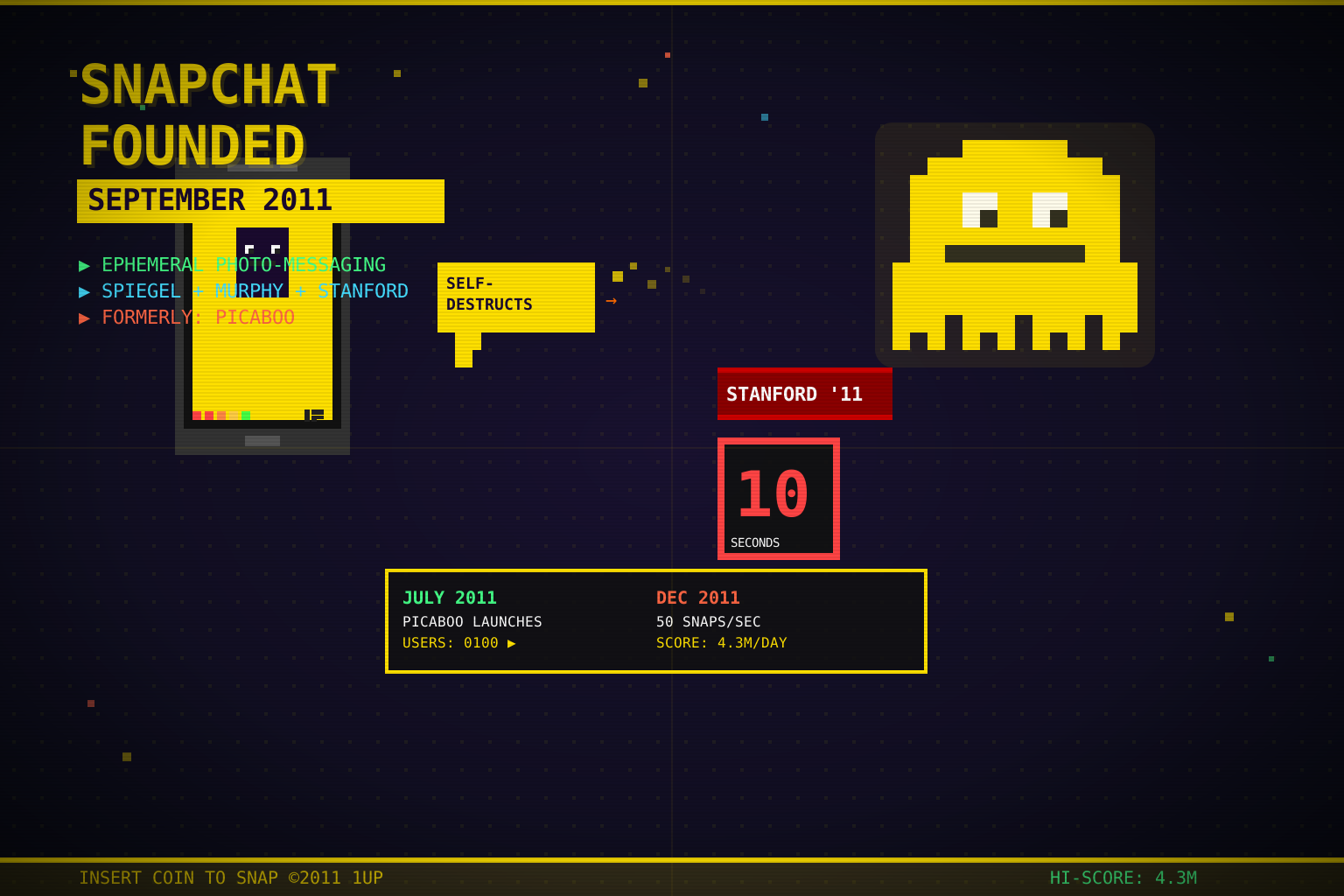
Key figures: Evan Spiegel (CEO and co-founder), Bobby Murphy (CTO and co-founder), Reggie Brown (original co-founder, later ousted), Jeremy Liew (Lightspeed Venture Partners, seed investor), Mitch Lasky (Benchmark Capital, Series A investor)
Summary
In September 2011, Stanford University students Evan Spiegel and Bobby Murphy publicly launched Snapchat — a mobile application centered on ephemeral photo-messaging that had begun as “Picaboo” a few months earlier. The app allowed users to send photos and brief messages that automatically deleted after viewing — a radical departure from the permanent, archivable communication model established by Facebook, Twitter, and email. Within two years, Snapchat had invented a content format (Stories) that every major social platform would copy.
Growth Milestones
| Date | Milestone |
|---|---|
| April–May 2011 | Reggie Brown pitches “Picaboo” concept to Evan Spiegel at Stanford |
| July 8, 2011 | Picaboo launches on iOS App Store (Spiegel, Murphy, Brown listed as founders) |
| August 2011 | Brown removed from the project; Spiegel and Murphy rename the app Snapchat |
| September 2011 | Snapchat relaunches publicly; ~100 users, mostly Spiegel’s family |
| December 2011 | ~50 snaps per second being sent (approximately 4.3 million snaps per day) |
| February 2012 | Snapchat surpasses 1 billion total snaps sent |
| May 2012 | $485,000 seed round led by Lightspeed Venture Partners |
| November 2012 | ~1 million daily active users |
| February 2013 | 60 million snaps per day |
| November 2013 | Snapchat Stories feature launches — photos/videos visible for 24 hours |
| November 2013 | Facebook offers $3 billion acquisition — Spiegel declines |
| March 2017 | Snap Inc. IPO at $17/share; $24 billion market capitalization |
From Picaboo to Snapchat: The Founding Dispute
The Original Concept
The origin story of Snapchat is inseparable from a founding dispute that would shadow the company for years. In early 2011, Reggie Brown — a Stanford fraternity member who had no technical background — pitched a concept to his friend Evan Spiegel: a messaging platform where photos would vanish after being viewed. Brown’s stated motivation was personal: he had sent a photo he wished he could take back, and was frustrated by the permanence of digital communication. He approached Spiegel, and the two recruited Bobby Murphy to write the code.
The app launched as “Picaboo” in July 2011. By August 2011, internal tensions led Spiegel and Murphy to remove Brown from the company. Brown received no equity settlement at the time of his removal. He later sued Spiegel and Murphy for his share of the company; the case was settled in September 2014 for a reported $157.5 million — a figure that retroactively valued Reggie Brown’s conceptual contribution at a substantial fraction of the company’s then-valuation of approximately $10 billion.
After Brown’s removal, Spiegel and Murphy renamed the app Snapchat and relaunched it in September 2011, the date most commonly cited as Snapchat’s founding.
The Core Design Insight
Snapchat’s core concept — impermanence as a feature rather than a bug — was a direct inversion of the assumptions underlying every major social platform of 2010. Facebook, launched 2004, was built around a persistent profile and archived timeline. Twitter (2006) created a searchable public record. Instagram, launched in October 2010, was built around a curated, permanent photo feed.
Spiegel’s insight (later the subject of litigation regarding its authorship) was that the permanence of social media created psychological friction. Users self-censored, carefully curating what they shared because anything posted might be seen by employers, parents, or future selves. A platform where messages disappeared would liberate users to share more candidly, more frequently, and more authentically — creating a different kind of social connection.
Technical Architecture and iOS-First Design
Snapchat launched exclusively on iOS — specifically requiring iOS 4.0 or later, compatible with the iPhone 3GS and all subsequent iPhones. This was a deliberate choice: Apple’s camera API provided cleaner, faster access to the camera hardware than Android’s fragmented ecosystem in 2011, and the target demographic (teenagers and college students) skewed heavily toward iPhone usage.
The app’s technical architecture at launch was intentionally minimal:
- Client-side timer: The snap duration (1–10 seconds) was enforced on the recipient’s device. A sophisticated recipient could, in theory, screenshot the snap before it disappeared. Snapchat’s terms of service prohibited this, and the app attempted to detect screenshots (alerting the sender), but there was no technical way to prevent it — a limitation that critics used to challenge the “disappearing” premise.
- Server-side message storage: Despite the ephemeral UX, Snapchat stored snaps on its servers until they were opened or expired. The media files were encrypted but not immediately deleted from server storage, a nuance that the U.S. Federal Trade Commission (FTC) later investigated. In 2014, Snapchat settled FTC charges that it had misrepresented its privacy practices.
- No public feed: Unlike Instagram or Google+, Snapchat had no public timeline, no follower count displayed, no likes, no retweets. Communication was strictly one-to-one or one-to-many (via group snaps), never public broadcast.
The rise of the Android ecosystem through 2011–2012 eventually forced Snapchat to build an Android client, which launched in October 2012 — more than a year after the iOS app. The Android version was widely criticized as inferior to the iOS experience, a reputation that persisted into the mid-2010s and became a recurring complaint among Android users.
Early Growth and User Adoption
Snapchat’s adoption accelerated through word-of-mouth among teenagers and young adults. The app’s early user base was concentrated in high schools and universities in Southern California, near Spiegel’s social network. The self-deleting feature held particular appeal to younger users who were growing wary of Facebook’s permanent data retention and perceived intrusion by parents, educators, and employers.
By December 2011, Snapchat users were sending approximately 50 snaps per second — roughly 4.3 million snaps per day — a figure Spiegel cited in early investor presentations as evidence of genuine engagement. This number dwarfed early-stage engagement metrics for comparable social apps at the same point in their development.
In May 2012, Lightspeed Venture Partners led a $485,000 seed round, with Jeremy Liew as the lead partner. Liew had identified Snapchat through a friend whose teenage daughter was using it; his investment thesis was simple: teenagers were abandoning Facebook for Snapchat, and wherever teenagers went, the rest of the internet eventually followed. The seed round gave Spiegel and Murphy the resources to hire their first employees and scale server infrastructure.
The Ephemeral Content Paradigm Shift
Snapchat’s launch in 2011 preceded the mainstream adoption of ephemeral content by several years. At the time, the social media industry was locked in a race to maximize time-on-platform and data retention. Facebook’s business model depended on permanent user data; Twitter’s on searchable archives; Instagram’s on beautiful, archivable photos.
Stories: The Feature That Reshaped Social Media
In November 2013, Snapchat launched Stories — a sequential, ordered slideshow of photos and videos that remained visible to a user’s followers for 24 hours before disappearing. Stories added an asynchronous broadcast dimension to Snapchat’s previously one-to-one messaging model. Users could now share their day as a narrative rather than isolated moments.
Stories was immediately copied across the industry, with significant consequences:
- Instagram Stories (August 2016) — Instagram launched a near-identical feature within three years of Snapchat Stories. Instagram CEO Kevin Systrom explicitly acknowledged the imitation, stating, “They deserve all the credit.” Instagram Stories surpassed Snapchat’s total daily active users within two months of launch.
- Facebook Stories (March 2017) — Facebook followed with its own Stories format across its main app and Messenger.
- WhatsApp Status (February 2017) — WhatsApp adapted the format as “Status.”
- YouTube Stories (2018), Twitter Fleets (2020, discontinued 2021), LinkedIn Stories (2020, discontinued 2021) — Stories spread across virtually every major platform.
By 2019, Instagram Stories alone had 500 million daily active users — more than Snapchat’s entire user base. TikTok’s algorithmic short-video format, launched to Western markets in 2018, can be understood as a further evolution of the ephemeral content paradigm Snapchat introduced.
Business Model and Monetization Challenges
In its earliest phase, Snapchat had no monetization strategy. The company’s famously minimal interface — no feed, no algorithm, no ads — was built for user experience rather than revenue extraction. Evan Spiegel’s stated philosophy prioritized building a loyal, engaged user base (particularly among youth) before monetizing.
Snapchat’s first advertising product — Brand Stories — launched in October 2014, more than three years after the app’s founding. The company subsequently developed Discover (curated media channels, January 2015), Sponsored Lenses (October 2015), and Snap Ads (video interstitials, 2015). The delayed monetization strategy contrasted sharply with Facebook’s approach of integrating advertising early and scaling it aggressively.
When Snap Inc. filed for its IPO in February 2017, the company disclosed it had lost $514 million in 2016 on revenues of $404.5 million — a loss ratio that reflected the costs of building global infrastructure and a sales organization without years of accumulated advertising revenue. The March 2017 IPO at $17/share valued Snap at approximately $24 billion.
Regulatory and Privacy Perspectives
Snapchat’s privacy-first positioning came at a time when Facebook’s data practices were beginning to attract scrutiny. The “disappearing” promise was a marketing claim that proved legally complex:
- In 2014, the FTC found that Snapchat had misrepresented its privacy practices, specifically regarding the permanence of snaps (which were retrievable before deletion from servers) and the effectiveness of its screenshot notification feature (which could be bypassed). Snapchat settled without admitting liability, accepting 20 years of external privacy audits.
- In 2014, a third-party app database breach (not from Snapchat’s servers directly, but from an unsanctioned API client) exposed approximately 4.6 million usernames and phone numbers.
- The FTC settlement established that “ephemeral” UX was not equivalent to privacy-preserving infrastructure — a distinction that shaped subsequent regulatory thinking about social media privacy claims.
Significance
Snapchat’s founding in September 2011 marked a watershed moment in social media’s evolution. The app demonstrated that a viable alternative to permanent, feed-based social networks existed — one built on ephemeral, peer-to-peer communication rather than public broadcasting. This insight reshaped the entire industry.
Several durable impacts stand out:
-
The Invention of Stories — Snapchat’s Stories format became the dominant social media content paradigm of the 2010s, displacing the static feed model that Facebook had established. Every major platform adopted it.
-
Generational Leapfrogging — Snapchat became the first major social network designed for Generation Z rather than ported to them. Facebook and Twitter were built by millennials for millennials; Snapchat emerged from Gen Z’s intuitive understanding of privacy, impermanence, and peer-to-peer communication. This generational specificity made Snapchat’s user loyalty unusually durable even as Instagram Stories captured a wider audience.
-
Redefining Privacy as UX — By making impermanence the default rather than an option, Snapchat forced the industry to confront the assumptions embedded in permanent data retention. Though Snapchat’s privacy claims were legally challenged, the design philosophy influenced a broader industry shift toward user control over data persistence.
-
The Growth-Before-Revenue Model — Snapchat’s trajectory from 2011 to its 2017 IPO — years of growth with zero advertising revenue, followed by a multi-billion-dollar public offering — exemplified the venture capital thesis that user growth and engagement could justify enormous valuations absent profitability. This pattern defined the decade (Uber, Airbnb, WeWork) and its contradictions.
Snapchat’s founding dispute, its imitation by giants, and its difficult path to profitability made it a defining case study in the economics of social platform competition: the inventor of a feature rarely profits most from it; network effects and distribution determine which platform captures the format’s value.
Sources
- Snapchat — Wikipedia
- Evan Spiegel — Wikipedia
- Reggie Brown Snapchat Settlement — Business Insider, 2014
- The History of Snapchat — Business Insider, 2015
- Snapchat FTC Settlement — FTC.gov, 2014
- Instagram Stories Surpasses Snapchat — TechCrunch, 2016
- Snap Inc. IPO Prospectus (S-1) — SEC, February 2017
- Lightspeed Investment in Snapchat — Wall Street Journal, 2014