Key figures: China Manned Space Engineering Office (mission management), China National Space Administration (CNSA), Shenzhou 8/9/10 crews, Jing Haipeng (commander, Shenzhou 9), Liu Yang (first Chinese woman in space, Shenzhou 9)
Summary
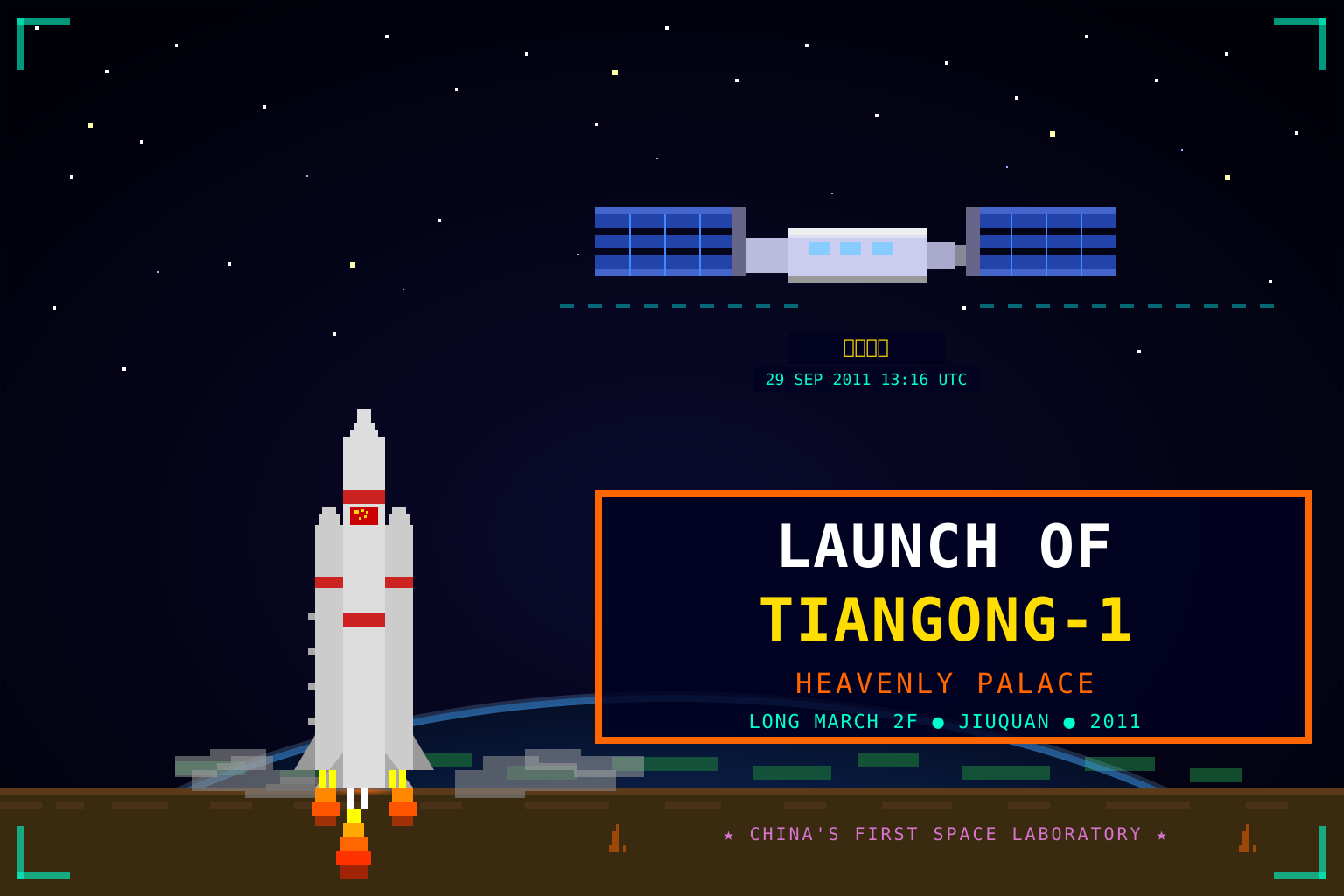
Tiangong-1 (天宫一号, “Heavenly Palace-1”), China’s first space laboratory module, launched at 13:16 UTC on September 29, 2011, aboard a Long March 2F rocket from the Jiuquan Satellite Launch Center in the Gobi Desert. The uncrewed module — about 10.4 meters long, 3.35 meters in maximum diameter, and roughly 8,500 kilograms — was designed as a target vehicle to let China develop and demonstrate the rendezvous and docking techniques required to build and operate a permanent crewed space station.
The launch marked the second of the three stages in China’s long-term human spaceflight strategy, sometimes called Project 921: the first stage had achieved crewed orbital flight with Shenzhou 5 in 2003, and the third would be a large modular space station. Tiangong-1 bridged the two by proving the technologies for automated and piloted docking.
Weeks after launch, the uncrewed Shenzhou 8 spacecraft accomplished China’s first-ever orbital docking with Tiangong-1 on November 2, 2011. Two crewed missions followed — Shenzhou 9 in 2012 and Shenzhou 10 in 2013 — before the module was retired. After China lost telemetry contact in 2016, Tiangong-1 made an uncontrolled reentry over the South Pacific Ocean on April 2, 2018.
Design and Purpose
Tiangong-1 was a prototype module rather than a full station, built around an experimental section that could host up to three taikonauts for short stays and a resource section housing propulsion and power systems. It offered roughly 15 cubic meters of habitable volume. Its central purpose was to serve as a docking target: mastering the automated approach, alignment, and hard-docking of two spacecraft in orbit was an essential capability that only the United States and the Soviet Union/Russia had previously demonstrated independently. The module also supported experiments in space medicine, materials, and Earth observation during the crewed visits.
Dockings and Crewed Missions
- Shenzhou 8 (uncrewed): Launched on October 31, 2011, and docked with Tiangong-1 on November 2, 2011, executing China’s first orbital rendezvous and docking. The two craft later undocked and repeated the maneuver to confirm the system’s reliability.
- Shenzhou 9 (crewed): Launched on June 16, 2012, carrying commander Jing Haipeng, Liu Wang, and Liu Yang — the first Chinese woman to fly in space. The mission achieved China’s first crewed docking, including a manually piloted docking, and its astronauts lived and worked aboard Tiangong-1.
- Shenzhou 10 (crewed): Launched in June 2013, the mission included a live science lecture broadcast from the module to students on Earth by astronaut Wang Yaping.
End of Mission and Reentry
Designed for a service life of about two years, Tiangong-1 continued operating past its planned lifetime after the Shenzhou 10 visit. China’s manned space agency announced the end of the module’s data service in March 2016, and controllers subsequently lost the ability to command it. Without functioning propulsion to guide a controlled deorbit, the module’s orbit decayed gradually until it reentered the atmosphere and largely burned up over the South Pacific Ocean on April 2, 2018.
Significance
Tiangong-1 was the decisive middle step in China’s methodical, decades-long program to establish a crewed presence in orbit. By validating rendezvous, docking, and short-duration habitation, it laid the groundwork for the larger Tiangong-2 laboratory launched in 2016 and for the modular Tiangong space station assembled in 2021–2022. Its 2011 launch also positioned China as the third nation to independently develop orbital docking, arriving in the same year that the United States retired its Space Shuttle fleet — a juxtaposition widely read as a signal of shifting momentum in human spaceflight. The module’s later uncontrolled reentry drew international attention to the challenge of safely disposing of large objects returning from orbit.
Sources
- Tiangong-1 - Wikipedia
- Chinese Space Station Tiangong-1 Falls to Earth - Scientific American
- China launches spacecraft on docking mission - Al Jazeera
Related
- Space Shuttle Final Mission — the 2011 U.S. shuttle retirement, a contrasting turn in human spaceflight
- Launch of NASA’s Juno Spacecraft — another major 2011 space launch
- NASA Curiosity Rover — a fellow late-2011 spaceflight milestone