Category: Society & Economics
Key figures: Jack Dorsey (CEO and co-founder), Jim McKelvey (co-founder), Keith Rabois (COO), Roelof Botha (Sequoia Capital, lead investor)
Summary
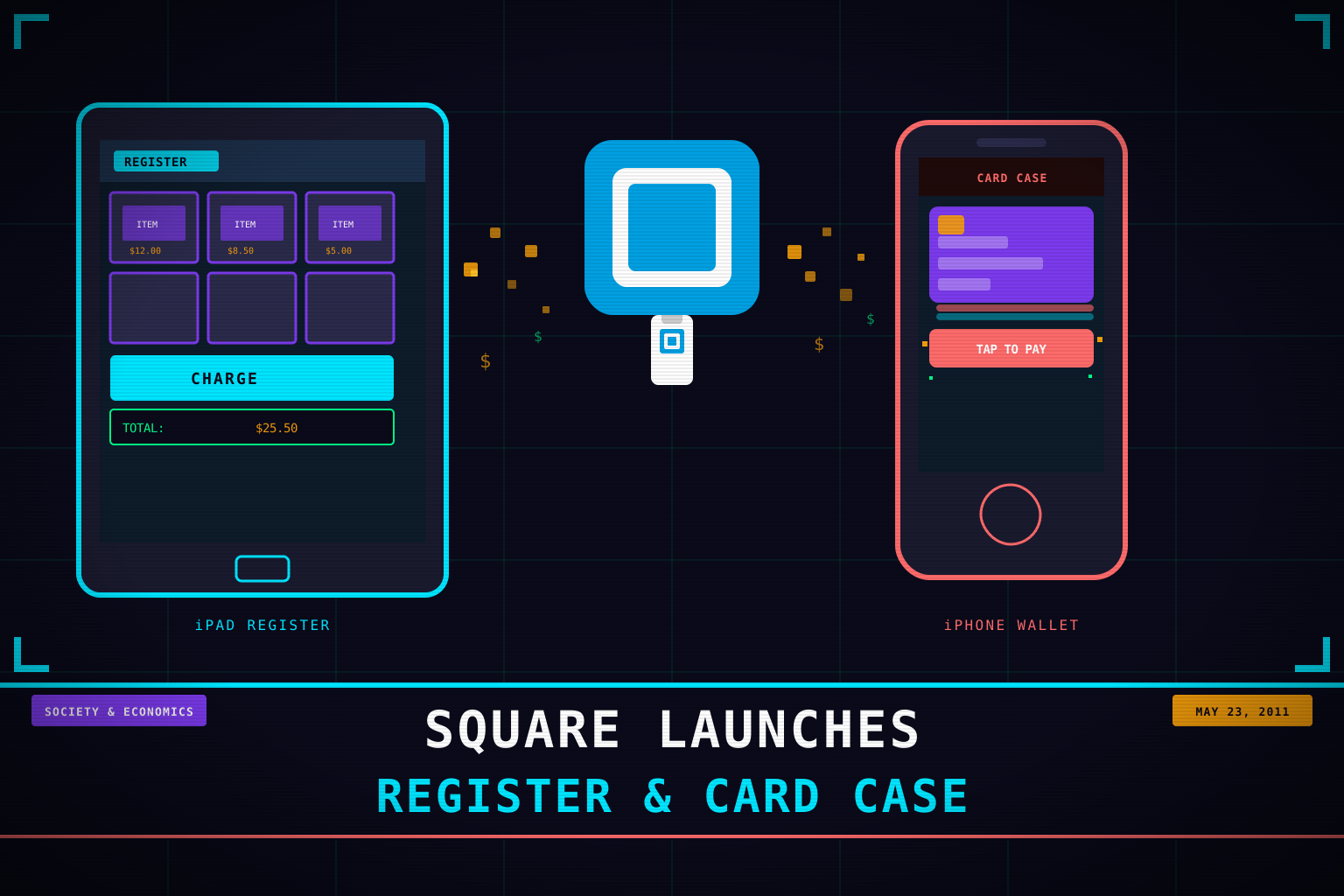
On May 23, 2011, Square Inc. unveiled two new products — Square Register, a point-of-sale application for the iPad, and Card Case, a digital wallet for the iPhone — a major expansion of the mobile-payment platform whose free card reader and companion app had reached the public during 2010. The company was founded in 2009 by Jack Dorsey — co-founder and executive chairman of Twitter — and Jim McKelvey, a St. Louis-based glass artist and software developer who had lost a sale because he could not accept a credit card. The founding insight was simple: every merchant should be able to accept any card, anywhere, with no merchant-account setup, no leasing of expensive point-of-sale terminals, and no lengthy approval process.
Square’s 2011 expansion positioned it at the center of a transformative year for mobile commerce and fintech. Concurrent with the rise of smartphone platforms and mobile-first business models, Square offered the clearest articulation of the smartphone-as-point-of-sale thesis: that the devices already in millions of merchants’ pockets were powerful enough to replace dedicated payment hardware.
Founding and Development
Jim McKelvey’s motivating incident occurred in 2009 when he lost a $2,000 art glass sale because he could not accept an American Express card at his studio. He called Jack Dorsey, a former Twitter colleague, and proposed building a simple card-acceptance system for small merchants. The two worked out of McKelvey’s studio in St. Louis and Dorsey’s San Francisco apartment, building the initial magnetic-stripe reader from scratch — McKelvey, who had expertise in hardware manufacturing, led the physical engineering.
Square Inc. was incorporated in 2009. The company’s early team included:
- Keith Rabois (COO), who had previously served as VP of Business Development at LinkedIn and executive roles at PayPal.
- Roelof Botha of Sequoia Capital, who led the company’s initial venture funding.
- Megan Quinn, VP of Merchant Services, who oversaw the early merchant-acquisition strategy.
Square tested its card reader with roughly 50,000 merchants during the summer of 2010 and rolled the free device out to the wider public later that year; by November 2010 it was processing millions of dollars in payments each week. Its early adopters — farmers-market sellers, street-food vendors, independent retailers, and craft makers — supplied the transaction-reliability, fraud, and user-experience data that shaped the platform. By the time Square Register and Card Case arrived in May 2011, the company had refined the reader and its software stack through roughly a year of real-world merchant use.
Product Ecosystem
By mid-2011 the Square system consisted of three interlocking components:
| Component | Description | Cost |
|---|---|---|
| Square Reader | White plastic magnetic-stripe dongle; plugged into iPhone or Android headphone jack | Free (or $9.99, refunded as account credit) |
| Square Register | iPad point-of-sale app (launched May 2011), with companion card-acceptance apps for iPhone and Android; managed transactions, inventory, tipping | Free |
| Square Dashboard | Web-based analytics; showed transaction history, sales trends, refunds | Free |
Square’s pricing model was disruptive: a flat 2.75% per-swipe transaction fee with no monthly fees, no per-transaction fixed charges, and no merchant-account application. Traditional credit-card processing charged merchants between 1.5% and 3.5% per transaction plus a per-transaction fee of $0.10–$0.30, a monthly gateway fee of $10–$30, and required a merchant account that could take weeks to establish and required a credit check.
Square removed all of those barriers. A merchant could download the app, plug in the reader, and accept a card within five minutes of signing up, with no credit check required and funds deposited in the merchant’s bank account within two business days.
Funding and Growth
Square’s venture-funding history through 2011 reflected investor confidence in mobile-commerce’s trajectory:
| Round | Date | Amount | Lead Investor |
|---|---|---|---|
| Seed | 2009 | $10 million | Khosla Ventures, Sequoia Capital |
| Series A | January 2011 | $27.5 million | Sequoia Capital |
| Series B | June 2011 | $100 million | Kleiner Perkins Caufield & Byers |
The Series B at $100 million, led by Kleiner Perkins, valued Square at approximately $1 billion — making it one of the first unicorn-tier fintech startups of the mobile era. Transaction volume climbed steeply through the year: Square was processing at an annualized rate of about $2 billion by October 2011, a figure that reached roughly $4 billion — some $11 million a day — by early 2012, validating the scale of the underserved small-merchant market.
The company’s growth was driven partly by partnerships: Starbucks announced a $25 million investment in Square and the adoption of Square for payment at its 7,000+ U.S. locations in August 2012, providing both capital and a massive brand-validation moment.
Significance
Square’s 2011 expansion and growth arc demonstrated the viability of a mobile-first fintech model in a year when the financial sector was under intense public scrutiny. The Occupy Wall Street movement, which launched in September 2011, highlighted public anger at large financial institutions; Square’s model — cutting banks and card networks’ complexity down to a flat fee, giving power back to small merchants — resonated as a structural counterpoint to big-bank dominance.
The company operated in a broader 2011 context of tech-sector confidence in disrupting legacy industries. That same spring, Microsoft acquired Skype for $8.5 billion, another sign that established tech giants were responding to mobile-era challengers. Square represented the inverse: a startup moving upward into financial services rather than a giant acquiring mobile capability.
For small merchants, freelancers, and gig-economy workers — a category that was expanding rapidly in 2011 as the U.S. economy recovered unevenly from the 2008 financial crisis — Square materially changed how informal commerce worked. Farmers market vendors, craft sellers, independent contractors, and food-truck operators could for the first time accept cards as routinely as cash, eliminating a practical barrier that had pushed small-dollar transactions into cash-only informality. This aligned with the broader trends documented in 2011’s business and entrepreneurship landscape.
Square went public on the New York Stock Exchange on November 19, 2015, at an IPO price of $9 per share, valuing the company at approximately $2.9 billion. By 2021, Square had rebranded as Block Inc., expanded into cryptocurrency trading, small-business lending, and payroll services, and acquired the buy-now-pay-later company Afterpay for $29 billion — becoming one of the defining fintech platforms of the 2010s.