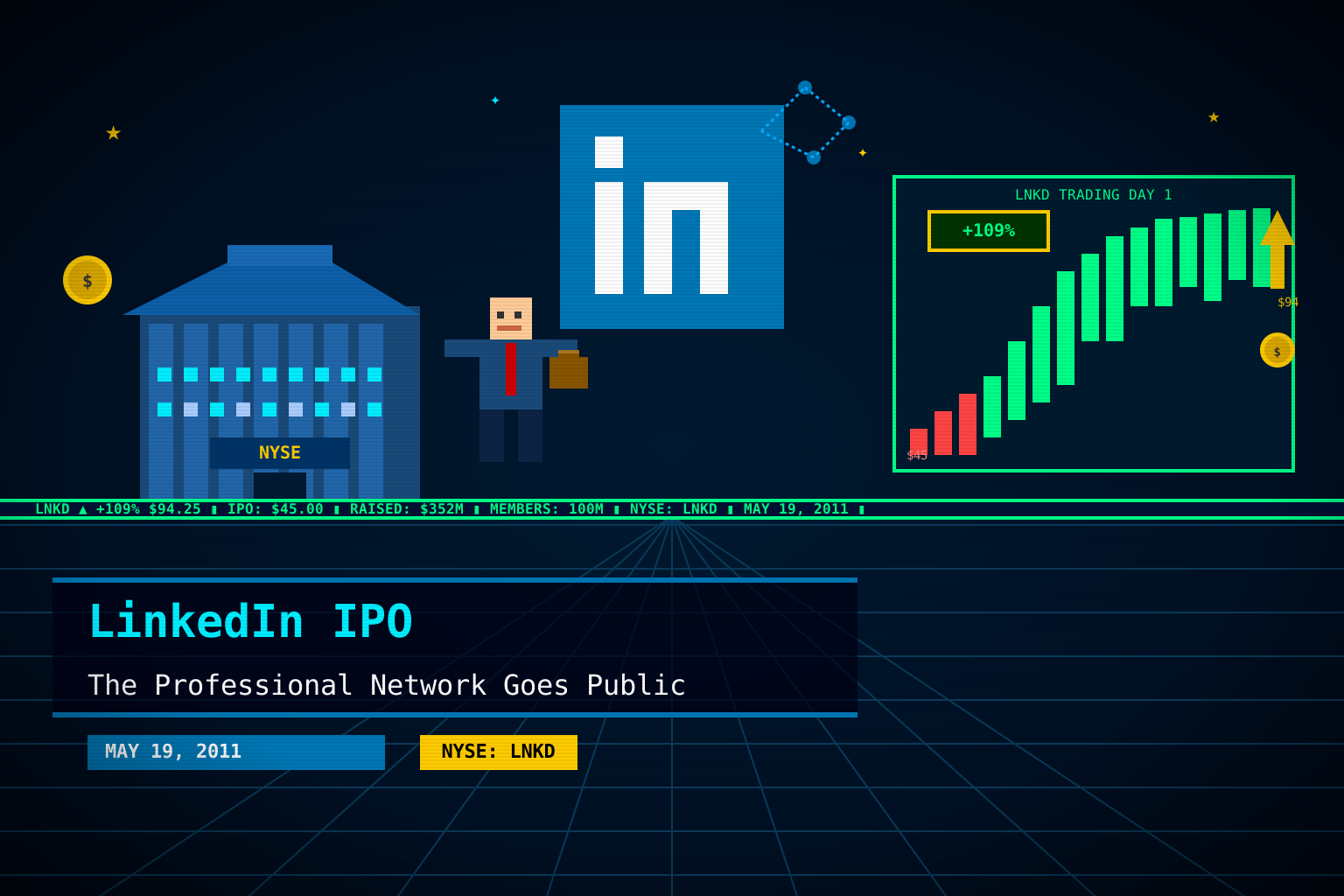
LinkedIn IPO — The Professional Network Goes Public
Category: Society & Economics
Date: May 19, 2011 (trading debut)
Summary
On May 19, 2011, LinkedIn held its initial public offering (IPO) on the New York Stock Exchange under the ticker symbol LNKD, raising approximately $352 million at an offering price of $45 per share. The offering became one of 2011’s most anticipated and triumphant tech IPOs, as shares surged 109% on their first day of trading—closing at $94.25—marking a watershed moment for professional networking and demonstrating the tech industry’s continued appetite for social platforms and workplace-focused technologies. Co-founded in December 2002 by Reid Hoffman and colleagues and launched publicly in May 2003, LinkedIn had grown to approximately 100 million members worldwide by the time of its IPO, establishing itself as the de facto platform for professional connections, job searching, and career development in the digital age.
Significance
LinkedIn’s successful IPO signaled several profound shifts in Silicon Valley, venture capital, and global technology markets. First, it validated the business model of B2B (business-to-business) social networking, proving that workplace-focused platforms could generate sustainable revenue through premium subscriptions, recruitment solutions, and advertising—contrasting with consumer social networks like Facebook that relied primarily on advertising. Second, the stock’s explosive first-day surge reflected investor enthusiasm for social media platforms and cloud-based enterprise software, categories that would dominate venture capital and stock-market performance throughout the 2010s. Third, LinkedIn’s IPO created a pathway for later professional-networking and work-focused platforms, encouraging venture investment in competitor products and adjacent categories.
The IPO also represented a coming-of-age moment for professional-networking technology. While early platforms like Monster.com and CareerBuilder had dominated online job searching, LinkedIn’s approach—building a comprehensive professional social graph rather than merely a job board—proved more durable and valuable. The platform’s emphasis on professional identity, recommendations, and relationship-building resonated with white-collar workers, managers, and enterprises seeking to modernize talent acquisition and employee engagement.
Geopolitically, LinkedIn’s success demonstrated that social-networking innovation was not limited to consumer-facing platforms or to Silicon Valley pioneers like Facebook and Twitter. The company’s strength in international markets, particularly Europe and Asia-Pacific, showed that professional networking transcended cultural and regional boundaries, with LinkedIn expanding rapidly across linguistic and geographic lines.
Key Figures
- Reid Hoffman — Co-founder, founding CEO (2003–2007), and Chairman; drove the platform’s growth and strategic direction
- Jeff Weiner — CEO since 2009; shepherded LinkedIn through growth and toward IPO readiness
- Konstantin Guericke — Co-founder; helped lead the platform’s early marketing and growth
- Morgan Stanley, JPMorgan Chase, Goldman Sachs — Lead underwriters for the IPO; managed capital raising and public-market introduction
Financial Profile at IPO
| Metric | Value |
|---|---|
| IPO price per share | $45 |
| Opening trade | ~$83 |
| First-day closing price | $94.25 |
| First-day gain | +109.4% |
| First-day trading volume | ~30 million shares |
| Shares offered (primary) | ~4.8 million |
| Total capital raised | ~$352.8 million |
| Market capitalization at close | ~$8.9 billion |
| Revenue (full-year 2010) | $243 million |
| Revenue (Q1 2011) | ~$94 million |
| Gross margin | ~83% |
| Members at IPO | ~100 million |
| Employees at IPO | ~2,100 |
LinkedIn was the first major U.S. social-media company to go public — Facebook’s IPO would not come until May 2012, and Twitter’s not until November 2013 — giving it a first-mover advantage in public-market investor appetite for social platforms.
Historical Context
Founding and Early Growth (2003–2007) LinkedIn was founded in December 2002 by Reid Hoffman and colleagues, launching publicly in May 2003. The platform’s early years focused on organic growth within professional circles, emphasizing quality over quantity and building a strong user base among executives, managers, and knowledge workers. By 2007, LinkedIn had approximately 20 million members and had begun experimenting with premium features and recruiting solutions.
Venture Growth and Profitability Path (2007–2010) From 2007 through 2010, LinkedIn expanded its feature set and revenue streams. The platform introduced LinkedIn Jobs (2006), LinkedIn Ads (2008), Sponsored Inmail (2010), and LinkedIn Recruiter—a sophisticated talent-acquisition tool sold to enterprise clients. By 2010, LinkedIn had achieved profitability and demonstrated a clear path to sustainable business economics. Revenue grew from approximately $49 million in 2009 to over $243 million by 2010, driven by recruiting solutions ($160 million) and advertising ($60 million).
Pre-IPO Scaling (2010–2011) In preparation for its IPO, LinkedIn accelerated international expansion, launched new products, and refined its financial disclosures. The company operated offices across North America, Europe, and Asia-Pacific, and had scaled its member base to approximately 100 million. LinkedIn’s S-1 registration statement (filed in January 2011) revealed a company with strong revenue growth, expanding margins, and a clear strategic roadmap—positioning it as a rare profitable, growth-stage tech company entering the public markets.
The IPO Event
Pricing and Opening (May 18–19, 2011) LinkedIn priced its IPO at $45 per share on May 18, 2011, at the upper end of its $32–$45 guidance range. The strong pricing reflected investor demand and optimism about the company’s trajectory. On May 19, when trading opened, the stock immediately surged, driven by retail investors, hedge funds, and institutional buyers eager to own shares in a rare profitable tech company with dominant market position and clear growth drivers.
Market Reception The first-day surge—climbing from $45 to a peak intraday price exceeding $120 before closing at $94.25—marked one of the strongest IPO debuts in tech history. The 109% first-day return created headlines worldwide and triggered discussions about valuation bubbles, retail investor enthusiasm, and the tech industry’s momentum. LinkedIn’s IPO became emblematic of a broader wave of social-media and cloud-technology IPOs that would accelerate through the 2010s, including Groupon, Zynga, and others.
Post-IPO Trajectory In the weeks and months following its IPO, LinkedIn’s stock continued to climb, reaching market capitalization exceeding $16 billion by year-end 2011. The company continued to expand internationally, acquire complementary companies, and build new revenue streams. The IPO windfall provided capital for acquisitions and product development, enabling LinkedIn to expand its footprint in emerging markets and compete against global rivals.
Business Model and Revenue Drivers
Recruiting Solutions LinkedIn Recruiter, the company’s enterprise talent-acquisition tool, represented the largest revenue contributor (~66% of 2010 revenue). The product allowed HR departments, recruiters, and hiring managers to search and contact potential candidates directly on the platform, fundamentally transforming talent acquisition.
Marketing Solutions LinkedIn Ads and Sponsored Inmail enabled advertisers to target professionals based on job function, industry, company, and other professional attributes—a capability increasingly valuable to B2B advertisers, enterprise software vendors, and recruiting firms.
Premium Subscriptions LinkedIn Premium offered individual professionals enhanced features including expanded profile searches, richer analytics on who viewed their profiles, and direct messaging (InMail) to people outside their network. Premium subscriptions generated growing revenue, particularly as the platform expanded internationally.
Competitive Context
Versus Facebook and Twitter LinkedIn was the first of the major U.S. social networks to go public: Facebook would not follow until May 2012, nor Twitter until November 2013. LinkedIn differentiated itself through its B2B focus and professional network effects. Unlike consumer social networks, its value proposition centered on career advancement, talent acquisition, and professional development—creating different revenue drivers and user behaviors.
Versus Legacy Job Boards Traditional job-search platforms like Monster.com, CareerBuilder, and Indeed had dominated online recruitment through the 2000s. LinkedIn’s social-networking approach created a more dynamic, identity-rich, and relationship-driven alternative that eventually displaced legacy platforms in recruitment’s stratified market.
Significance of the 2011 IPO Moment
2011 as a Tech IPO Inflection The 2011 calendar year marked a resurgence in technology IPOs after the 2008–2010 downturn. LinkedIn’s May IPO was followed by Groupon (November 2011) and multiple other tech offerings, signaling renewed venture-capital appetite and public-market enthusiasm for internet companies. However, the subsequent performance of Groupon and others (which saw sharp stock declines post-IPO) contrasted with LinkedIn’s sustained strength, establishing the professional network as a rare success story among the new cohort of tech IPOs.
Cloud and SaaS Validation LinkedIn’s IPO was particularly significant for cloud-based and software-as-a-service (SaaS) companies. The company’s profitability, high gross margins (>80%), and recurring-revenue business model became a reference point for subsequent SaaS IPOs of the 2010s, such as Workday and ServiceNow.
Global Reach By 2011, LinkedIn had achieved meaningful scale in international markets, with substantial member bases in India, China, Brazil, and Europe. The company’s IPO thus represented not merely a U.S. tech success but a global technology achievement, with revenue streams and users spanning continents.
Legacy and Subsequent Developments
LinkedIn’s IPO established it as one of the tech industry’s enduring public companies. The platform continued to grow through the 2010s, expanding its product portfolio, making strategic acquisitions (including LinkedIn Learning from Lynda.com in 2015), and adapting to mobile-first usage patterns. In June 2016, Microsoft announced its acquisition of LinkedIn for $26.2 billion, marking one of the tech industry’s largest acquisitions and validating the platform’s strategic importance in the enterprise-software ecosystem.
The 2011 IPO remains a landmark moment in professional networking’s history and a turning point for how the tech industry approached B2B social platforms and workplace-focused technologies.
Sources
- Wikipedia: LinkedIn IPO (2011)
- SEC S-1 Filing: LinkedIn Corporation (January 2011)
- Financial Times coverage: “LinkedIn’s strong IPO debut” (May 2011)
- Reuters / Bloomberg: LinkedIn IPO reporting (May 2011)
- TechCrunch: LinkedIn IPO analysis and market reaction
- LinkedIn official investor relations and press releases
Related
- Skype Acquisition by Microsoft — Microsoft’s $8.5B tech acquisition announced days before LinkedIn’s IPO
- Square Mobile Payments — Another 2011 Silicon Valley startup redefining a professional category
- Google+ Launch — Social platform competition intensifying in 2011
- Instagram Founding — Consumer social network growing rapidly while LinkedIn led B2B social
- Business and Entrepreneurship in 2011 — Startup success and tech-industry dynamics
- U.S. Credit Rating Downgrade — Macro financial turbulence in the same calendar year
- Eurozone Debt Crisis — Global economic conditions shaping tech-IPO investor sentiment