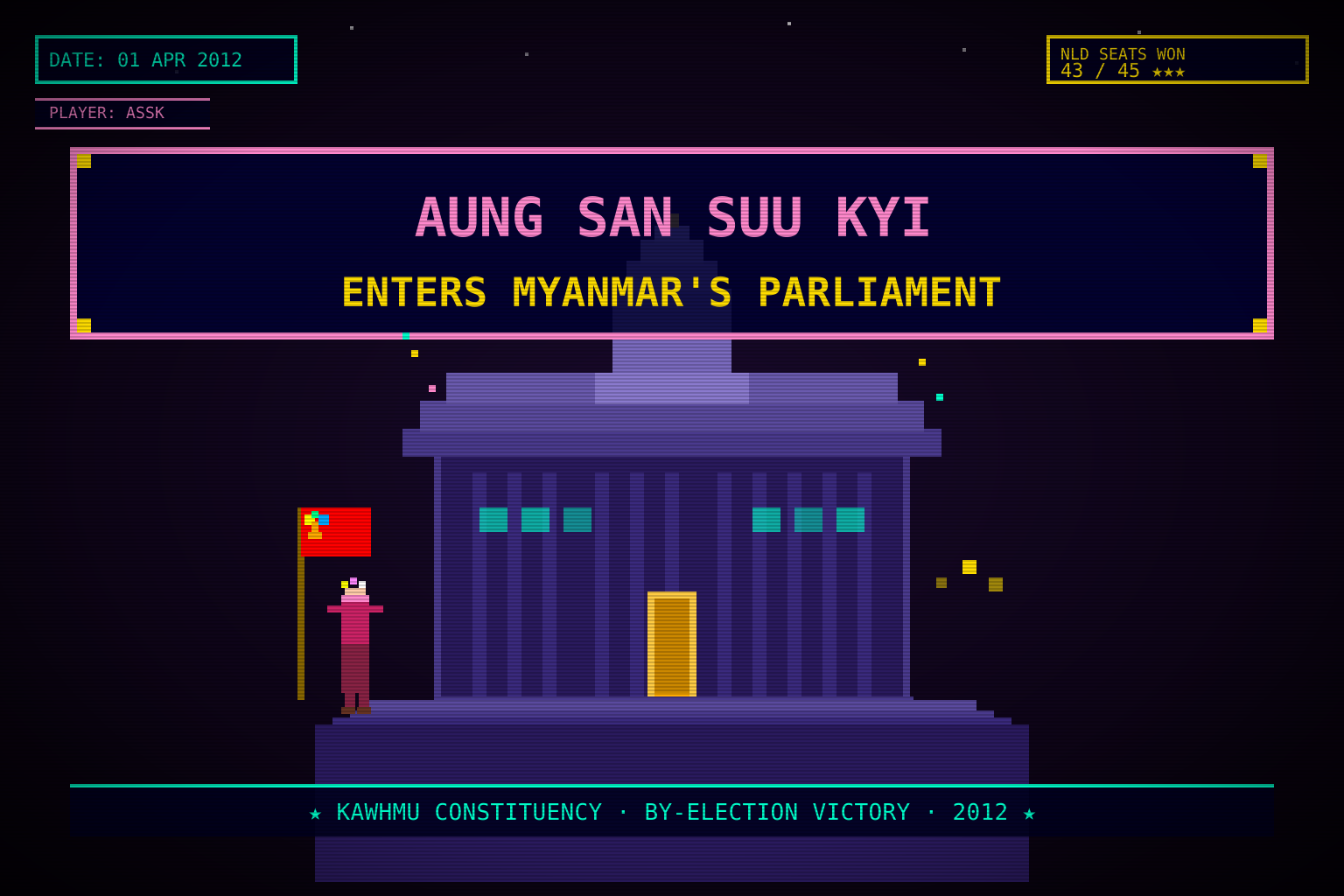
Key figures: Aung San Suu Kyi (National League for Democracy leader and Nobel Peace Prize laureate); Thein Sein (reformist President of Myanmar); Shwe Mann (Speaker of the Pyithu Hluttaw)
Summary
On 1 April 2012, Aung San Suu Kyi — the long-detained figurehead of Myanmar’s democracy movement — won election to the country’s parliament for the first time. Contesting a seat for the Kawhmu constituency, a rural township south of Yangon, she led her party, the National League for Democracy (NLD), to a sweeping victory in a round of by-elections held to fill seats vacated by lawmakers who had joined the executive. Of the 45 seats contested that day, the NLD won 43, taking all but a handful of the vacancies open to it and demonstrating the party’s overwhelming popular support after decades of suppression.
The by-elections were a limited exercise — the 45 seats represented only a small fraction of Myanmar’s roughly 660-seat national legislature, which remained dominated by the military-backed Union Solidarity and Development Party (USDP) and by 25% of seats reserved for serving military officers under the 2008 constitution. Their significance was therefore symbolic rather than a shift in the balance of power: they marked the NLD’s return to electoral politics after it had boycotted the 2010 general election, and they brought Aung San Suu Kyi from the status of a former political prisoner into the halls of the state she had opposed for a generation. She and other NLD members-elect were sworn in on 2 May 2012, after a brief standoff over the wording of the parliamentary oath.
The vote unfolded amid a broader liberalisation launched by President Thein Sein, a former general who had taken office in March 2011 and begun releasing political prisoners, easing censorship, and legalising the NLD. Western governments treated the by-elections as a test of the reforms’ credibility, and their broadly credible conduct prompted the United States, the European Union, and others to begin suspending or lifting long-standing sanctions.
Background: house arrest and the 2010 boycott
Aung San Suu Kyi, the daughter of the assassinated independence hero Aung San, rose to prominence during Myanmar’s 1988 pro-democracy uprising and co-founded the NLD that year. The party won a landslide in the 1990 general election, but the ruling military junta annulled the result and refused to hand over power. Suu Kyi spent much of the following two decades in detention: she was held under house arrest for roughly 15 of the 21 years between 1989 and 2010, across three main periods (1989–1995, 2000–2002, and 2003–2010). She was awarded the Nobel Peace Prize in 1991 while confined and was unable to travel to accept it; her sons received the award on her behalf.
In 2010 the junta staged the country’s first general election in two decades on 7 November, under an electoral framework the NLD regarded as rigged to entrench military rule. The party boycotted the poll and was consequently dissolved. Suu Kyi was released from her final spell of house arrest on 13 November 2010, days after that election. Over the following year, as Thein Sein’s nominally civilian government pursued reforms and engaged Suu Kyi directly, the NLD re-registered as a legal party and agreed to compete in the 2012 by-elections.
The by-elections of 1 April 2012
The 2012 by-elections filled seats left vacant when their previous holders were appointed to government posts. Voting for three constituencies in Kachin State — Mogaung, Hpakant, and Bhamo — was postponed, officially because of the security situation amid fighting between the army and the Kachin Independence Army, leaving 45 seats to be decided on 1 April. The NLD fielded candidates in 44 of them and won 43 — 37 in the Pyithu Hluttaw (House of Representatives, the lower house), 4 in the Amyotha Hluttaw (House of Nationalities, the upper house), and 2 in region or state assemblies. The two remaining seats went to the ruling USDP and to the Shan Nationalities Democratic Party.
Aung San Suu Kyi won the Kawhmu seat decisively. In the run-up to the vote, she and the NLD had complained of irregularities in the voter rolls — including the names of deceased and under-age people — and of intimidation, though the party accepted the results and international observers judged the process broadly credible despite flaws. The scale of the NLD’s win, in a contest the government could have manipulated more heavily, was widely read as a signal of the reformers’ seriousness and of the party’s enduring mandate.
The oath dispute and swearing-in
The newly elected NLD members did not immediately take their seats. Under the 2008 constitution, legislators were required to swear to “safeguard” the charter — a document drafted under military rule that guaranteed the armed forces a political veto. The NLD objected, arguing the wording should be changed to “respect” the constitution, which the party sought to amend rather than protect, and initially declined to be sworn in when parliament convened. The impasse lasted only days: on 30 April 2012 the NLD dropped its objection, with Suu Kyi citing her supporters’ wish to see her take her seat, while pledging to keep pressing for constitutional change through parliamentary means. She and her fellow members-elect took the oath as written on 2 May 2012 before Speaker Shwe Mann in the capital, Naypyidaw.
Significance
Aung San Suu Kyi’s entry into parliament was one of the defining images of Myanmar’s opening after nearly half a century of military dominance. It converted the country’s most famous dissident into a sitting legislator working inside institutions she had long boycotted, and it lent the reform process a legitimacy that accelerated the country’s re-engagement with the outside world. In the weeks that followed she made her first foreign trips in 24 years, and on 16 June 2012 she finally delivered her Nobel lecture at Oslo City Hall, more than two decades after the prize was awarded, opening with the observation that she had once been “a prisoner of conscience.”
The by-elections also set the stage for the NLD’s landslide in the 2015 general election, after which Suu Kyi became State Counsellor and de facto head of government, the constitution barring her from the presidency itself. That later period would prove far more contested — her international standing was severely damaged by her government’s response to the persecution of the Rohingya minority, and the democratic experiment ended when the military seized power again in a February 2021 coup and detained her once more. Viewed from 2012, however, her seating in parliament stood as a hopeful marker of transition, part of a wider year of consequential leadership change across Asia and the world.
Key Facts
- By-election date: 1 April 2012; NLD members sworn in 2 May 2012
- Constituency: Kawhmu Township, Yangon Region (Pyithu Hluttaw seat)
- NLD result: won 43 of the 45 contested seats (37 lower house, 4 upper house, 2 regional); three Kachin State seats were postponed
- Scale: the 45 seats were a small fraction of the ~660-seat legislature, which stayed dominated by the military-backed USDP and by 25% reserved military seats
- Prior detention: roughly 15 of 21 years under house arrest (1989–2010); released 13 November 2010
- Context: NLD had boycotted the 2010 general election; reforms under President Thein Sein prompted its return
- Nobel Peace Prize: awarded 1991; acceptance lecture delivered in Oslo on 16 June 2012
See Also
- Mohamed Morsi — 2012 Egyptian Presidency and Muslim Brotherhood — another 2012 democratic transition emerging from an authoritarian order
- Malala Yousafzai October 2012 Shooting — a parallel Asian human-rights story that drew global attention in 2012
- Xi Jinping’s 2012 Elevation to General Secretary — a contrasting Asian leadership transition the same year
- Nobel Prize Announcements 2012 — the year’s laureates, in the tradition of the prize Suu Kyi accepted in 2012