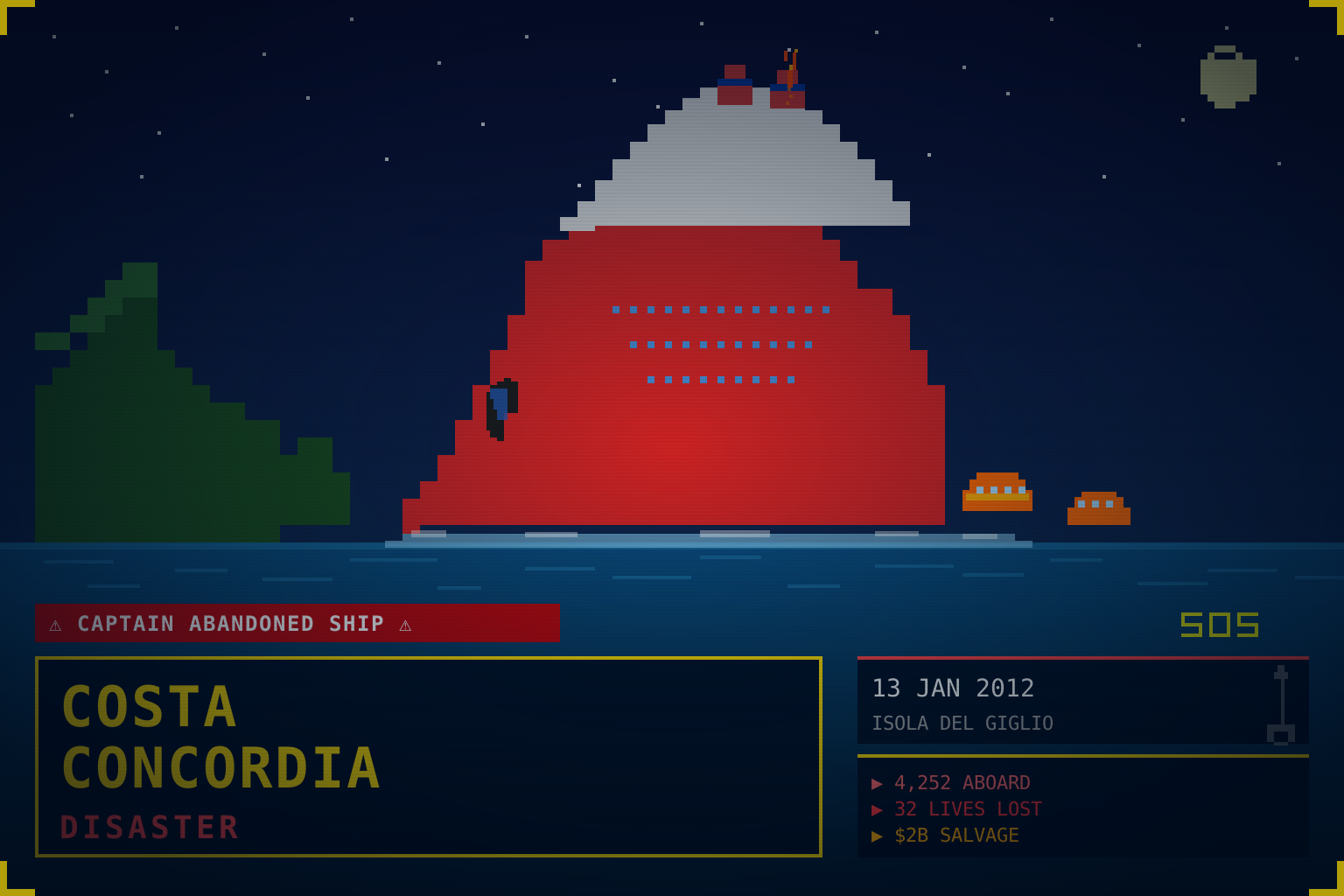
Key figures: Francesco Schettino (captain), Gregorio De Falco (Italian Coast Guard officer), Costa Crociere (operator), Carnival Corporation (parent company)
Summary
On the night of 13 January 2012, the Italian cruise ship Costa Concordia struck a rock formation off the Tuscan island of Giglio (Isola del Giglio), in the Tyrrhenian Sea, while performing an unauthorized close-shore “sail-past salute.” The impact tore a long gash in the port-side hull below the waterline, flooding the engine rooms, disabling propulsion and power, and causing the 114,000-ton vessel to drift back toward the island and capsize onto a rocky shelf. Of the 4,252 people aboard — roughly 3,206 passengers and 1,023 crew from some 70 nations — 32 died, and dozens were injured in a chaotic evacuation.
The disaster became internationally notorious for the conduct of the ship’s captain, Francesco Schettino, who left the stricken vessel while passengers were still aboard and was later recorded being ordered back by an Italian Coast Guard officer, Gregorio De Falco. Schettino was convicted of multiple counts of manslaughter, causing a shipwreck, and abandoning ship, and in 2015 was sentenced to 16 years in prison. The wreck’s removal — a parbuckling (rotation-and-righting) operation completed in September 2013 and a refloating in 2014 — became the largest maritime salvage of its kind ever attempted, at a total cost estimated near US$2 billion.
The Grounding
The Costa Concordia, a seven-year-old vessel operated by Costa Crociere (a subsidiary of the U.S.-based Carnival Corporation), had departed Civitavecchia, near Rome, on a week-long western-Mediterranean cruise. At approximately 21:45 local time, near the entrance to the harbour of Giglio Porto, the ship deviated from its programmed navigational route to pass close to the island — a maneuver known as an inchino (“bow” or salute), performed to display the vessel to islanders and to people aboard.
The ship struck a submerged reef known as Le Scole, a group of rocks lying off the island’s eastern coast. The collision opened a gash — variously reported at between roughly 50 and 70 metres — in the port side of the hull below the waterline. Seawater rapidly flooded the engine compartments, knocking out the diesel generators and leaving the ship without propulsion or main electrical power. Drifting and listing, the Concordia turned back toward Giglio and grounded on a rocky shelf just off Giglio Porto, ultimately coming to rest on its starboard side in shallow water.
Evacuation
The loss of power complicated the evacuation. The abandon-ship order was issued more than an hour after the initial impact, by which time the ship’s growing list made lowering many of the lifeboats on the elevated side difficult or impossible. Passengers described confusion, conflicting announcements, and delays, with crew initially telling those aboard that the situation was under control. Many people were evacuated by lifeboat and helicopter over the following hours; some swam or climbed to shore, and residents of Giglio, a community of only a few hundred year-round inhabitants, opened homes, churches, and shops to survivors.
Search-and-rescue and body-recovery operations continued for weeks amid unstable conditions inside the half-submerged wreck. The final confirmed death toll from the disaster was 32. A member of the salvage team, a Spanish diver, later died during the wreck-removal operations, and is generally counted separately from the disaster’s toll.
The Captain’s Conduct
Central to the public response was the conduct of Captain Francesco Schettino, who left the ship while an evacuation was still under way. In a widely publicized recorded exchange, Coast Guard officer Gregorio De Falco, coordinating the response from the mainland port of Livorno, repeatedly ordered Schettino to return aboard to direct the evacuation, at one point commanding “Vada a bordo, cazzo!” (“Get back on board, damn it!”). De Falco’s insistence was widely praised in Italy, while Schettino — dubbed by some Italian media “Capitano Codardo” (“Captain Coward”) — became the object of national and international criticism. Schettino maintained that he had fallen into a lifeboat and that his ship-handling had ultimately reduced the death toll by bringing the vessel closer to shore.
Trial and Sentence
After a lengthy investigation and trial in Grosseto, an Italian court in February 2015 found Schettino guilty of manslaughter, causing a shipwreck, and abandoning ship with passengers still aboard. He was sentenced to 16 years and one month in prison — comprising ten years for multiple manslaughter, five years for causing the wreck, and one year for abandoning ship — a term significantly shorter than the more than 26 years sought by prosecutors. The conviction and sentence were upheld on appeal, and in May 2017 Italy’s highest court, the Court of Cassation, definitively confirmed the verdict, after which Schettino began serving his sentence.
Five other Costa Crociere employees and officials, including crew members and the company’s crisis-coordination manager, had earlier accepted plea bargains for their roles. Costa Crociere itself paid an administrative fine and negotiated compensation settlements with survivors and the victims’ families.
Salvage and Removal
The wreck’s removal was one of the most complex marine-salvage projects ever undertaken. In an operation led by the salvage firms Titan Salvage and Micoperi, engineers first stabilized the ship, then on 16–17 September 2013 performed a parbuckling — rotating the hull upright off the underwater rocks and onto a purpose-built subsea platform using a system of caissons (sponsons) and cables. It was the largest parbuckling of a vessel ever attempted.
After further refitting with buoyancy tanks, the Concordia was refloated in July 2014 and towed roughly 320 kilometres to the port of Genoa, arriving on 27 July 2014 for dismantling. The scrapping of the ship was completed in 2017. The entire recovery and salvage effort was estimated to have cost on the order of US$2 billion, far exceeding the value of the ship itself.
Significance
The Costa Concordia disaster prompted a broad reassessment of cruise-ship safety at a time when the cruise industry was carrying record numbers of passengers on ever-larger vessels. In its aftermath, the industry’s trade body and international regulators tightened practices around passenger muster (safety) drills — moving them to before departure — and reviewed bridge procedures, route-planning discipline, and emergency management. The episode also renewed scrutiny of the inchino salute practice and of the concentration of authority in a single ship’s master.
Beyond the maritime sector, the disaster became a widely discussed case study in leadership, crisis decision-making, and accountability, with the contrast between Schettino’s flight and De Falco’s insistence that he return aboard entering popular reference well beyond Italy. Coming at the start of 2012, it was among the year’s most closely followed disaster stories.
Key Facts
- Date: 13 January 2012, approximately 21:45 local time
- Location: off Isola del Giglio, Tyrrhenian Sea, Tuscany, Italy
- Vessel: Costa Concordia, operated by Costa Crociere (Carnival Corporation)
- Aboard: about 4,252 people (≈3,206 passengers, 1,023 crew)
- Deaths: 32 (plus one salvage diver during later recovery)
- Cause: deviation for a close-shore “sail-past salute”; struck the Le Scole rocks
- Captain: Francesco Schettino — convicted 2015, sentenced to 16 years (upheld 2017)
- Salvage: parbuckled upright 16–17 September 2013; refloated and towed to Genoa July 2014; scrapping completed 2017
- Estimated total cost: roughly US$2 billion
See Also
- Hurricane Sandy 2012 — the year’s other defining disaster-response story, on the U.S. Atlantic coast
- Aurora Theater Shooting 2012 — another 2012 tragedy that dominated news coverage and public debate
- Queen Elizabeth II Diamond Jubilee 2012 — a contrasting large-scale 2012 event on European waters