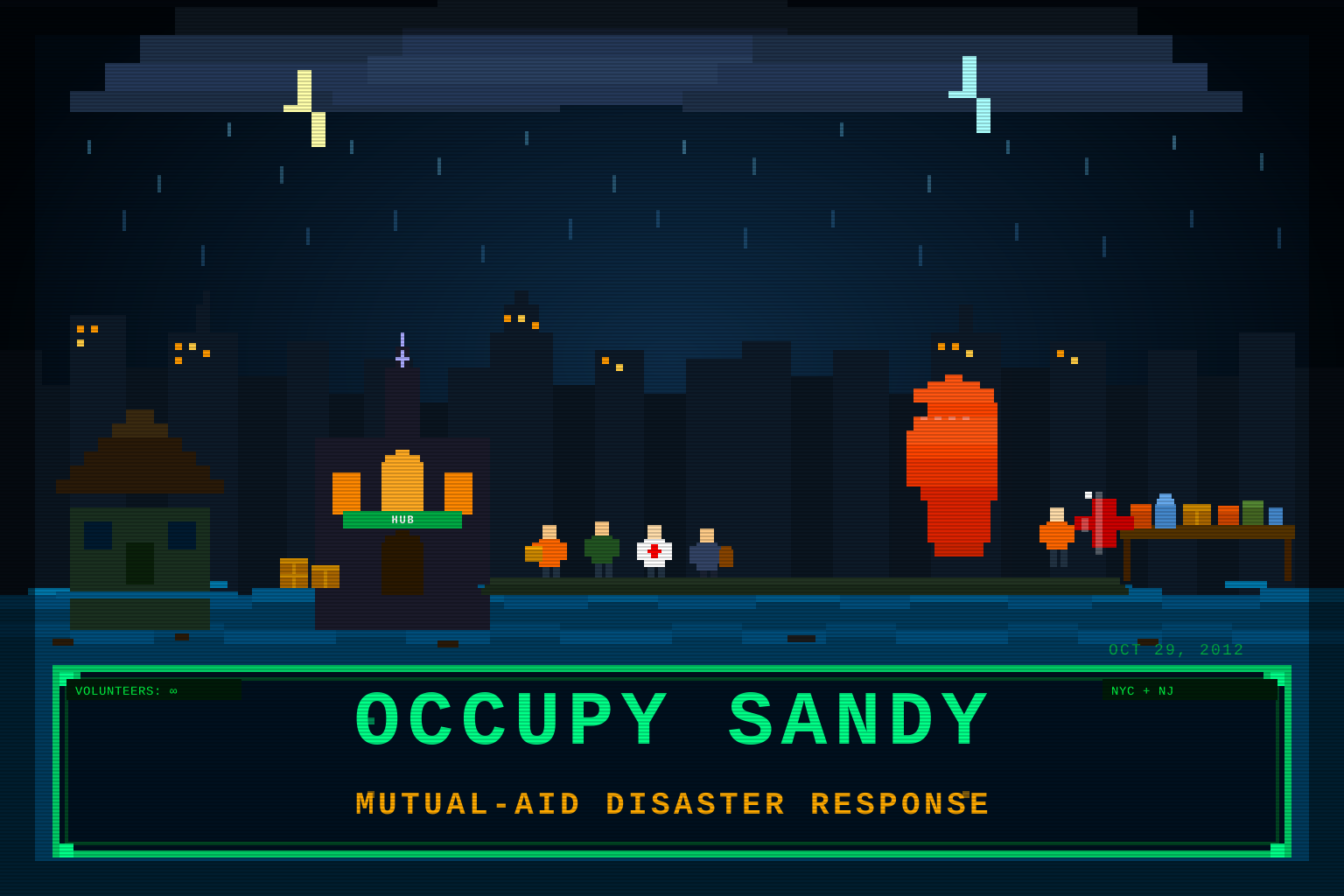
Key figures: Chris Ferlazzo, Nellie Field, Priscilla Grim (Occupy co-founder), Nastaran Mohit (healthcare coordinator), Occupy Wall Street activists, Red Cross volunteers
Summary
In the aftermath of Hurricane Sandy’s October 29, 2012 landfall on the New Jersey and New York coastlines—at the time the second-costliest Atlantic hurricane on record, causing an estimated $65 billion in damage—Occupy Wall Street activists and volunteers self-organized into “Occupy Sandy,” a mutual-aid disaster-relief network operating across New York City and New Jersey. The storm killed at least 125 people in the United States, caused catastrophic flooding in coastal neighborhoods, and left millions without power for days to weeks.
Beginning within hours of the storm’s landfall, volunteers—many with roots in the Occupy Wall Street movement that had swept through lower Manhattan in 2011–2012—established ad-hoc supply distribution points, hot meal stations, and volunteer coordination hubs in neighborhoods hardest hit by flooding, power outages, and infrastructure collapse. Key operational hubs included St. Jacobi Church in Sunset Park, Brooklyn (which served as a central warehouse and staging area), and recovery sites in the Rockaways (Queens), Coney Island, Red Hook (Brooklyn), and Staten Island’s Midland Beach.
Scale and Coordination
By the first week of November 2012, Occupy Sandy had established itself as one of the most significant non-governmental relief presences in the city, operating independently of—and often faster than—official relief organizations. The network’s coordination methods were distinctive:
- Amazon wish lists: The network published publicly shareable Amazon wish lists specifying needed supplies (tarps, flashlights, hand warmers, cleaning products), enabling supporters nationwide to ship goods directly to distribution hubs without requiring cash donations to pass through a nonprofit structure.
- Social media logistics: A volunteer-built website (interoccupy.net/occupysandy) and active Twitter account (@OccupySandy) coordinated supply runs, volunteer deployments, and needs assessments in near-real time.
- Horizontal decision-making: The network operated without a formal hierarchy or executive director; decisions were made by working groups organized around specific functions (food, supply, healthcare, communications), echoing the organizational model of the 2011 Occupy encampments.
- Skill-matching: A volunteer-built online system matched volunteer skills and availability with specific neighborhood needs, enabling the network to deploy carpenters, nurses, social workers, and translators to particular sites.
At its peak in November 2012, estimates placed the number of volunteers mobilized by Occupy Sandy at 50,000–60,000 across the affected region, with hundreds active on any given day.
Operational Focus: Underserved Neighborhoods
A defining feature of Occupy Sandy’s relief model was its explicit prioritization of neighborhoods and populations underserved by official relief channels. While FEMA and the Red Cross operated primarily through official collection points and established shelter networks, Occupy Sandy volunteers did direct door-to-door outreach in public housing developments (where elevators were disabled by flooding and elderly residents were stranded on upper floors without power, heat, or food), informal housing situations, and communities with large immigrant populations who were reluctant to interact with government agencies.
Occupy Sandy volunteers delivered:
- Hot meals to residents unable to leave flooded or unheated buildings
- Generators and fuel to medical equipment-dependent residents
- Cleaning supplies and mold remediation assistance to flooded homes
- Phone charging stations and internet access points
- Medical care through a volunteer healthcare team (including bilingual outreach)
The Red Cross, by contrast, received significant public criticism during the Sandy response for bureaucratic inefficiencies, poor communication, and insufficient presence in the hardest-hit neighborhoods. An October 2014 ProPublica investigation found that the Red Cross had mismanaged portions of its $312 million Sandy relief fund, diverting trucks for “public relations purposes” rather than direct relief delivery.
Comparison with Official Response
The contrast between Occupy Sandy and official disaster-response agencies sparked wide media commentary. Key differences:
| Dimension | Occupy Sandy | FEMA / Red Cross |
|---|---|---|
| Activation speed | Hours after landfall | Days to full deployment |
| Neighborhood reach | Door-to-door in public housing | Fixed relief centers |
| Organizational structure | Horizontal, volunteer-run | Hierarchical, credentialed |
| Funding mechanism | Direct Amazon wish lists + crowdfunding | Institutional donations + government grants |
| Accountability | Peer-driven, social media transparent | Formal nonprofit reporting |
FEMA’s response was also hampered by the sheer geographic scope of Sandy’s damage and by pre-existing bureaucratic constraints on rapid asset deployment; Occupy Sandy’s volunteers faced none of the liability, procurement, or institutional constraints that slowed larger organizations.
Transition to Long-Term Advocacy
As acute relief needs wound down in December 2012 and early 2013, Occupy Sandy volunteers shifted toward longer-term advocacy on issues the disaster had exposed:
- Housing justice: Many residents displaced by flooding faced landlords who refused to make repairs, used the disaster as pretext for eviction, or raised rents on rebuilt units. Occupy Sandy alumni organized tenant advocacy networks and supported affected residents in housing court.
- Climate adaptation: The storm crystallized arguments about climate change and coastal vulnerability. Occupy Sandy volunteers and alumni became involved in campaigns for resilient infrastructure, community land trusts, and climate-adaptation planning—particularly in low-income coastal neighborhoods that had received little investment before the storm.
- Mutual-aid as model: The Occupy Sandy experience was extensively documented and became a reference point for subsequent mutual-aid organizing, including networks activated during later disasters (Hurricane Harvey 2017, Hurricane Maria 2017, and the COVID-19 pandemic in 2020, when “mutual aid” became a widely used term in activist circles).
Significance
Occupy Sandy exemplified a new model of disaster relief rooted in the anti-hierarchical ethos of the Occupy movement. By demonstrating that tens of thousands of volunteers could self-coordinate to deliver relief faster and with more neighborhood granularity than some traditional institutions, Occupy Sandy validated core Occupy claims about the potential of decentralized, community-driven action. The network’s success also revealed specific, structural gaps in official disaster response—particularly in public housing, immigrant communities, and low-income neighborhoods—which would fuel housing-justice and climate-resilience organizing for years to come.
The speed of Occupy Sandy’s activation reflected organizational capacity built during the 2011–2012 Occupy encampments: networks of trust, communication tools, and practical experience running open-source logistics operations were rapidly repurposed from protest infrastructure into disaster-relief infrastructure. The Occupy Wall Street movement had been largely dismantled by city authorities in November 2011, but the human networks it built outlasted the encampments themselves.
Occupy Sandy remains cited in academic and practitioner literature on disaster response as a proof-of-concept for crisis networks that prioritize community agency, direct action, and horizontal coordination—as a complement to, or in some cases a corrective for, the limitations of top-down institutional relief.
Key Facts
- Storm landfall: October 29, 2012, near Brigantine, New Jersey
- US storm fatalities: at least 125
- US economic damage: ~$65 billion
- Occupy Sandy peak volunteers: estimated 50,000–60,000 mobilized
- First Occupy Sandy hubs: established within hours of landfall
- Primary coordination hub: St. Jacobi Church, Sunset Park, Brooklyn
- Neighborhoods served: Rockaways (Queens), Coney Island, Red Hook, Staten Island, Lower Manhattan
See Also
- Hurricane Sandy — 2012 Atlantic Disaster — the storm whose flooding and power outages the mutual-aid network mobilized to answer
- Occupy Wall Street — 2012 Momentum — the movement whose organizers, communication tools, and trust networks were repurposed into disaster relief
- Occupy Wall Street Founders and the Movement’s Ideological Core — the horizontalist, mutual-aid organizing principles (traced to figures like David Graeber) that Occupy Sandy put into practice
- KONY 2012 Campaign — another 2012 case of social media driving rapid, large-scale civic mobilization
- 2012 Arctic Sea Ice Minimum — the record Arctic melt of the same year, central to the climate-and-storms debate the disaster reignited