Key figures: Wu Hongbo (UN Under-Secretary-General), Brahima Sanou (ITU Telecommunications Development Bureau Director), telecommunications regulators worldwide
Summary
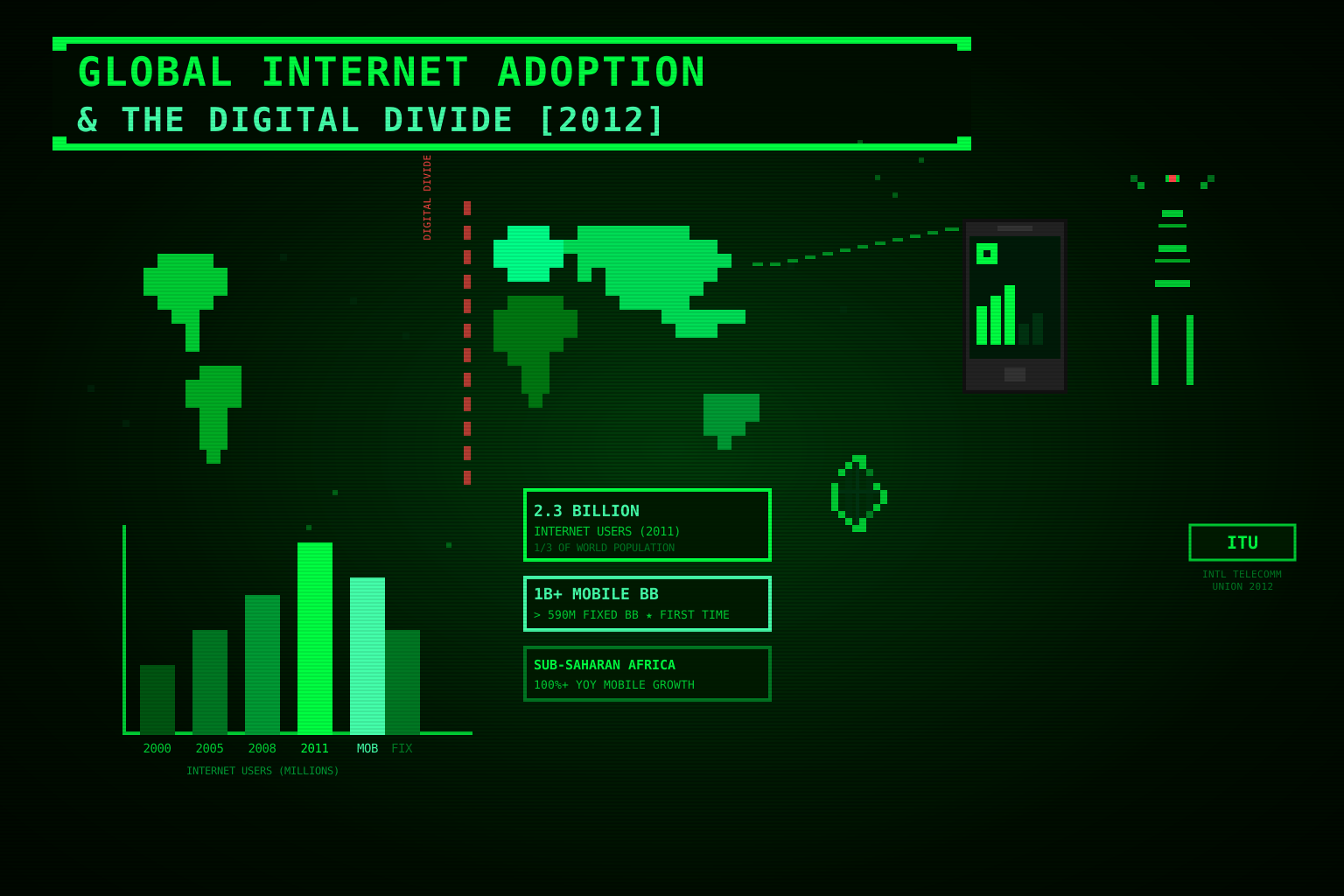
In November 2012, the International Telecommunication Union (ITU) and other United Nations communications agencies released landmark statistics documenting the global state of internet adoption and the persistent digital divide. By the end of 2011, there were approximately 2.3 billion internet users worldwide—roughly one-third of the global population—up from just 400 million in 2000, reflecting a compound annual growth rate of nearly 18% over eleven years.
A critical inflection point occurred in the device and infrastructure landscape: mobile broadband subscriptions (over 1 billion active connections) for the first time exceeded fixed broadband subscriptions (590 million), signaling a global shift toward mobile-first connectivity. This crossover was driven primarily by explosive smartphone adoption in Asia, Africa, and Latin America. In Sub-Saharan Africa, mobile broadband growth exceeded 100% year-on-year in several markets between 2010 and 2012, enabling millions who had never used a fixed telephone line to leap directly to smartphone internet access.
Regional Disparities
Despite record-setting growth, the data exposed profound regional inequalities:
- Developed economies: Penetration rates exceeded 70–80% in the United States, Western Europe, Japan, and South Korea.
- Developing world: Only approximately 25% of the population had internet access by the end of 2011—less than half the developed-world rate.
- Bandwidth concentration: Just three countries hosted approximately 50% of the world’s installed international bandwidth capacity, cementing a structural imbalance in connectivity quality and speed.
- Africa: The continent accounted for less than 7% of global internet users despite representing 15% of world population, though mobile subscriber growth was accelerating rapidly.
The ITU’s 2012 Measuring the Information Society report noted that fixed broadband prices in developing countries averaged more than 30% of monthly income, compared to under 2% in wealthy nations—making affordability, not just infrastructure, a defining barrier.
Demographic Dimensions of the Divide
The UN analysis revealed how digital access intersected with gender, education, and geography:
- Approximately 28% of the offline population was illiterate, underscoring the compounding relationship between digital exclusion and educational access.
- An estimated 52% of the offline population was female, compared to approximately 42% of the online population worldwide—a gender gap that was widest in South Asia and Sub-Saharan Africa.
- Urban-rural divides remained extreme: in many developing countries, rural broadband penetration was below 5% even where urban penetration exceeded 40%.
These figures showed that engineering solutions—laying cables, licensing spectrum—were necessary but insufficient. Content availability in local languages, digital literacy programs, and affordable device financing were identified as equally critical requirements.
Mobile Leapfrogging as a Structural Shift
The mobile-broadband milestone was particularly consequential because it validated the leapfrogging hypothesis: that developing economies could bypass the fixed-line infrastructure phase that had defined connectivity in wealthy countries during the 1990s. The rapid proliferation of low-cost Android smartphones (several models fell below $100 by late 2012) accelerated this transition. Across Africa, mobile money systems like M-Pesa in Kenya demonstrated that mobile connectivity could deliver economic services—banking, payments, commerce—to populations that legacy financial institutions had never reached.
By 2012, mobile broadband networks covered approximately 45% of the world’s population, with 4G LTE networks beginning commercial rollout in markets including the United States, South Korea, and Sweden. LTE subscriber counts remained below 100 million globally, but aggressive spectrum auctions and network investments signaled that mobile broadband would be the dominant form of internet access for the following decade.
Significance
The 2012 digital divide statistics exposed the profound unevenness of globalization and technological progress. While the raw numbers suggested rapid advancement—2.3 billion users was a historic milestone—the underlying data revealed how progress concentrated in wealthy regions and among more privileged demographics.
The UN’s emphasis that “we have a long way to go” in bridging the digital divide became increasingly urgent as the internet’s economic, educational, health, and civic roles expanded. The 2012 snapshot established a baseline against which the next decade’s progress—and remaining failures—would be measured. Subsequent milestones, including internet user counts surpassing 4 billion by 2019 and mobile broadband covering 93% of the global population by 2022, traced a trajectory that began at this inflection point.
See Also
- YouTube and Streaming Video Adoption (2012) — the content landscape that mobile broadband growth was enabling at scale
- Apple iPhone 5 Launch — the LTE flagship whose adoption typified the mobile-broadband shift documented here
- SOPA/PIPA 2012 Internet Activism — internet governance and access debates that ran parallel to adoption milestones
- The 2012 India Blackouts (July 2012) — infrastructure vulnerability affecting hundreds of millions of internet-dependent users
Sources
- Over two billion people now connected to Internet but digital divide remains wide – UN | UN News
- Global digital divide
- The digital divide: Trends in global mobile and broadband Internet access from 2000–2010 - PMC
- Internet access and digital divide: global statistics - DevelopmentAid
- Measuring the Information Society Report 2012 - ITU