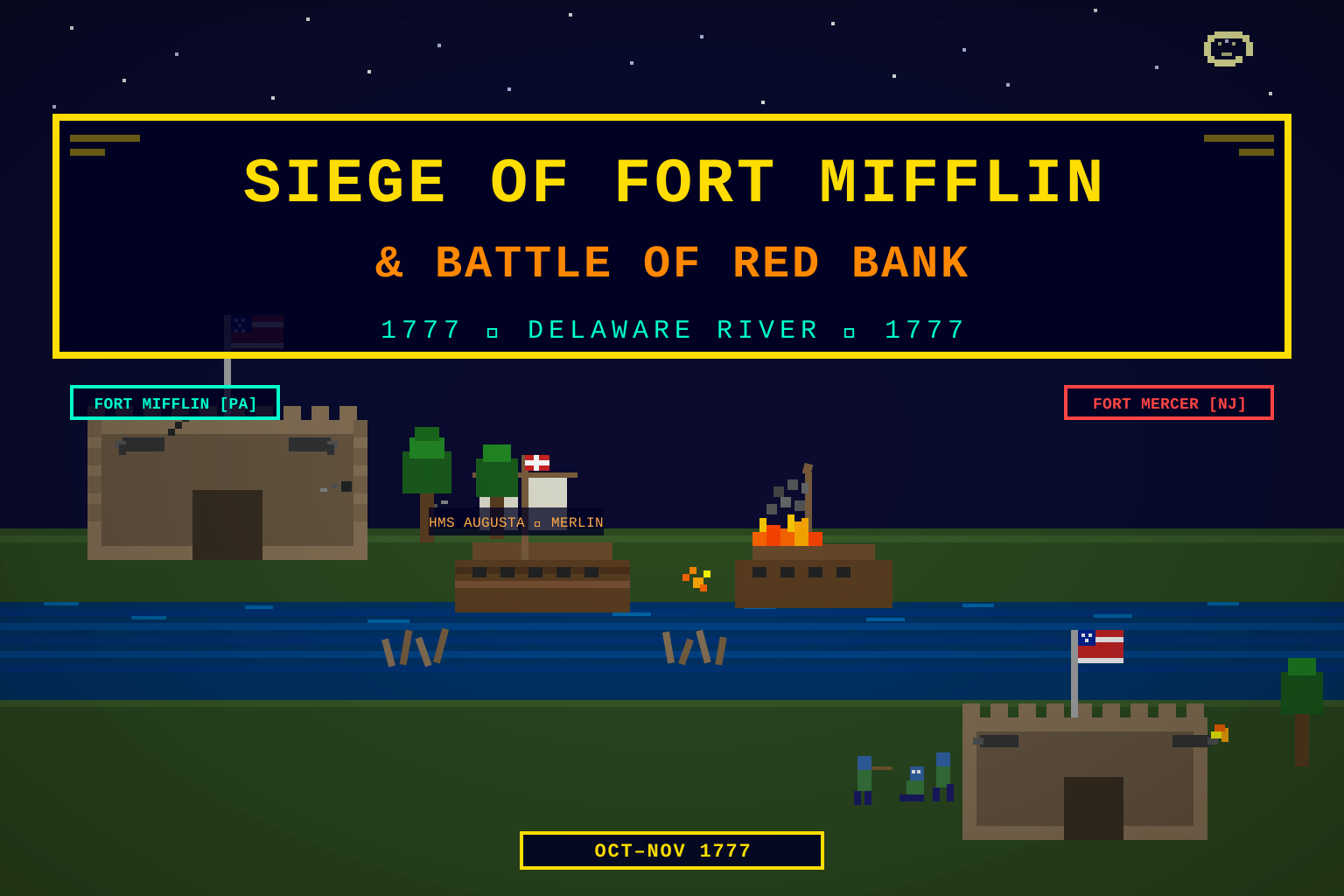
Key figures: Colonel Christopher Greene (American, Fort Mercer), Lieutenant Colonel Samuel Smith (American, Fort Mifflin), Major Simeon Thayer (American, Fort Mifflin), Colonel Carl von Donop (Hessian, killed at Red Bank), Captain John Montresor (British, siege engineer), Vice Admiral Lord Richard Howe (British, Royal Navy), General Sir William Howe (British Commander-in-Chief)
Summary
After occupying Philadelphia in late September 1777, General Sir William Howe’s army could not resupply the city until it controlled the Delaware River, which the Americans blocked with underwater obstructions (chevaux-de-frise) covered by forts at Mud Island (Fort Mifflin, Pennsylvania) and Red Bank (Fort Mercer, New Jersey). On October 22, 1777, a Hessian assault on Fort Mercer was bloodily repulsed in the Battle of Red Bank, and the following day American gunfire destroyed two Royal Navy warships attempting to support the attack. The British then turned massed land batteries and naval gunfire on Fort Mifflin; after a sustained bombardment beginning November 10, the battered garrison evacuated on the night of November 15–16, and Fort Mercer’s defenders abandoned and burned their works several days later as a British relief column approached, finally opening the Delaware to British shipping in late November 1777.
The River Blockade
Philadelphia depended on seaborne supply, and the Continental Congress and Pennsylvania authorities had spent 1776 and 1777 fortifying the approach to the city along the Delaware River. The primary obstacle was a double row of chevaux-de-frise — iron-tipped timber frames, each roughly twenty feet across and loaded with a thousand pounds of stone as ballast, anchored to the riverbed in rows across the main ship channel — sunk near Mud Island and at Billingsport to the south. To prevent warships from simply going around them, Fort Mifflin on Mud Island and Fort Mercer at Red Bank on the New Jersey shore covered the obstructions with artillery fire, supported by a flotilla of Continental and Pennsylvania State Navy row galleys, fire rafts, and floating gun batteries.
Howe’s army had entered Philadelphia on September 26, 1777, following the American defeat at the Battle of Brandywine on September 11 — in which the young volunteer officer Marquis de Lafayette was wounded in the leg while helping rally the retreating Continental infantry — and Howe’s subsequent flanking maneuver. A subsequent British attempt to destroy Washington’s army at the Battle of Germantown on October 4 was repulsed; the army’s strategic position remained solid but logistically constrained. This constraint illustrated the central weakness of Howe’s 1777 Philadelphia strategy: occupying the American capital did not in itself end the war, and the more territory Howe held, the more his supply lines stretched and his operational options narrowed. As long as the Americans held the river forts, Howe’s army — despite occupying the city itself — could not be resupplied or reinforced by sea, forcing reliance on a precarious overland wagon route from the Chesapeake. British engineers had cleared and opened the southernmost obstruction at Billingsport by mid-October, but the passage was still blocked by the Mud Island–Red Bank choke point, which gave the Royal Navy’s deep-draft ships no clear channel to the city’s wharves.
The American Naval Flotilla
Covering the submerged chevaux-de-frise was a mixed flotilla of Continental Navy and Pennsylvania State Navy vessels under Commodore John Hazelwood. The core of the flotilla consisted of at least thirteen row galleys — broad, shallow-draft craft propelled by both oars and lateen sails, each mounting one or two heavy bow guns — supplemented by a number of gondolas (flat-bottomed gunboats), armed brigs, fire rafts loaded with combustibles, and floating gun batteries. The flotilla’s strength was not in individual firepower but in its exploitation of geography: within the chevaux-de-frise’s narrow cleared channel, larger Royal Navy vessels could not maneuver freely, while Hazelwood’s shallow-draft craft could attack from multiple angles at close range.
The flotilla’s most effective moment came on October 23, 1777, the day after the Battle of Red Bank. Two Royal Navy warships — the 64-gun third-rate ship of the line HMS Augusta and the 18-gun sloop HMS Merlin — had advanced to support the failed Hessian assault and were caught by the combined fire of the shore batteries and the flotilla after grounding in the channel. The Augusta burned for approximately three hours, drawing the fire of shore batteries and American gunboats, before the flames reached her powder magazine; the resulting explosion was reported felt in Philadelphia, roughly twenty-five miles distant, and heard as far as thirty miles. An estimated 70 of her crew of approximately 490 were killed or wounded before the survivors escaped in boats. The Merlin’s crew, unable to re-float their vessel, set her afire and abandoned her to prevent capture. The destruction of two Royal Navy vessels in a single afternoon — including one of the larger ships to be lost during the entire American war — was reported extensively in the colonial press and became one of the most-cited demonstrations that the American cause could inflict serious material losses on Britain’s professional forces.
The Battle of Red Bank
On October 22, 1777, Colonel Carl von Donop led roughly 1,200 to 2,000 Hessian troops in an assault on Fort Mercer, garrisoned by about 400 to 600 Rhode Island Continentals under Colonel Christopher Greene. Von Donop first demanded surrender, warning that “no quarter” would be given if the Americans resisted; Greene reportedly answered that his men would “ask no quarter, nor will we give any.” The Hessians, lacking axes or tools to clear the fort’s abatis, advanced into heavy American musket and artillery fire, while American gunboats on the river raked their flank. The assault collapsed with severe Hessian losses — historians place the casualties at roughly 80 killed, more than 200 wounded, and dozens captured, against light American losses of well under 50 — and Von Donop himself was mortally wounded, dying three days later. The following day, October 23, American shore batteries and gunboats engaged a Royal Navy squadron attempting to force the river obstructions in support of the ground assault; the 64-gun ship of the line HMS Augusta ran aground and caught fire, exploding when the flames reached her powder magazine in a blast reportedly heard thirty miles away and felt in Philadelphia, while the sloop HMS Merlin was likewise grounded and destroyed by her own crew to prevent capture.
The Bombardment of Fort Mifflin
With the direct assault repulsed, the British shifted to a methodical reduction of Fort Mifflin by siege artillery and naval gunfire. British engineers under Captain John Montresor constructed land batteries on nearby Province Island, while warships under Vice Admiral Lord Richard Howe added their guns to the effort. Beginning on November 10, 1777, the British opened a sustained bombardment that intensified through the week.
The climax came on November 15, when the British mounted what many participants described as the heaviest bombardment of the entire Philadelphia campaign. The key weapon was HMS Vigilant, a 16-gun armed vessel light enough to be warped through a secondary channel behind Province Island, from where she could deliver enfilading fire directly into the fort from a range of about 100 yards — bypassing most of the fort’s remaining functional guns, which faced the main river channel. Together with the Province Island land batteries’ 32-, 24-, and 18-pounders, mortars, and howitzers, the combined fire that day reportedly struck the fort’s interior at a rate of 1,000 rounds or more over the course of hours — some accounts record as many as 250 rounds per hour at the peak — demolishing the blockhouses, barracks, and palisades and leaving almost no structure standing. Defenders later recalled that the interior of the fort became an open killing ground, with no shelter from plunging mortar fire and direct hits from Vigilant’s carronades arriving from nearly point-blank range; men huddled in the earthworks themselves rather than inside any structure. By the end of the day the entire parapet facing Province Island had been breached, nearly all of the fort’s artillery was dismounted or disabled, and the remaining garrison of perhaps 150 effective men held little more than rubble. Lieutenant Colonel Samuel Smith, the garrison commander, had already been knocked unconscious by falling debris during the earlier bombardment and was succeeded in command by Major Simeon Thayer, who organized the remaining defenders in the fort’s rubble and directed the evacuation.
By the night of November 15, nearly all of the fort’s guns had been dismounted and its works reduced to rubble; American losses over the course of the siege have been estimated at roughly 250 killed and wounded out of a garrison that never exceeded about 500 men. Thayer ordered the fort abandoned that night, and the remaining defenders — some 300 survivors — withdrew across the river to Fort Mercer and the New Jersey shore under cover of darkness.
The Fall of Fort Mercer and the Opening of the River
With Fort Mifflin lost, Fort Mercer’s position on the New Jersey shore became untenable. As a British column of roughly 2,000 troops under Lord Cornwallis advanced overland to reduce the fort, its garrison burned the works and evacuated on the night of November 20–21, 1777, rather than risk another siege. With both forts eliminated and the river obstructions no longer covered by artillery, the Delaware was finally opened to British shipping in the final days of November, six weeks after Howe had first entered Philadelphia.
Significance
The defense of the Delaware forts, though ultimately unsuccessful, was one of the most costly and prolonged episodes of the 1777 Philadelphia campaign, and the bombardment of Fort Mifflin is often described as among the heaviest sustained artillery bombardments any American position endured during the Revolutionary War. The six-week delay it imposed on British resupply compounded the strategic costs of the Philadelphia campaign, tying down British forces and shipping at the same moment that General John Burgoyne was surrendering his army at Saratoga — reinforcing, alongside the British occupation of Philadelphia itself, the broader pattern in which Howe’s tactical successes failed to translate into a decisive strategic advantage. The destruction of HMS Augusta and the stubborn defense of Fort Mifflin were widely publicized in America as evidence that determined resistance could inflict serious losses even on Britain’s professional forces, contributing to the same wave of confidence that Saratoga’s news carried to Paris in December 1777 and helped consolidate Franco-American diplomatic alignment.
The fall of the forts also cleared the way for the British winter in Philadelphia that Washington’s army would endure in its shadow at Valley Forge, beginning December 19 — with a well-supplied British garrison twenty miles away in the city the river forts had so expensively failed to hold.