Key figures: Joseph Priestley; Antoine Lavoisier; Carl Wilhelm Scheele; Henry Cavendish; phlogiston theory
Summary
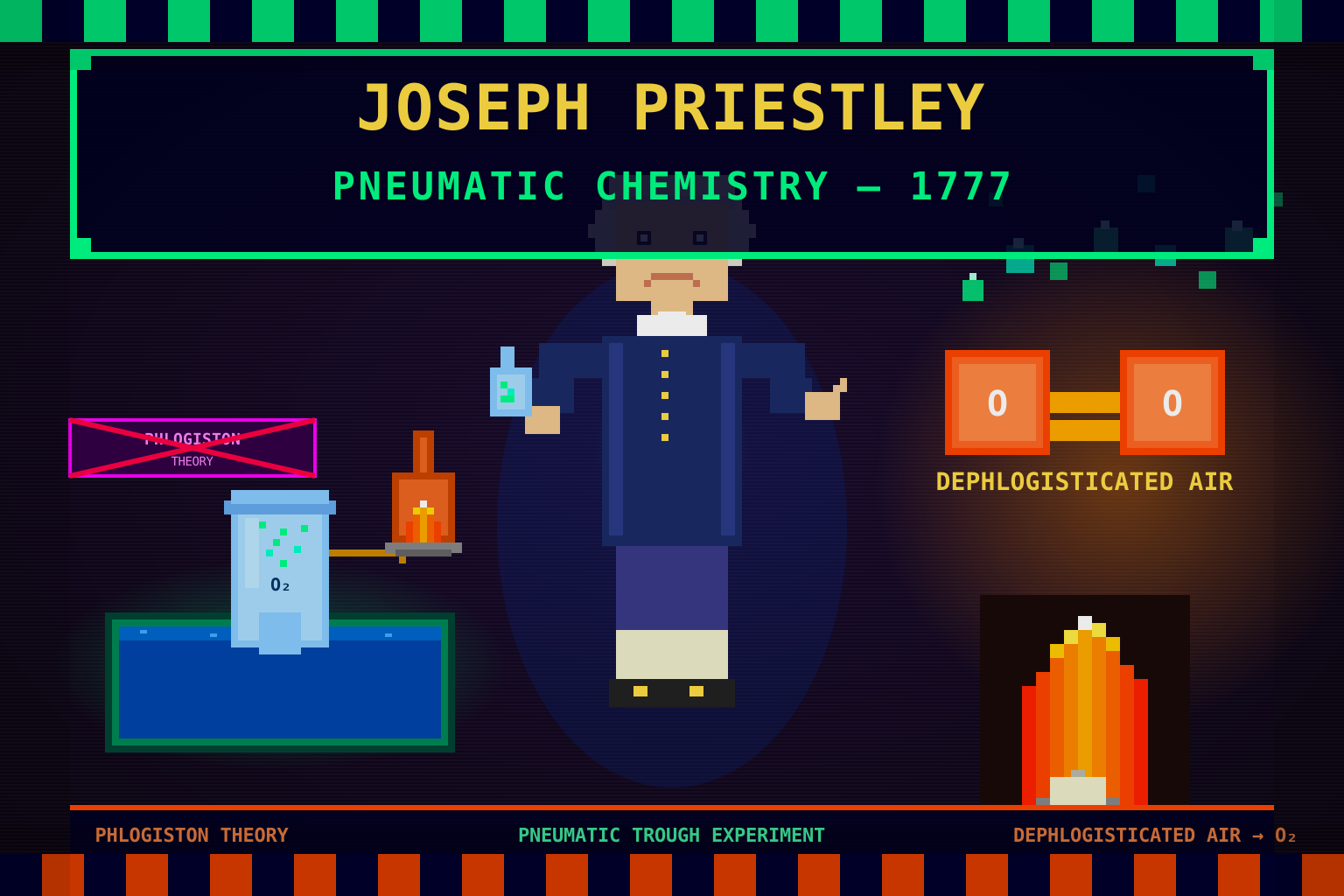
Joseph Priestley (1733–1804), an English minister, natural philosopher, and political theorist, had achieved scientific prominence in 1774 with his isolation of “dephlogisticated air” — the gas later named oxygen by Antoine Lavoisier. Throughout 1777, Priestley continued his program of pneumatic chemistry, meticulously designing and conducting experiments using his “pneumatic trough” apparatus — a breakthrough technique for collecting and studying gases. His work in 1777 contributed crucial evidence that the prevailing phlogiston theory — the dominant chemical framework of the era — was incomplete or fundamentally flawed. Though Priestley himself clung to phlogiston theory even as his own experiments undermined it, his methodical documentation of gas properties and the behavior of “dephlogisticated air” provided the empirical foundation upon which Lavoisier and other chemists would build the modern theory of combustion and oxidation. Priestley thus stands as a paradoxical figure in the Chemical Revolution: his experiments were revolutionary, but his theoretical interpretations remained grounded in the older paradigm he was helping to overturn.
Priestley’s Path to Pneumatic Chemistry
Priestley’s scientific career had been marked by intellectual curiosity and institutional independence. Ordained as a Dissenting minister (a Protestant sect outside the Church of England establishment), he held ministerial posts in Leeds and other towns, where he had access to laboratories and opportunity for experimental work. By the 1770s, he had turned to the study of gases — a field still largely unexplored and poorly understood.
The dominant chemical theory of Priestley’s time was phlogiston, a hypothetical substance believed to be released during combustion and oxidation. The theory explained some phenomena but failed to account for others, particularly the weight changes observed in combustion. Priestley’s mentor, the scientist Henry Cavendish (who worked privately in his London home and did not publish many results), had conducted rigorous experiments on gases, and Priestley built upon this foundation.
In August 1774, Priestley had achieved his breakthrough: using a 12-inch focus lens to heat mercuric oxide (red mercury oxide), he collected the gas released and discovered that a candle burned more brightly in this gas than in ordinary air — it was “dephlogisticated air,” supposedly air that had been stripped of phlogiston and thus could absorb more from burning materials. The discovery was sensational, and Priestley’s careful documentation of the gas’s properties was published in the Philosophical Transactions of the Royal Society.
1777: The Third Volume of Experiments and Observations
Throughout 1777, Priestley continued his pneumatic research and brought his findings to publication in a landmark work. His Experiments and Observations on Different Kinds of Air appeared in multiple volumes over the 1770s: Volume I in 1774, Volume II in 1775–1776, and Volume III in 1777 — each documenting new gas discoveries, refined experimental techniques, and accumulating anomalies for the phlogiston theory. Volume III is particularly significant because it synthesized his post-oxygen-discovery research and presented systematic comparisons of gas behaviors that Lavoisier and other Continental chemists read closely. The three-volume set circulated widely across Europe and was translated into French and German, ensuring that Priestley’s experimental data became the common currency of the Chemical Revolution even as its theoretical framing was contested.
By 1777, Priestley was living in Calne, Wiltshire, as librarian and intellectual companion to William Petty, 2nd Earl of Shelburne, a prominent Whig politician and reformer. The position gave Priestley access to an excellent laboratory, a library, and the financial security to pursue research full-time — an unusual privilege for a Dissenting minister outside the established church. From his Calne laboratory, he refined his pneumatic trough and conducted the systematic combustion experiments that filled Volume III.
One of his key 1777 contributions was the systematic study of how different substances burned in “dephlogisticated air.” He observed that metals burned more vigorously, that the residual air after combustion had different properties than the original, and that the phenomenon was repeatable and measurable. These observations directly challenged phlogiston theory: if phlogiston were simply being released from burning materials, why should the properties of the air change? Why should the weight of metal increase (not decrease) after combustion? Priestley did not fully grasp the implications, but his data pointed toward a new theory.
The Lunar Society Connection
Priestley’s scientific work did not occur in isolation. He was a member of the celebrated Lunar Society of Birmingham — an informal gathering of industrialists, scientists, and philosophers who met monthly near the full moon (to have light for the journey home) and included James Watt, Matthew Boulton, Erasmus Darwin, Josiah Wedgwood, and William Withering. The society, which met from the 1760s through the 1790s, functioned as an intellectual accelerator: members shared experimental results, discussed new theories, and applied scientific reasoning to engineering and manufacturing problems. Though Priestley was stationed in Calne through 1777 (he would move to Birmingham in 1780), he maintained active correspondence with the Birmingham circle and attended meetings when possible.
The Lunar Society connection was significant for Priestley’s chemistry in two ways. First, members like Watt and Boulton provided engineering perspectives on gas behavior that informed his apparatus design — Watt, in particular, was thinking deeply about steam and gas pressures in the context of his steam engine work. Second, the society’s culture of shared, open inquiry meant that Priestley’s results circulated rapidly to other practitioners who could replicate, challenge, and build upon them. This collaborative network prefigured the modern scientific community and accelerated the pace of the Chemical Revolution throughout the 1770s and 1780s.
The Paradox: Revolutionary Experiments, Conservative Theory
Priestley’s intellectual position in 1777 was paradoxical. He was a Fellow of the Royal Society and a respected experimental chemist whose techniques and observations were setting the standards for the emerging field of pneumatic chemistry. Yet he remained committed to the phlogiston framework and insisted that “dephlogisticated air” was simply air with phlogiston removed, not a fundamental element or new substance in itself. He even resisted Lavoisier’s later interpretation of the same gas as oxygen — a novel element central to a new theory of combustion.
This conservatism reflected both Priestley’s intellectual commitments and the slow, contested process of scientific paradigm shift. The old theory had deep institutional roots, and abandoning it required not just new experiments but a wholesale reconstruction of chemical thought. Priestley’s experiments were extraordinarily valuable, but he was not the one to synthesize them into a new framework — that work fell to Lavoisier and others who were willing to discard phlogiston entirely.
1777 in the Broader Chemical Revolution Context
Priestley’s 1777 work was occurring in parallel with Lavoisier’s oxygen theory research in France and Carl Wilhelm Scheele’s isolated oxygen preparation in Sweden. All three chemists — Priestley, Scheele, and Lavoisier — were approaching the same phenomenon from different directions and with different interpretive frameworks. Priestley’s priority in discovering the gas (1774) was indisputable, yet his reluctance to accept a radical reinterpretation meant that credit for the “oxygen theory” went to Lavoisier, who by 1777 was explicitly rejecting phlogiston and building a quantitative chemistry based on a new understanding of combustion.
Priestley’s 1777 contributions included not just the experiments themselves but also the dissemination of pneumatic techniques throughout the experimental community. His publications and correspondence ensured that his methods and preliminary findings circulated among European natural philosophers, creating the foundation for the Chemical Revolution even as Priestley himself remained a skeptic of the revolution’s theoretical conclusions.
Significance for 1777
In 1777, Joseph Priestley represented the transitional state of chemistry itself: rigorous empirical method pointing toward revolutionary conclusions, yet theoretical conservatism holding back the full synthesis. His pneumatic chemistry was unambiguously advanced and influential. His 1777 work refined techniques, accumulated evidence, and trained the next generation of experimenters. Yet his theoretical interpretation — clinging to phlogiston despite mounting contrary evidence — illustrates the power of paradigms and the difficulty of scientific revolution even for those who, like Priestley, were doing the empirical work that made the revolution inevitable.
Priestley’s later life (after 1777) saw him emigrate to America after the 1791 riots in Birmingham, where he had become too associated with political radicalism. He continued his chemical work in Pennsylvania but remained intellectually isolated from the new chemistry that had superseded his phlogiston framework. Yet his 1777 investigations — documenting the properties of “dephlogisticated air,” refining pneumatic techniques, and demonstrating the experimental precision achievable in gas chemistry — stand as a landmark in the transition to modern chemistry, even if Priestley himself did not fully accept the theoretical revolution his experiments had set in motion.
Sources
- Wikipedia contributors. “Joseph Priestley.” Wikipedia, The Free Encyclopedia. Accessed 2026.
- Britannica Online. “Joseph Priestley.” https://www.britannica.com/biography/Joseph-Priestley
- Royal Society of Chemistry. “Joseph Priestley (1733–1804).” https://www.rsc.org/
- McEvoy, John G. “Joseph Priestley, ‘Aerial Philosophy,’ and the Chemical Revolution.” Ambix, vol. 40, no. 1, 1993.
- Brock, William H. The Norton History of Chemistry. W.W. Norton & Company, 1992.
- Schofield, Robert E. The Lunar Society of Birmingham: A Social History of Provincial Science and Industry in Eighteenth-Century England. Oxford University Press, 1963. — Reconstructs Priestley’s role in the Birmingham circle and his correspondence with Watt and Boulton.
- Priestley, Joseph. Experiments and Observations on Different Kinds of Air, Vol. III. London, 1777. — Primary source; documents combustion experiments and gas characterizations published that year.
Related
- Lavoisier’s Oxygen Theory — The chemical revolution that built on (and reinterpreted) findings like Priestley’s
- Scheele’s Chemical Treatise on Air and Fire — Parallel discovery of “fire air” (oxygen) and its characterization
- Coulomb’s Torsion Balance and Electrostatics — Contemporary instrument innovation in the quantitative sciences
- Royal Society Lightning Conductor Controversy — Concurrent debates in the Royal Society about empirical methodology and scientific disputes