Key figures: John Paul Jones, Benjamin Franklin, Comte d’Estaing, George Washington, King Louis XVI
Summary
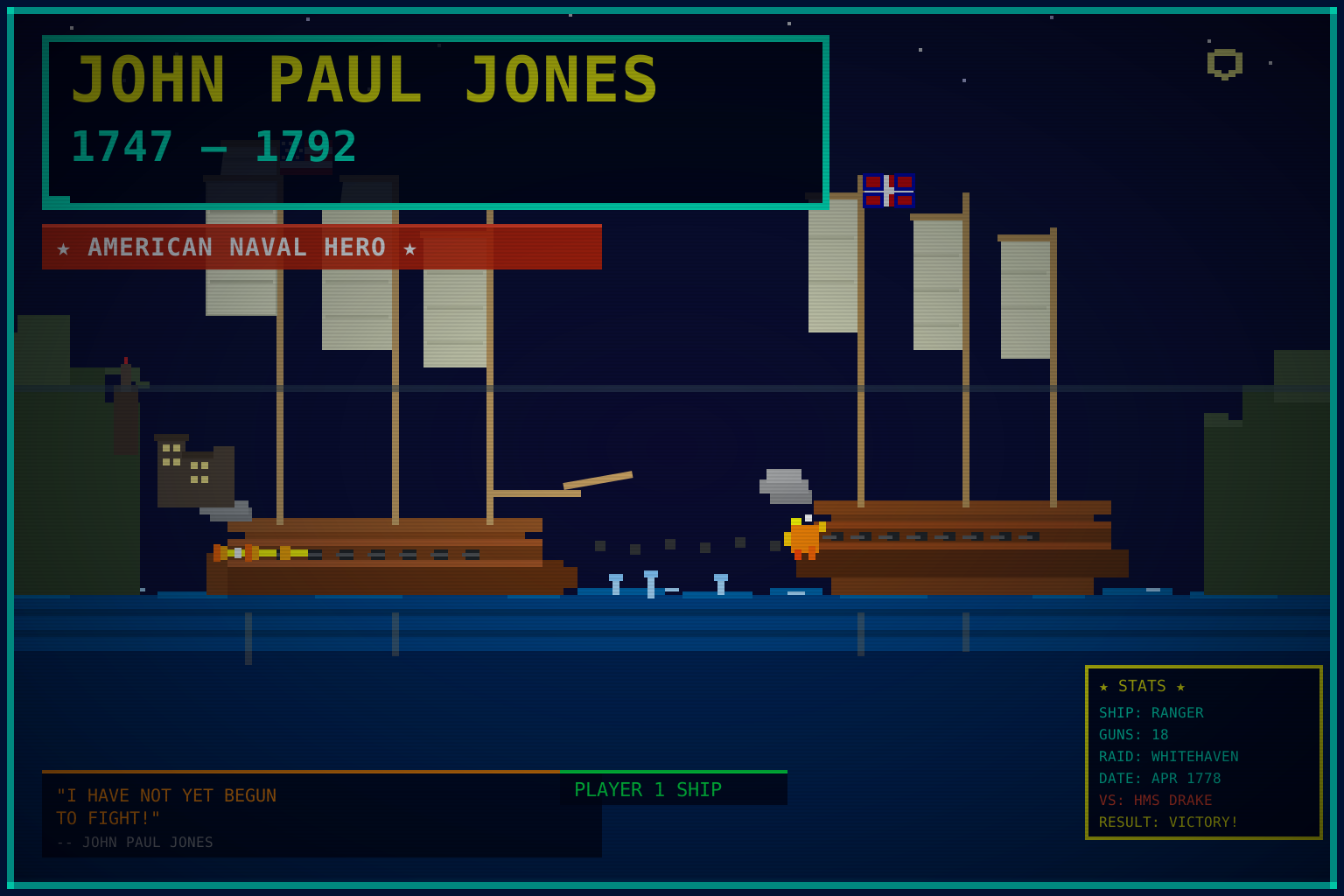
John Paul Jones (July 6, 1747 – July 18, 1792) was an American naval officer and privateering commander whose 1778 operations in the Irish Sea and off the British coast demonstrated American naval reach and vindicated French diplomatic investment in the Franco-American Alliance. Born in Scotland as John Paul and adopting the surname “Jones” in the early 1770s, Jones served in the Continental Navy from 1775 and commanded the merchant ship Ranger (18 guns) in 1778 under Franklin’s sponsorship at the port of Nantes. In the spring of 1778, Jones conducted a series of audacious raids on British soil — the Whitehaven raid (April 23), St. Mary’s Isle (April 23–24), and most significantly, the HMS Drake engagement (April 24) — that produced the first American naval victory in European waters and transformed the American naval presence from theoretical to actual in French eyes.
These operations occurred amid the Franco-American Alliance ratification (February 6, 1778) and served as direct naval expression of that alliance’s commitments. While Comte d’Estaing’s larger French fleet operated off the American coast, Jones’s Ranger carried the American flag to European waters and demonstrated that American naval force could project power across the Atlantic. His operations galvanized French confidence in American military credibility and disrupted British coastal commerce and public confidence in naval security.
Early Life and the Name Change
John Paul Jones was born John Paul on July 6, 1747, in Kirkbean, Kirkcudbrightshire, Scotland, the son of a gardener on the estate of local gentry. At age 13 he was apprenticed to a merchant ship owner in Whitehaven — the same English port he would later raid in 1778 — learning seamanship and Atlantic trade routes across Virginia and the Caribbean. He rose rapidly through the merchant marine, serving as first mate and then captain on vessels carrying tobacco from Virginia and slaves from West Africa before he abandoned the slave trade on moral grounds by 1768.
In 1773, while captain of the merchant vessel Betsy in the Caribbean, Jones killed a mutinous crew member during an altercation in Tobago. Fearing trial under British admiralty law, he fled to America, assumed the surname “Jones” to obscure his identity, and settled in Virginia. The exact timing and reasons for the surname adoption remain partly obscure, but Jones himself later confirmed that “John Paul Jones” was the name he used from 1773 onward. By the outbreak of the Revolutionary War in 1775, he was established in Virginia’s merchant community and quickly obtained a Continental Navy commission through his Virginia connections.
The 1778 Ranger Commission and Sponsorship
Jones had been given command of the Continental sloop-of-war USS Ranger (18 guns) on June 14, 1777 — reputedly the same day Congress adopted the Stars and Stripes — and had sailed her from Portsmouth, New Hampshire, reaching France by early December 1777. In early 1778, Benjamin Franklin, serving as the principal American commissioner at Passy, coordinated Jones’s cruise into home British waters. On April 10, 1778 the Ranger departed Brest with a crew of approximately 140 men drawn from American sailors, French volunteers, and Irish immigrants. Franklin’s endorsement was critical: French port authorities and naval officials allowed an American warship to refit and operate from a French port, technically a violation of official French neutrality but operationally essential to the alliance’s naval strategy.
The Ranger’s specifications: The ship was a sloop-of-war built in New Hampshire in 1777, measuring approximately 97 feet in length with a 28-foot beam, displacing around 308 tons. She carried 18 nine-pound guns arranged along a single gun deck, supplemented by swivel guns mounted on the rails. Her speed under sail was superior to most British sloops, a key advantage that allowed Jones to choose engagement or escape. The crew complement of 140 included experienced American seamen but also a significant proportion of French-speaking volunteers recruited with French government acquiescence at Nantes.
Jones’s mission was explicit: demonstrate American naval force in European waters, inflict material damage on British shipping and coastal installations, and inspire American privateering by showing that American naval operations could succeed against British naval power. The mission was also strategic: by conducting operations close to the British Isles, Jones would draw British naval resources away from the American theater, reducing British naval capacity in American waters where Comte d’Estaing’s fleet was simultaneously operating. The timing was deliberate: Jones sailed in April 1778, just two months after the Franco-American Alliance was formally signed on February 6, 1778, allowing him to operate from French ports with French logistical support.
The 1778 Raids: Whitehaven, St. Mary’s Isle, and HMS Drake
April 23, 1778 — Whitehaven Raid
Jones selected the coal port of Whitehaven (Cumbria), England, for the first armed American raid on British soil. A party of 30 armed crew landed on the harbor’s eastern pier at dawn, spiked the cannons at the fort guarding the harbor, and set fires in the ships anchored there. British coastal militia responded; the fires were contained before major damage could accumulate, but the symbolic impact was enormous. The first American military action on British soil had occurred. News of the raid traveled rapidly through Britain and shocked the coastal population; it demonstrated that no British port was beyond American reach.
April 23–24, 1778 — St. Mary’s Isle
Immediately after the Whitehaven raid, Jones sailed the Ranger to St. Mary’s Isle in the Firth of Solway (Scotland), the estate of the Earl of Selkirk. Jones had intended to capture the Earl as a hostage for prisoner exchanges (British-held American sailors vastly outnumbered American-held British prisoners), but found Selkirk absent. His crew ransacked the house and removed the Selkirk silver plate. Jones later personally returned the plate with a formal note of apology — a gesture that became legendary in British naval circles and demonstrated Jones’s military honor despite the raid’s brutality.
April 24, 1778 — HMS Drake Engagement (First American Naval Victory in European Waters)
On April 24, off Carrickfergus, Ireland, the Ranger encountered the British sloop-of-war HMS Drake (18 guns, similar class to the Ranger). The Drake’s captain, George Burdon, was killed almost immediately in the opening broadside, leaving the ship under a junior lieutenant. After approximately one hour and four minutes of intense fighting — Jones later recorded the engagement time precisely in his log — with both ships exchanging cannon and musket fire at close range, the Drake struck her colors and surrendered. The Drake’s casualty figures (1 killed, 9 wounded, including Burdon) were higher than the Ranger’s (2 killed, 6 wounded), and her surrender marked the first American naval victory by a commissioned U.S. Navy captain in European waters.
Jones sailed the captured Drake in company with the Ranger back to Brest, arriving on May 8, 1778. The prize ship attracted enormous attention in French ports. Franklin arranged for Jones to be received at the French court; King Louis XVI is reported to have sent Jones a personal sword of honor. Jones brought 200 British prisoners to France, whose presence in French custody constituted a diplomatic coup — American prisoners held in British prisons could now be exchanged for British prisoners held by Americans through French intermediary negotiations.
The Drake was brought back to Brest as a prize of war. The victory reverberated through French and British naval circles. For the French, the Ranger’s success vindicated the alliance: American naval force was real and capable of defeating British warships. For the British, the loss of the Drake and the vulnerability of home waters to American raids prompted a naval policy reversal — the Admiralty increased home-defense frigate patrols and recalled naval resources from the American theater to protect British commerce and coastal installations. The Admiralty also assigned faster frigates to patrol the Irish Sea specifically, acknowledging that the Whitehaven raid had exposed the vulnerability of British coastal commerce.
Strategic Significance
Jones’s 1778 Ranger operations served three critical functions:
Franco-American Alliance Validation: News of the Drake capture reached the French court weeks before Comte d’Estaing’s own inconclusive actions in American waters (the Battle of Ushant on July 27, 1778). The Ranger victory demonstrated that American naval capability was not illusory and that the French investment in the alliance would yield tangible results.
British Strategic Recalculation: The raids prompted the British Admiralty to redeploy naval assets toward home defense, reducing the British naval presence available for operations in American waters. This shift indirectly aided the Continental Army by reducing British capacity to support operations against the Americans or to relieve besieged garrisons.
Privateering Model: The Ranger’s success inspired a wave of American privateering. The operations proved that American ships could operate in European waters and return with prizes. Over the course of the war, American privateers captured over 600 British merchant vessels and distributed prize money through American crews and merchants, generating economic value and naval recruitment.
Broader Context and 1779 Continuation
Jones remained in European waters through 1778–1779, conducting further operations. In 1779, he took command of a larger frigate, the Bonhomme Richard (an old East Indiaman refitted with guns), and fought the celebrated engagement with the British frigate HMS Serapis on September 23, 1779 — the engagement where he reportedly declared “I have not yet begun to fight” as his ship caught fire. Though the Bonhomme Richard was lost, Jones captured the Serapis, cementing his reputation as the Revolutionary War’s most celebrated naval officer.
Jones’s success was inseparable from Benjamin Franklin’s diplomatic backing. Without Franklin’s authority at Passy, the Ranger would never have been refitted in French ports, and without French logistical support (provisions, repairs, crew recruitment), the 1778 raids would have been impossible. The Ranger operations exemplified the Franco-American Alliance’s naval dimension: French ports and French recognition enabled American naval force to project power in European theaters, while American naval success vindicated French political commitment to the alliance.
Legacy
John Paul Jones died in Paris in July 1792 during the early French Revolution, having spent his final years seeking pension and rank recognition from both the Continental Congress (which had promoted him to rear admiral in 1781) and from the French government. His body was lost for over a century; it was recovered in 1905 and reinterred in the Naval Academy Chapel at Annapolis, Maryland, where he remains honored as the founder of the American Navy and the war’s most legendary naval commander.
See Also
- Franco-American Alliance — the February 1778 alliance that enabled Jones’s Ranger operations from French ports
- Benjamin Franklin — the diplomat who sponsored Jones’s Nantes commission and the Ranger refit
- Battle of Ushant — the concurrent (July 1778) Anglo-French fleet action in European waters
- Comte d’Estaing — the admiral whose American naval operations (Rhode Island, St. Lucia) were roughly contemporary with Jones’s European operations
- Diplomatic Intelligence & Espionage Networks of 1778 — the Passy mission that coordinated both diplomacy and privateering/naval operations
- American Revolutionary War Financing in 1778 — prize ships and captured goods provided economic value alongside military impact
- George Washington — commander-in-chief who worked with naval force as part of overall war strategy
- Treaty of Alliance with the Delaware Nation — the September 1778 Indian treaty that, alongside Jones’s naval operations, secured the American western flank during the same year
Sources
- Wikipedia: John Paul Jones
- Britannica: John Paul Jones
- Evan Thomas, John Paul Jones: Sailor, Hero, Father of the American Navy (Simon & Schuster, 2003)
- Naval History and Heritage Command: USS Ranger
- Naval History and Heritage Command: John Paul Jones and the Ranger