Key figures: White Eyes (Koquethagechton), Captain Pipe (Hopocan), John Kill Buck (Gelelemend), Andrew Lewis, Thomas Lewis, George Morgan, George Rogers Clark
Summary
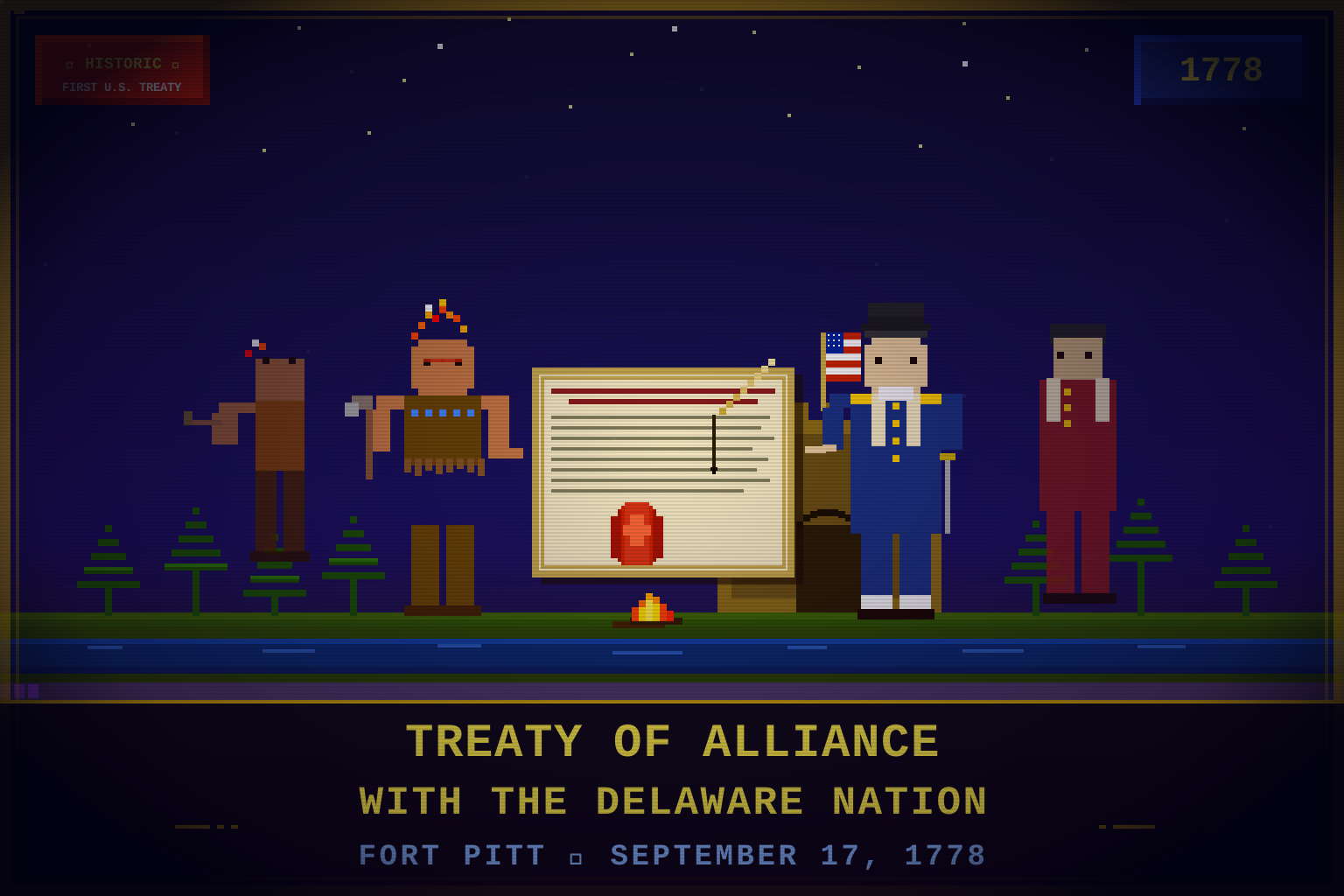
The Treaty of Alliance with the Delaware Nation (also known as the Treaty of Fort Pitt), signed on September 17, 1778 at Fort Pitt (Pittsburgh), was a historic diplomatic instrument marking the first formal treaty negotiated between the United States government and a Native American nation. Negotiated for the United States by commissioners Andrew Lewis and Thomas Lewis, the treaty was signed by Delaware leaders White Eyes (Koquethagechton), Captain Pipe (Hopocan), and John Kill Buck (Gelelemend).
The treaty represented a remarkable departure from European colonial precedent: unlike the land-cession treaties that characterized 18th-century Indian diplomacy, the 1778 Delaware treaty explicitly affirmed Delaware territorial sovereignty and made no demands for land cessions. Instead, it established a defensive military alliance, granted Americans passage rights through Delaware territory for military operations, and promised equitable trade relations. The treaty secured the American western flank during the Revolutionary War and enabled George Rogers Clark’s July 1778 Illinois campaign to consolidate American territorial gains in the Ohio Valley.
The agreement also set the legal precedent for subsequent U.S.–Indian treaties, though the promises of territorial recognition would be systematically violated by American frontier settlement over the following decades.
The Delaware Nation’s 1778 Dilemma
The Delaware (Lenape) Nation occupied the middle Ohio Valley region — present-day Ohio, Pennsylvania, and Indiana — in 1778, having been displaced from their original homelands (the Northeast: Delaware, New Jersey, Pennsylvania) through centuries of colonial expansion. By 1778, the Delaware faced intense competing pressures:
British Alliance with Ohio Nations: The British, through their agent at Detroit and their network of Indian department officials, had cultivated alliances with the Shawnee, Ottawa, and segments of the Iroquois Confederacy (especially the Seneca). These allied nations supplied British-provided arms and supplies and promised territorial support in return for military cooperation against the Americans.
American Westward Expansion: American settlers and the Continental Army were moving westward into the Ohio Valley, creating pressure on Delaware lands. The outbreak of the Revolutionary War had accelerated American westward operations; George Rogers Clark’s Illinois campaign (July 1778) demonstrated that American military force was extending into the interior.
Internal Delaware Divisions: The Delaware Nation itself was divided over alignment. Some leaders, particularly White Eyes, favored American alliance as the better long-term option for territorial survival. Others, including Captain Pipe, were initially skeptical but came to see alliance as preferable to British pressure. A third faction remained cautious, advocating neutrality.
Strategic Vulnerability: The Delaware’s geographic position made them critical to all parties. They controlled the Ohio Valley’s critical passages and tributaries; securing their alliance would either open the American western theater (if pro-American) or cut off American supply lines (if pro-British). Neither the Americans nor the British could afford Delaware opposition.
Negotiation and Signatories
The treaty was negotiated at Fort Pitt, the American-held stronghold commanding the confluence of the Allegheny and Monongahela rivers (forming the Ohio). Fort Pitt was the operational hub of American western strategy, and the site symbolized American military presence in Ohio Valley territory.
American Negotiators:
- Andrew Lewis — Virginia soldier and frontier commander of Seven Years’ War and Point Pleasant (1774) experience, appointed a United States treaty commissioner
- Thomas Lewis — his brother, a Virginia surveyor and legislator, the second United States commissioner
- George Morgan — the Continental Congress’s Indian agent for the Middle Department at Fort Pitt, a trader long trusted by the Delaware, who shaped the negotiations
- Brigadier General Lachlan McIntosh — the Continental commander at Fort Pitt, whose garrison hosted the council; the signing was witnessed by McIntosh, Colonel Daniel Brodhead, and Colonel William Crawford
These men represented the Continental Congress in securing Indian alliances and preventing hostile nations from disrupting westward supply lines.
Delaware Signatories:
- White Eyes (Koquethagechton) — Delaware principal chief and the treaty’s most ardent advocate on the Delaware side. A Turtle Clan leader who had traveled to Philadelphia and observed American colonial society before the war, he understood American political culture and became convinced that only formal alliance with the Continental Congress could protect Delaware sovereignty from both British domination and American settler encroachment. His death in early November 1778 — barely seven weeks after the treaty was signed — while guiding an American expedition under General McIntosh, was officially recorded as smallpox but is generally accepted by historians (following the later testimony of agent George Morgan) to have been a murder by American militia, covered up to keep the Delaware in the alliance. It robbed the Delaware of their most effective pro-American advocate at the critical early moment of treaty implementation.
- Captain Pipe (Hopocan) — Delaware war leader and a principal negotiator on the Indian side. A Wolf Clan war chief known for his military experience, Pipe was skeptical of the American alliance and signed with reservations; disillusioned by broken promises and White Eyes’ death, he later led the Delaware faction that aligned with Britain from Detroit.
- John Kill Buck (Gelelemend) — Delaware Turtle Clan chief and grandson of the sachem Netawatwees. He succeeded to leadership of the pro-American faction after White Eyes’ death and remained aligned with the United States until the 1782 Gnadenhütten massacre of Christian Delawares shattered his position.
The negotiations occurred amid the momentum of George Rogers Clark’s lightning campaign: Clark had captured Kaskaskia (Illinois) on July 4, 1778, just 11 weeks before the treaty signing. News of Clark’s bloodless conquest of the French-speaking Illinois Country and his announcement of the Franco-American Alliance to the French habitants elevated American prestige and demonstrated that American military success was accelerating. The Delaware treaty capitalized on this momentum.
Treaty Terms and Unprecedented Territorial Recognition
The Treaty of Alliance with the Delaware was organized into six articles, each addressing a specific dimension of the alliance:
Article I — Mutual Peace and Friendship: Established perpetual peace and friendship between the United States and the Delaware Nation, explicitly condemning any future aggression by either party against the other. This article distinguished the treaty from prior colonial proclamations by creating a bilateral legal obligation.
Article II — Mutual Defense Against Britain: Both parties committed to a defensive-offensive alliance against Britain and any British-allied nations. The Delaware agreed to provide warriors to assist American military operations when requested; the United States agreed to defend Delaware territory against British attacks. American continental regiments were specifically pledged to Delaware defense.
Article III — American Passage Rights and Military Assistance: The treaty granted the Continental Army the right of passage through Delaware territory for military operations in the Ohio Valley and Illinois Country. This article directly enabled George Rogers Clark’s operations — Clark required assured passage through Delaware lands to support his 1778–79 Illinois campaigns. Delaware warriors were permitted (but not required) to serve with American forces, with the same pay, provisions, and bounties as Continental Army soldiers.
Article IV — Territorial Sovereignty (Unprecedented): The treaty explicitly recognized Delaware territorial integrity and made no cessions of Delaware lands to the United States. This was revolutionary for 1778. Every major 18th-century Indian treaty had involved land surrender — the 1763 Treaty of Paris (ending the Seven Years’ War) had pushed tribes west; colonial treaties routinely extracted land. The Delaware treaty, by contrast, affirmed that the Delaware Nation retained sovereignty over its lands. American negotiators promised (in writing) not to seize Delaware land, a promise they lacked the authority to enforce against American settlers.
Article V — Trade and Commerce: The treaty established equitable commerce, promising American-set prices for Delaware trade goods (furs, produce) and access to American manufactured goods (cloth, metal tools, ammunition). The trade article also regulated which American merchants could trade in Delaware territory, attempting to prevent exploitative practices by frontier traders.
Article VI — An Extraordinary Provision (Possible Statehood): In an extraordinary clause that may reflect White Eyes’ influence in the negotiations, Article VI stated that if the Delaware Nation “found it conducive to the mutual interest of both parties to invite any other tribes who have been friends to the interest of the United States, to join the present confederation, and to form a state whereof the Delaware nation shall be the head,” such a state could be considered for admission to the United States with a Delaware representative in Congress. This provision — the only one ever made in U.S. history offering a Native American nation potential statehood — was never invoked and was almost certainly unenforceable given the political realities of 1778, but it signaled the treaty’s aspiration toward genuine nationhood recognition.
Significance: The First U.S.–Indian Nation Treaty
The Delaware treaty’s significance operated on multiple levels:
Historic Precedent: This was the first formal treaty negotiated between the United States government and a Native American nation — a distinction of profound legal and symbolic importance. It preceded the later cascade of treaties (the Treaty of Fort McIntosh with the Delaware in 1785, the Treaty of Hopewell with the Cherokees in 1785, the Northwest Ordinance in 1787) that nominally guaranteed Indian sovereignty but in practice enabled American expansion. The 1778 Delaware treaty set the legal framework for all subsequent U.S.–Indian diplomacy.
Military-Strategic Impact: The treaty secured the American western flank during 1778–1779. George Rogers Clark’s Illinois campaign depended entirely on Delaware neutrality — and ideally alliance. Without guaranteed passage through Delaware territory and without assurance that no hostile Indian force would attack supply lines and supply depots, Clark’s conquest would have been impossible. The treaty transformed the western theater from a dangerous frontier into a secured American operational zone.
Diplomatic Novelty: The non-cession clause was genuinely revolutionary for its era. In 1778, European colonial powers (Britain, France, Spain) had no tradition of respecting Indian territorial integrity; land-grabbing was the norm. American negotiators’ willingness to promise (in writing) respect for Delaware lands represented a recognition that the Delaware were a sovereign power with rights the U.S. should honor. This recognition would prove short-lived in practice, but in 1778 it was a powerful diplomatic signal to other Indian nations that the Americans might be a more trustworthy ally than the British.
Consequences: Alliance and Deterioration (1778–1781)
1778–1779: The Alliance Holds
In the immediate aftermath, the treaty achieved its aim. Delaware warriors served with American forces. American supply lines through Delaware territory remained secure. George Rogers Clark’s conquest of Illinois County was consolidated without Indian interference. The Franco-American Alliance’s global strategy received a boost from Indian alliance; the Continental Congress cited the Delaware treaty as evidence of growing American international legitimacy.
1780–1781: Alliance Deterioration
By 1780, the treaty’s foundations began to crumble:
-
Frontier Settlement: American settlers continued pushing into Ohio Valley territory despite treaty guarantees. The Delaware watched their lands fill with Americans, undermining confidence in U.S. treaty promises.
-
British Resurgence: The British captured Charleston, South Carolina in May 1780 and achieved major military successes in the southern theater. This British resurgence restored British prestige and encouraged pro-British Indian factions to pressure the Delaware.
-
Competing Alliances: The Shawnee, Wyandot, and other Ohio Valley nations remained allied to Britain and applied pressure on the Delaware to abandon the American alliance and rejoin British-allied coalitions.
-
American Military Reverses: The American disaster at Camden (August 1780) and other southern losses made the Continental Army appear vulnerable. Indian leaders questioned whether alliance with a weakening power remained advantageous.
Deterioration and Attempted Neutrality
By 1781, the Delaware attempted to return to neutrality — a middle position between British and American pressure. This approach proved unsustainable. The Delaware faced hostile pressure from both sides and ultimately drifted toward British alliance. The pro-American faction had already been fatally weakened at the outset: White Eyes, the treaty’s strongest advocate, was dead by November 1778, and his successor John Kill Buck could not hold the nation together as treaty promises went unmet. Captain Pipe led a growing faction to the British at Detroit, and the 1782 militia massacre of the Christian Delawares at Gnadenhütten destroyed what remained of American credibility among the Lenape.
Legacy and Violation
The Delaware treaty, though broken by American frontier settlement and abandoned by the Delaware under British and pro-British Indian pressure, established critical legal precedent:
- The treaty text was cited in 19th-century Indian law cases as evidence that the U.S. government had recognized Indian sovereignty and territorial rights.
- The treaty’s format — mutual defense, passage rights, territorial recognition — became the template for later treaties, though subsequent treaties often included cession clauses that the 1778 treaty had omitted.
- The systematic violation of the territorial guarantee (as American settlers flooded into Ohio Valley lands through the 1780s–1810s) demonstrated the gap between American treaty promises and American actions — a pattern that would characterize the entire history of U.S.–Indian relations.
The Delaware were eventually displaced from the Ohio Valley entirely by the early 19th century, moved to Oklahoma by the Indian Removal Act. But the 1778 treaty remained in the historical record as a moment when the United States had, however briefly and incompletely, recognized Indian sovereignty and promised to respect it.
See Also
- George Rogers Clark’s Illinois Campaign — the western-theater operations the Delaware treaty secured and enabled
- Haudenosaunee Strategic Alliance — the Six Nations’ wartime split, the other half of 1778’s Native-alliance diplomacy on the northern frontier
- Franco-American Alliance — the February 1778 alliance with France that provided diplomatic and military context for Indian treaty negotiations
- Global Crisis of 1778 — the year’s global diplomacy and geopolitics of which Indian treaties were a part
- Battle of Monmouth — the concurrent (June 1778) Eastern theater battle that demonstrated Continental Army capability
- Comte de Vergennes — French foreign minister whose support for American expansion included tolerance of American Indian alliances
- John Paul Jones and the Ranger — the naval operations that demonstrated American military reach in European waters during the same 1778 period
Sources
- Wikipedia: Treaty of Alliance with the Delaware
- Britannica: Delaware Nation in the Revolutionary War
- Yale Avalon Project: Treaty of Alliance with the Delaware (Full Text)
- National Archives: Revolutionary War Era Indian Treaties
- Colin G. Calloway, Pen and Ink Witchcraft: Treaties and Treaty Making in American Indian History (Oxford University Press, 2013)
- Amy C. Schutt, Peoples of the River Valleys: The Odyssey of the Delaware Indians (University of Pennsylvania Press, 2007)