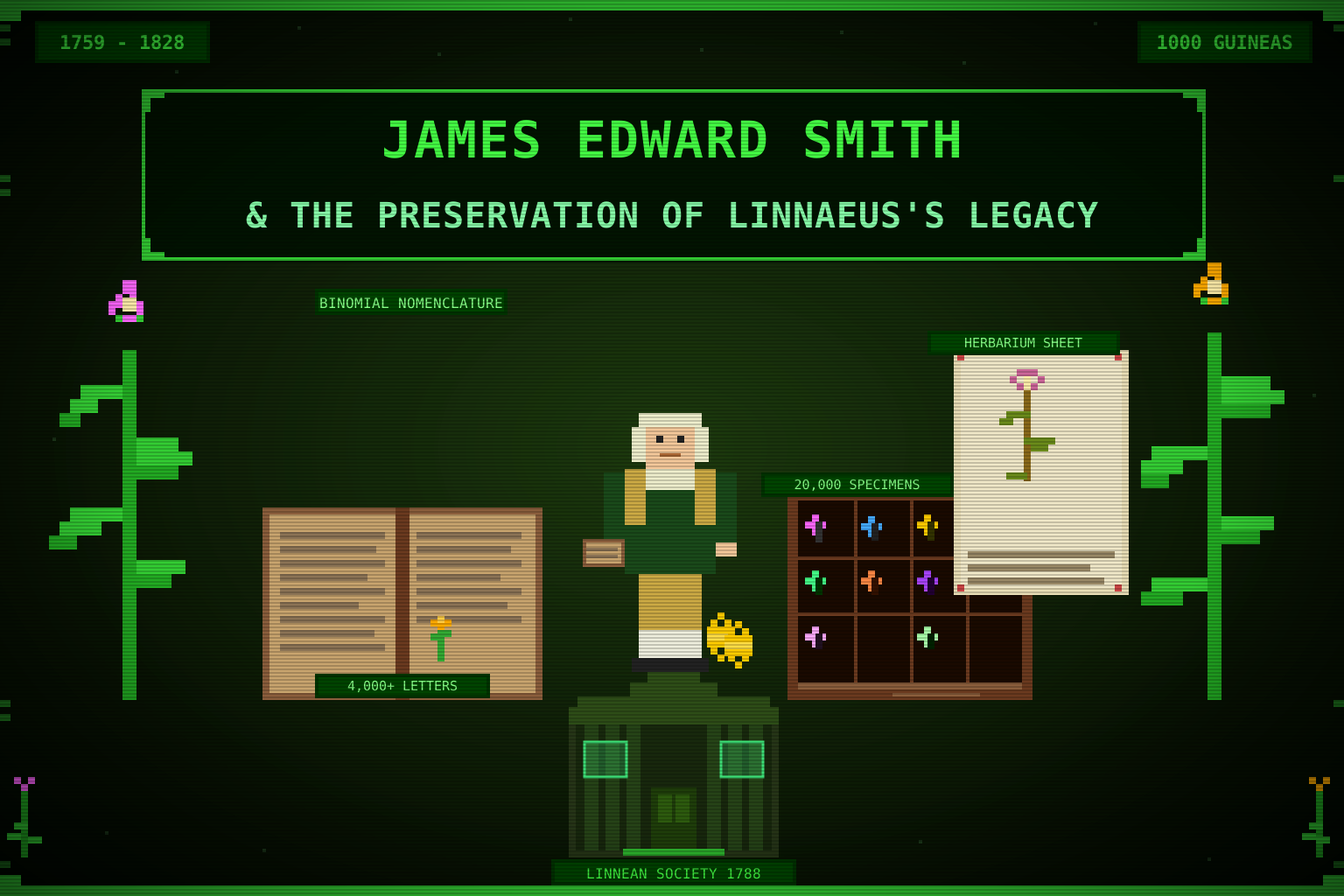
Key figures: James Edward Smith (1759–1828), Carl Linnaeus (1707–1778), Sir Joseph Banks, Samuel Goodenough, Thomas Marsham
Summary
James Edward Smith was a young English naturalist whose scientific career became inseparably linked to the legacy of Carl Linnaeus beginning in 1778, the year of the great Swedish naturalist’s death. Born in Norwich in 1759, Smith was eighteen years old and beginning his study of botany when Linnaeus died on January 10, 1778. Six years later, in 1784, Smith purchased Linnaeus’s entire collection—herbaria, insect cabinets, manuscripts, correspondence, and library comprising nearly 20,000 specimens and over 4,000 letters—for 1,000 guineas, preserving the collection intact at a moment when it might have been dispersed across European museums. In 1788, Smith founded the Linnean Society of London specifically to steward the Linnaean collections and advance binomial nomenclature as the international standard for biological classification. Smith’s acquisition and institutional guardianship of Linnaeus’s materials made him the bridge between the Enlightenment founding of scientific taxonomy and the 19th-century professionalization of natural history, ensuring that the binomial system that governed the cataloging of specimens from Captain Cook’s Pacific voyages and global exploration became permanent and universally adopted.
Background: Smith’s Formation as a Naturalist (1759–1778)
Early Life and the Year of Linnaeus’s Death
James Edward Smith was born on December 2, 1759, in Norwich, England, the eldest son of a wealthy wool merchant of nonconformist faith. Norwich at the time was a prosperous provincial town with a tradition of natural-philosophy discussion among its merchant and professional classes. Smith’s family circumstances afforded him private education and access to books and collectors’ networks unavailable to most English provincials of the period.
Smith’s interest in botany crystallized during his adolescence (1776–1778), coinciding precisely with the final years of Linnaeus’s life. In 1778, when Smith was eighteen years old and pursuing a self-directed study of botany in Norwich, Linnaeus died on January 10 at his estate of Hammarby in Sweden. Smith had never met Linnaeus, but the Linnaean system—binomial nomenclature and the hierarchical taxonomy of Systema Naturae—was already the lingua franca of European natural history by the time of Linnaeus’s death, and Smith’s formation as a botanist was built entirely on this foundation.
University Education and Introduction to Linnaean Methods (1781–1784)
Smith’s formal university education began in 1781 at the University of Edinburgh, where he studied medicine and botany under Dr. John Hope, a strong advocate of Linnaean taxonomy. Edinburgh was one of Britain’s premier centers for Linnaean teaching, and Smith excelled in his botanical studies, winning a gold medal for his work. The curriculum emphasized the systematic application of Linnaeus’s binomial nomenclature to the diverse flora of Scotland and beyond.
By 1783, Smith had moved to London to continue his medical studies under John Hunter and Dr. William Pitcairn, and through these connections he was introduced to Sir Joseph Banks, the renowned naturalist and president of the Royal Society. Banks had sailed as a naturalist on Captain Cook’s first Pacific voyage (1768–1771) and commanded the most comprehensive collection of Pacific specimens in Britain. This introduction to Banks, coupled with Smith’s growing reputation among London’s natural philosophers, positioned him at the intersection of global exploration and scientific systematization—precisely where Linnaean taxonomy was becoming indispensable.
The Acquisition of Linnaeus’s Collections (1783–1784)
Linnaeus’s Death and the Dispersal Crisis
When Carl Linnaeus died in January 1778, his collections passed into the custody of his family. His son, Carl Linnaeus the Younger, who had assisted with teaching at Uppsala University, retained nominal guardianship of the materials, but the younger Linnaeus had neither his father’s scientific reputation nor his standing. When the younger Linnaeus himself died in 1783, the entire assemblage of specimens, manuscripts, and books came onto the market.
The collection represented an unprecedented accumulation of natural-historical materials, including:
- Approximately 14,000–19,000 herbarium sheets (botanical specimens), many of them type specimens—the original plants on which Linnaeus had based his binomial names
- Over 3,200 insect specimens, carefully pinned and labeled
- More than 1,500 shells representing approximately 550 species
- 168 fish specimens and additional marine organisms
- Approximately 2,500 minerals
- Linnaeus’s personal library of approximately 1,600 volumes on natural philosophy, medicine, and natural history
- Over 3,000–4,000 letters from approximately 600 correspondents—the Linnaean correspondence network that spanned Europe and the colonial world
The threat was not merely academic: collections on this scale were typically broken up and sold to multiple institutions or wealthy collectors upon their owners’ deaths, dispersed across European museums where comparative study would be impossible. The Linnaean collections faced this fate after 1783.
Banks Declines; Smith Accepts
Sir Joseph Banks, as the senior British naturalist and the most obvious candidate, was offered first refusal on the collections by Linnaeus’s heirs. Banks declined—possibly because his own collections already encompassed much of the Pacific natural world, or because he preferred to remain focused on the Royal Society presidency and his own research. The reasons for Banks’s refusal are not documented in surviving accounts, but the outcome was decisive: the collections were offered for sale to the highest bidder.
James Edward Smith, in consultation with his father—whose merchant wealth made the purchase possible—stepped forward in 1783 and negotiated to purchase the entire collection for 1,000 guineas (equivalent to £1,050; total costs including freight came to approximately £1,088). The figure was substantial but represented significant value for a comprehensive assemblage that might have cost far more if broken into separate sales across multiple auctioneers.
Smith’s father financed the purchase, and the collection was shipped from Uppsala to London in 26 cases, arriving at Smith’s residence in Paradise Row, Chelsea, London, in October 1784. Smith, at twenty-five years old, had acquired the physical and intellectual inheritance of the greatest naturalist of the Enlightenment.
Stewardship of the Collections and the Founding of the Linnean Society (1784–1788)
Initial Guardianship and Study
Between the arrival of the collections in October 1784 and the founding of the Linnean Society in 1788, Smith undertook the scholarly work of cataloging, studying, and organizing Linnaeus’s materials. He examined the correspondence—which provided unprecedented insight into Linnaeus’s thinking and his relationships with the global network of naturalists he called his “apostles”—and he studied the type specimens, comparing them against the descriptions in Systema Naturae and Species Plantarum to verify Linnaeus’s original identifications.
This period was one of intensive scholarship. Smith was simultaneously:
- Establishing himself as a botanist and physician in London
- Serving as secretary to Sir Joseph Banks (beginning 1784)
- Publishing botanical monographs and descriptions of new species
- Engaging with the natural-philosophy community through the Royal Society and the Linnean Club (an informal dinner club of naturalists)
The Linnaean collections were not hidden or kept as a private treasure. Smith opened them to examination by fellow naturalists, and the collections became increasingly regarded as a national and international scientific resource that belonged in an institutional setting rather than in private hands.
The Conception and Founding of the Linnean Society (1788)
By the mid-1780s, it became clear to Smith and his colleagues that the collections needed an institutional home that could guarantee their preservation across generations and make them available to the expanding global community of naturalists. The founding of a society bearing Linnaeus’s name would accomplish this while simultaneously advancing the Linnaean system internationally.
The idea was conceived by Smith in consultation with Samuel Goodenough (a clergyman-naturalist) and Thomas Marsham (an entomologist). The three developed a formal proposal for a learned society dedicated to the study of natural history within the Linnaean framework, with the explicit purpose of acquiring, preserving, and advancing knowledge using binomial nomenclature.
The first meeting of the Linnean Society of London was held on April 8, 1788. Smith was elected its first President—a position he held for the remainder of his life (he died in 1828). The inaugural membership consisted of 36 fellows, 16 associates, and approximately 50 foreign members. Smith delivered the opening discourse, setting the intellectual tone for the Society: the advancement of natural history through systematic observation, accurate description, and the universal application of Linnaean taxonomy.
The Society leased premises in Great Marlborough Street, London, and the Linnaean collections became its founding holdings and institutional centerpiece.
Smith’s Own Scientific Contributions (1785–1828)
While best known as Linnaeus’s custodian, Smith was also a productive working naturalist whose publications extended and applied the Linnaean system across several decades:
| Publication | Years | Significance |
|---|---|---|
| Plantarum Icones Hactenus Ineditae | 1789–1791 | Illustrated plates of unpublished Linnaean plant species, drawn directly from the type specimens in Smith’s care |
| Transactions of the Linnean Society | 1791–1821 (vol. 1–13 under Smith) | Founded the primary research organ for British natural history; papers encompassed botany, zoology, entomology, and early geology |
| Icones Pictae Plantarum Rariorum | 1790–1793 | Hand-coloured plates of rare plants, continuing the tradition of botanical illustration as a scientific tool |
| The Natural History of the Rarer Lepidopterous Insects of Georgia | 1797 | Insect taxonomy using specimens sent from North American collectors, demonstrating the global reach of the Linnaean network |
| Flora Graeca (Smith’s role in Sibthorp’s work) | 1806–1840 | Smith edited and completed the posthumous publication of John Sibthorp’s Greek flora, applying Linnaean taxonomy to Mediterranean specimens |
| English Botany | 1790–1814 (36 vols.) | Major illustrated flora of the British Isles, with 2,592 plates; the standard reference for British plants for decades |
| Introduction to Botany | 1807 | Pedagogical text that became the standard teaching introduction to Linnaean botany for university students |
| English Flora | 1824–1828 (4 vols.) | Systematic descriptive flora of British plants, Smith’s comprehensive late-career synthesis |
Smith was knighted in 1814, the year the Prince Regent became patron of the Linnean Society, in recognition of his botanical work and his stewardship of the Linnaean legacy; he had also instructed Queen Charlotte and the princesses in botany. These honors reflected the international consensus that Smith had performed an irreplaceable service to science.
The Linnean Society’s First Decade (1788–1798)
The first decade of the Linnean Society’s existence established institutional patterns that persisted into the 21st century:
Membership and geographic reach: By 1798, the Society’s fellowship had grown from its founding 36 fellows to over 200 fellows and associates. Foreign membership included naturalists from Sweden, France, Germany, the Netherlands, and the emerging American republic—making the Society a genuinely international body despite its London address.
Publication: The Transactions of the Linnean Society published its first volume in 1791, covering botanical and zoological papers presented at Society meetings. Early volumes included papers on the new specimens arriving from the Pacific, Australia (following the 1788 founding of the New South Wales colony and the first botanical surveys by collectors associated with Banks), and India. The Transactions established peer review and standardized description formats that became models for subsequent scientific journals.
The Linnaean correspondence: Smith catalogued and began organizing Linnaeus’s 4,000+ letters, identifying 600+ correspondents across Europe. This work—published posthumously in part in Correspondence of Linnaeus (1821, 2 vols.)—revealed for the first time the full extent of the Linnaean network, which had functioned as an informal global data-collection system, with correspondents in the Americas, Africa, and Asia sending specimens and observations back to Uppsala.
Library and collections access: The Society established a reading room and made the Linnaean collections available to visiting naturalists by appointment. Between 1788 and 1798, researchers from at least twelve countries are documented as having examined the herbarium specimens at the Society’s premises in Great Marlborough Street.
The Significance of Smith’s Guardianship
Preservation of the Original Specimens
The value of maintaining Linnaeus’s herbarium and specimens as an integrated collection cannot be overstated. When a taxonomist in the 19th or 20th century wished to verify a Linnaean identification or resolve a question about what Linnaeus had actually named a particular organism, the type specimen—the original plant on which the name was based—was the authoritative reference. If Linnaeus’s specimens had been dispersed to a dozen museums across Europe, such verification would have been impossible, and the stability of binomial nomenclature itself would have been jeopardized.
Smith’s insistence on keeping the collection together—and his creation of an institutional framework to house it permanently—protected the very foundation on which modern taxonomy rests.
Bridge Between Enlightenment Taxonomy and Victorian Natural History
The period from Linnaeus’s death (1778) through the 1830s was a time of explosive expansion in biological exploration. Captain Cook’s voyages, which reached their culmination in 1778–1779, returned hundreds of plant and animal species entirely unknown to Linnaeus. The voyages of subsequent naturalists—including many trained in the Linnaean system at the societies and universities that propagated it—discovered thousands more. All of these specimens needed to be classified and named, and all of them used the binomial nomenclature that Linnaeus had created.
Smith, as the living guardian of Linnaeus’s legacy and as president of the society bearing his name, became the de facto custodian and advocate for the Linnaean system during this expansionist period. When Charles Darwin systematized evolution in On the Origin of Species (1859), he worked entirely within the taxonomic framework that Linnaeus had established and that Smith had preserved.
International Scientific Authority
The Linnean Society of London, through Smith’s leadership, became the international authority on questions of Linnaean taxonomy and nomenclature. Naturalists and scientific institutions across Europe and the colonial world—including in newly explored regions like Australia, the Pacific Islands, and India—deferred to the Society’s expertise on taxonomic questions precisely because it housed Linnaeus’s own reference collections and corresponded with the global network of his apostles and their successors.
Smith’s publishing activities—particularly the Linnaean Transactions (1791–1798) and the English Flora (1824–1828), both produced under the Society’s auspices—spread Linnaean taxonomy and its applications to a wider audience and maintained the system’s authority even as it evolved.
After Smith: The Society’s Transition (1828–1900)
James Edward Smith died on March 17, 1828, in Norwich, fifty years after Linnaeus’s death and forty years after the Society’s founding. His widow offered the Linnaean collections to the Society for purchase; the Society raised the necessary funds—approximately £3,000 in 1829 prices—and acquired both the Linnaean collections and Smith’s own natural-history library and specimens, consolidating under one roof the greatest single archive of 18th-century taxonomy in existence.
Robert Brown, the Scottish botanist who had served as Banks’s librarian and had accompanied Matthew Flinders on the first circumnavigation of Australia (1801–1803), became one of the Society’s leading figures after 1828. Brown’s work on Australian flora, which added over 2,000 new species to the Linnaean system, demonstrated the continuing practical value of the taxonomic framework Smith had preserved.
By 1850, the Society occupied Burlington House in London (where it remains today), and the Linnaean collections had been catalogued into a format accessible to visiting researchers from around the world. When Darwin prepared On the Origin of Species (1859), he worked in close contact with Society fellows including Joseph Hooker and Asa Gray, and his and Alfred Russel Wallace’s joint papers were famously presented to the Linnean Society on July 1, 1858—the event now recognized as the first public announcement of the theory of evolution by natural selection, which was built upon but ultimately transformed the Linnaean taxonomic framework that Smith had safeguarded.
The Linnaean type specimens—the same physical plants Smith purchased in 1784—are still used today to resolve taxonomic disputes. When molecular phylogenetics produce results that conflict with traditional Linnaean classification, the type specimens at Burlington House provide the authoritative anchor point. Smith’s 1,000-guinea investment in 1784 continues to yield scientific returns in the 21st century.
See Also
- Death of Carl Linnaeus — the Swedish naturalist whose collections and binomial system Smith preserved
- Captain Cook’s Discovery of Hawaii — the Pacific voyage whose specimens were classified using the Linnaean system that Smith championed
- Joseph Banks (1743–1820) — the British naturalist and Smith’s mentor who declined the Linnaean collections but influenced Smith’s career
- Voltaire (1694–1778) — fellow Enlightenment intellectual who died the same year Linnaeus did, marking a watershed in European thought
Sources
- James Edward Smith (botanist) - Wikipedia — Comprehensive biography covering Smith’s early life, acquisition of Linnaean collections, and founding of the Linnean Society
- Dictionary of National Biography, 1885–1900: Smith, James Edward - Wikisource — Authoritative biographical source with specific dates (birth, university enrollment, collection acquisition, Society founding) and financial figures
- Smith Collections - The Linnean Society — Description of the Smith Collections at the Society, including inventory of contents
- Linnaean Collections - The Linnean Society — Detailed account of the Linnaean Collections themselves and their acquisition by Smith, including specimen counts and catalogue information
- Carl Linnaeus - Encyclopædia Britannica — Background on Linnaeus and the state of his collections at his death