Key figures: Kanye West (artist, producer), Jay-Z (featured artist), Jon Brion (co-producer, string arrangements), Adam Levine, Jamie Foxx, Lupe Fiasco, Paul Wall (featured artists)
Summary
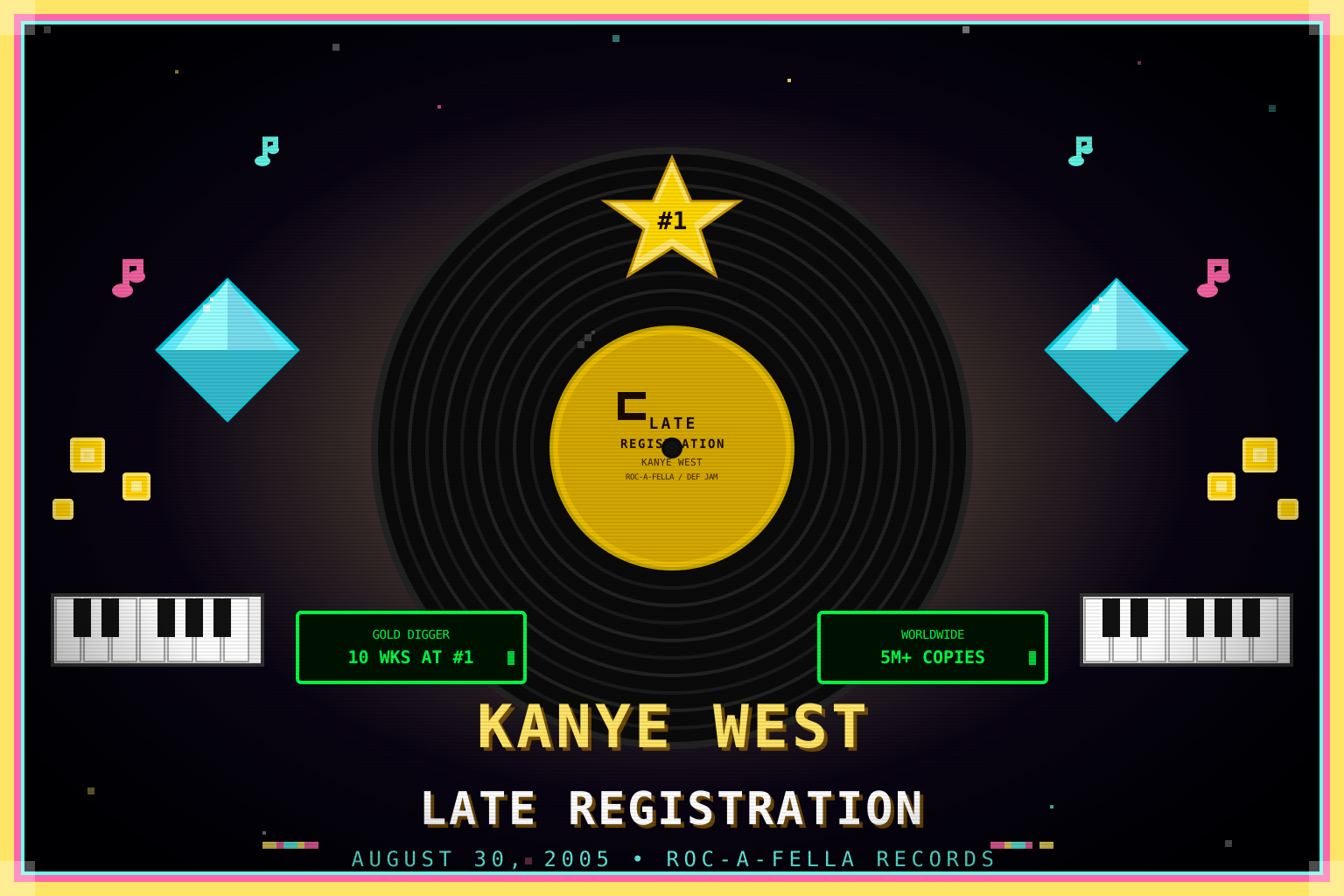
Kanye West released his second studio album Late Registration on August 30, 2005, through Roc-A-Fella Records and Def Jam. The album debuted at number one on the Billboard 200 with first-week sales of 860,000 copies in the United States—making it the second-biggest debut of 2005—and eventually sold over 3.2 million copies domestically and more than 5 million copies worldwide.
Produced primarily by Kanye alongside Jon Brion, the album spans twenty-one tracks (including interludes) across a runtime of approximately 73 minutes. Brion’s involvement grew out of early studio sessions at Westlake Recording Studios in West Hollywood, California; he contributed orchestral string arrangements and sampled the works of film composers to give the record an unusually lush sonic palette for mainstream hip-hop. The sample clearance budget alone reportedly reached into the millions of dollars.
Tracklist Highlights
- “Heard ‘Em Say” — a piano-led ballad featuring Adam Levine of Maroon 5, using a flute sample from Natalie Cole’s “Someone That I Used to Love”
- “Gold Digger” — built around Ray Charles’s “I Got a Woman” and featuring a Jamie Foxx vocal performance; it spent ten consecutive weeks at #1 on the Billboard Hot 100
- “Diamonds from Sierra Leone (Remix)” — featuring Jay-Z, with lyrics critiquing the conflict diamond trade amid the album’s own opulent imagery
- “Gone” — an introspective closer featuring Otis Redding, Consequence, and Cam’ron, later re-recorded without Cam’ron for the final release
- “Drive Slow” — featuring fellow Chicago rapper Paul Wall and GLC, spotlighting the Chicago street scene
Production and Recording
Recording took place throughout 2004–2005 at multiple studios, including Chalice Recording Studios and Record Plant in Los Angeles. Jon Brion initially came aboard as a co-producer on a handful of tracks; his contributions expanded substantially as the creative rapport between the two developed. The collaboration was unconventional: Brion, best known for his work on film scores and albums by Fiona Apple and Aimee Mann, had limited experience in hip-hop production, and their working dynamic sometimes involved Kanye presenting raw beat sketches that Brion would augment with live instrumentation and orchestration.
Significance
Critical Reception
Late Registration received near-universal critical acclaim. It holds a Metacritic score of 88 (based on 30 reviews) and appeared on year-end and decade-end “best albums” lists in Rolling Stone, NME, Pitchfork, and dozens of other publications. Time magazine named it the best album of 2005.
Awards and Recognition
At the 48th Grammy Awards (February 2006), Late Registration won Best Rap Album, while its singles earned Best Rap Solo Performance for “Gold Digger” and Best Rap Song for “Diamonds from Sierra Leone.” Kanye received a total of eight nominations that evening—including Album of the Year, one of the highest honors ever extended to a hip-hop record at that point—though the top prize ultimately went to U2’s How to Dismantle an Atomic Bomb. The scale of the album’s recognition was widely read as a sign that hip-hop had achieved parity with rock and pop as a prestige genre.
Cultural Impact
The album’s social commentary tracks—”Crack Music,” “Diamonds from Sierra Leone,” and “We Major”—demonstrated that hip-hop could engage substantively with systemic inequality, the drug war, and global supply chains without sacrificing commercial appeal. Kanye’s September 2005 off-script remarks during an NBC telethon for Hurricane Katrina relief, where he stated “George Bush doesn’t care about Black people,” were made just days after the album’s release and became inseparable from the album’s cultural context. The incident amplified the reach of the socially conscious themes already present on Late Registration.
Jon Brion’s orchestral production approach influenced a generation of producers who subsequently sought to blend classical and jazz instrumentation into hip-hop beats, contributing to developments in what critics later called “baroque rap” or “orchestral hip-hop.”
Context in 2005 Hip-Hop
Late Registration arrived during a period of significant evolution in hip-hop. The genre’s commercial center of gravity was shifting: the South (represented by artists like Lil Wayne, Young Jeezy, and T.I.) was becoming increasingly dominant, while New York’s traditional dominance was waning. In this environment, Kanye—a Chicago producer with literary and artistic pretensions—occupied a unique position that was neither coastal nor purely Southern. The album appeared the same year as 50 Cent’s The Massacre (March 2005), which had sold over a million copies in its first week; Late Registration’s robust debut nonetheless demonstrated that introspective, orchestrally enriched hip-hop could compete commercially with the era’s hardest-edged rap.
See also: Coldplay releases X&Y · Live 8 concerts · The Colbert Report premieres