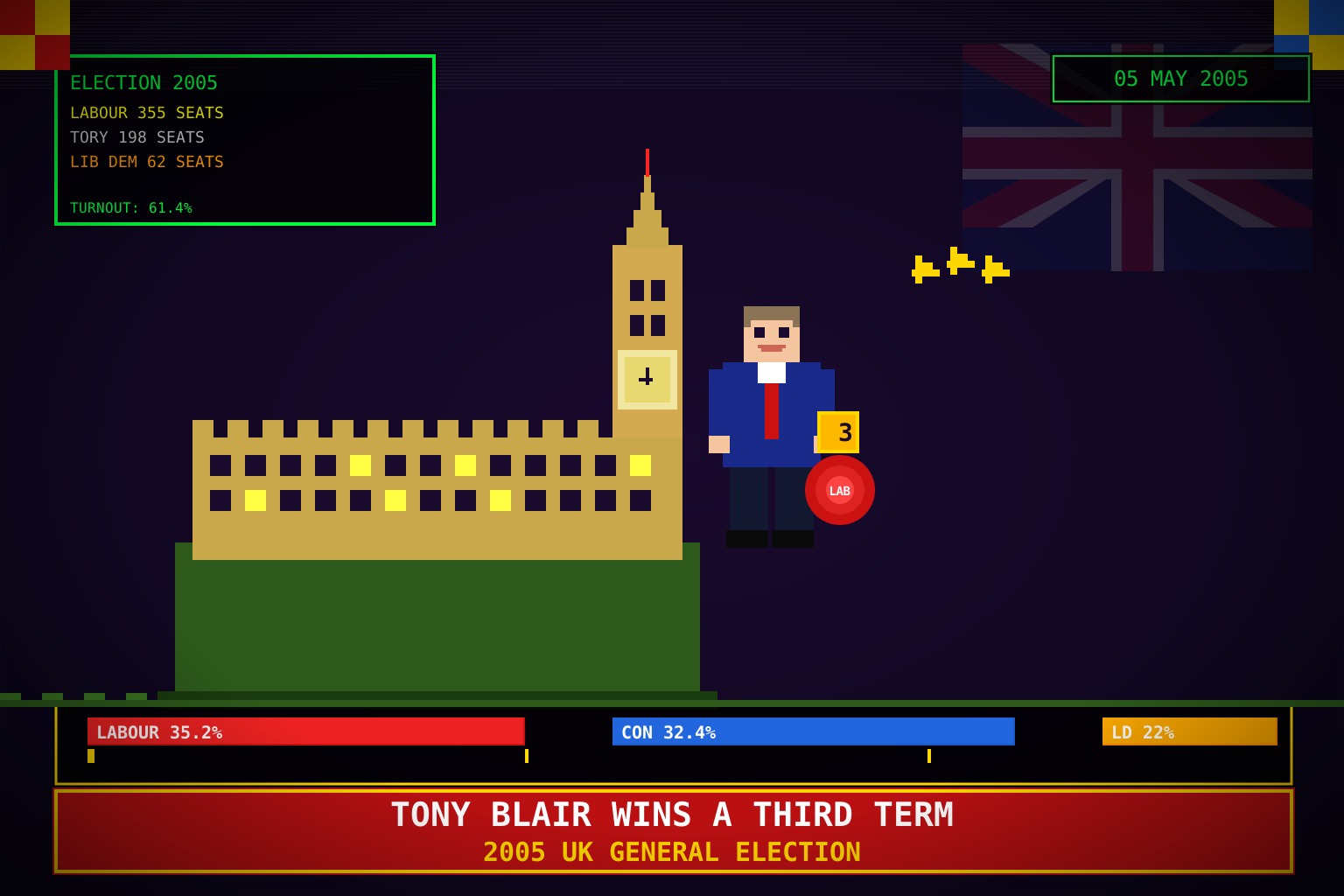
Key figures: Tony Blair (Prime Minister, Labour leader), Michael Howard (Conservative leader), Charles Kennedy (Liberal Democrat leader), Gordon Brown (Chancellor of the Exchequer)
Summary
The 2005 United Kingdom general election was held on May 5, 2005. Tony Blair’s Labour Party won a third consecutive term in government—the first time a Labour leader had achieved three successive majority governments—but with a sharply reduced mandate. Labour took 355 of the 646 seats in the House of Commons on 35.2% of the popular vote, the lowest share ever recorded for a party forming a single-party majority government. Its overall majority fell from 167 to 66. The Conservatives under Michael Howard won 198 seats and 32.4% of the vote, and the Liberal Democrats under Charles Kennedy won 62 seats and 22.0%, their best result since the 1920s. National turnout was 61.4%.
Background
Labour had governed since Tony Blair’s landslide victory of 1997 and had won a second landslide in 2001. By 2005 the political climate had cooled markedly. The 2003 invasion of Iraq, undertaken over large-scale public protest and later controversy over the government’s case for war, had eroded trust in Blair personally and divided Labour’s traditional support. Domestic debates over public-service reform, university tuition fees, immigration, and asylum policy also shaped the campaign.
Michael Howard, who had become Conservative leader in 2003, sought to rebuild a party that had suffered two heavy defeats, campaigning on immigration controls, crime, and “cleaner hospitals.” Charles Kennedy’s Liberal Democrats positioned themselves to Labour’s left on several issues, opposing the Iraq war and university top-up fees, and targeting disaffected Labour voters as well as Conservative-held seats.
The election
Polling took place on May 5, 2005, for all 646 seats of the House of Commons. Labour’s vote share fell 5.5 percentage points from 2001 to 35.2%, and it lost dozens of seats, yet Britain’s first-past-the-post system converted its plurality into a working majority of 66. The Conservatives gained seats to reach 198 but were held below one-third of the national vote. The Liberal Democrats advanced to 62 seats, benefiting from anti-war sentiment and opposition to tuition fees.
The result was widely read as a rebuke delivered without a change of government: voters returned Labour to power while stripping away much of the authority it had enjoyed since 1997. Blair acknowledged on election night that the electorate had sent a message over Iraq and pledged to focus on domestic priorities.
Aftermath
Michael Howard announced shortly after the election that he would resign as Conservative leader once a successor could be chosen; the ensuing contest was won by David Cameron in December 2005. Charles Kennedy remained Liberal Democrat leader until January 2006. Blair had stated before the election that he would serve a full third term but would not seek a fourth; the reduced majority intensified pressure within Labour over the timing of his departure and the succession of Chancellor Gordon Brown, to whom Blair handed the premiership in June 2007.
Significance
The 2005 election confirmed Labour’s dominance of British politics across three parliaments while exposing the limits of that dominance. Blair’s third victory secured his place as Labour’s most electorally successful leader, but the 35.2% vote share—smaller than that of any previous single-party majority government—underscored how far his personal standing and the party’s coalition had narrowed since 1997. The gap between vote share and seat share renewed debate over the fairness of the first-past-the-post electoral system.
The election also reset the opposition. The Conservatives’ recovery was modest, and Howard’s resignation opened the way for David Cameron’s modernising leadership, which would carry the party back toward government by 2010. For Blair, the diminished mandate framed a difficult final period in office: within two months he was managing the response to the 7 July London bombings and hosting the G8 summit at Gleneagles, which opened the day after London won the 2012 Olympic bid.
Sources
- 2005 United Kingdom general election - Wikipedia
- General Election 2005 (Research Paper 05/33) - House of Commons Library
-
[Tony Blair Biography, Facts, & Iraq War - Britannica](https://www.britannica.com/biography/Tony-Blair) - United Kingdom general election of 2005 - Britannica