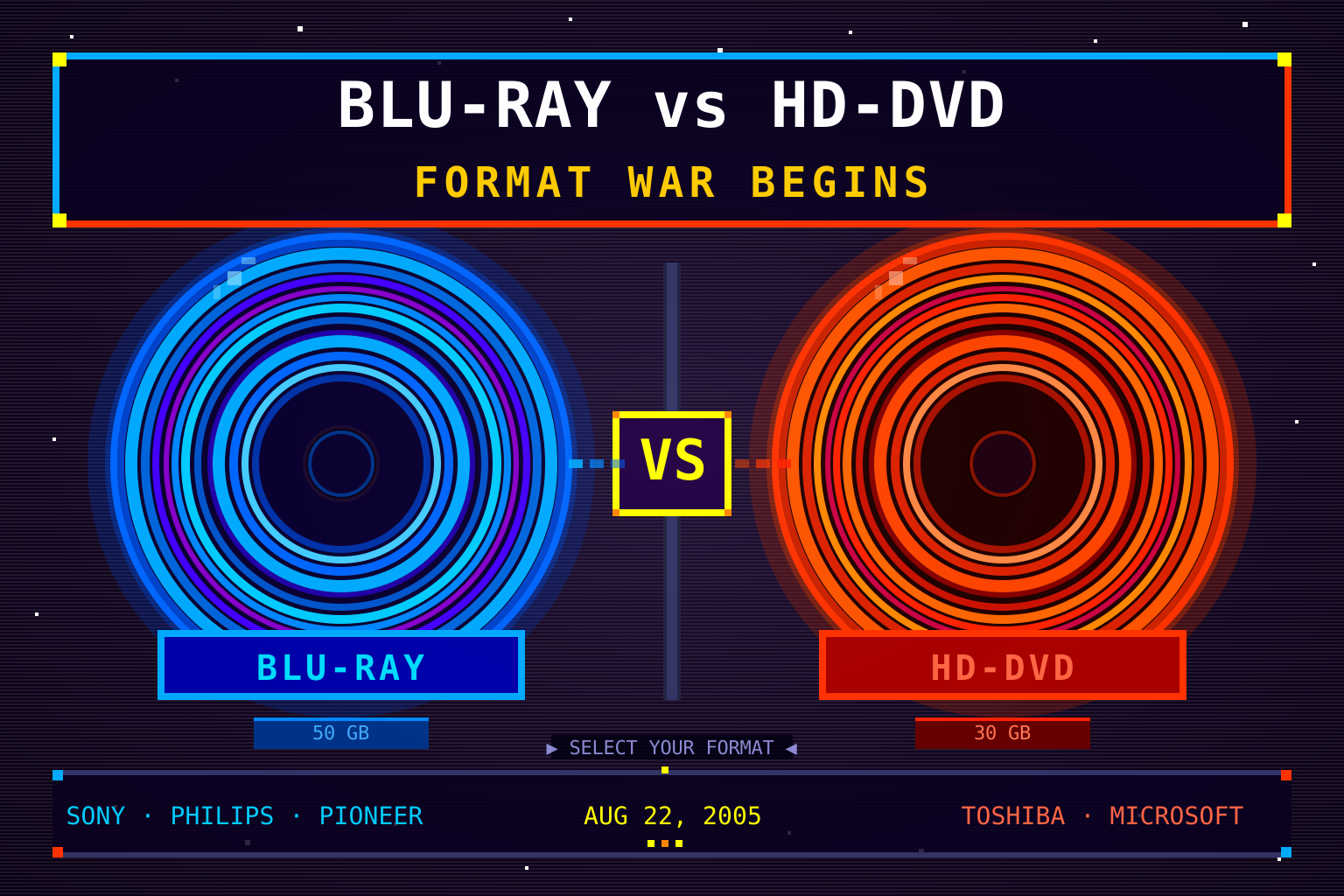
Key figures: Sony (Blu-ray Disc Association founder), Toshiba (HD-DVD developer), Microsoft (HD-DVD ally), Philips, Panasonic, Pioneer
Summary
In August 2005, the DVD Forum and the Blu-ray Disc Association formally ended two years of negotiations aimed at creating a single unified standard for next-generation optical discs. The breakdown on August 22 marked the official onset of a “format war” between two competing technologies: Blu-ray (backed by Sony, Philips, and others) and HD-DVD (backed by Toshiba and Microsoft).
Both formats aimed to replace the standard DVD in the consumer market by offering significantly higher storage capacity and quality for high-definition video content. Blu-ray could store up to 50 GB per dual-layer disc (25 GB per layer), while HD-DVD offered 30 GB dual-layer (15 GB per layer), giving Blu-ray a clear capacity advantage. Both used the same blue-violet laser wavelength of 405 nm — a narrower beam than the red lasers in standard DVD players, enabling finer data pits and greater disc density. However, HD-DVD offered a cost advantage, as its physical disc structure more closely resembled existing DVD manufacturing, while Blu-ray’s thinner 0.1 mm cover layer required substantial retooling of production lines.
The critical technical disagreement centered on interactivity standards: Blu-ray employed a Java-based interactive system (later branded BD-J), while HD-DVD advocated for Microsoft’s “iHD” (Interactive HTML) technology. With neither camp willing to compromise, unification became impossible. By mid-2005, major film studios began declaring support for one standard or the other, creating additional market pressure.
Origins and Alliance Formation
The two competing lineages had distinct roots. The Blu-ray Disc Association (BDA) was founded in February 2002 by nine founding companies — Sony, Matsushita (Panasonic), Philips, Samsung, Sharp, Pioneer, LG, Hitachi, and Thomson — who jointly developed the format’s specifications. Blu-ray’s name derives from the blue-violet laser it employs and the fact it reads data from a layer only 0.1 mm beneath the disc surface.
The DVD Forum, meanwhile, endorsed HD-DVD (then called “AOD,” or Advanced Optical Disc) in November 2003, positioning it as the evolutionary successor to DVD with backward compatibility as a core design principle. Toshiba and NEC were the primary technical proponents, with Microsoft joining as a strong software and interactivity partner.
Sony made a pivotal announcement in May 2005, confirming that its forthcoming PlayStation 3 console would include a Blu-ray drive — instantly giving the format access to the massive gaming market and millions of potential early adopters.
Studio Alignments in 2005
By the end of 2005, most major Hollywood studios had taken sides:
- Blu-ray exclusive: Sony Pictures, Walt Disney Studios, 20th Century Fox
- HD-DVD exclusive: Universal Pictures
- Supporting both: Paramount Pictures, Warner Bros. (both formats), Warner Home Video
Disney’s alignment was particularly significant: the studio’s extensive back catalog and its control of major franchises gave Blu-ray strong catalogue depth. Universal’s HD-DVD exclusivity gave Toshiba’s format a crucial mass-market champion, especially for the fast-growing action and blockbuster categories.
Technical Specifications Compared
| Feature | Blu-ray | HD-DVD |
|---|---|---|
| Storage (single-layer) | 25 GB | 15 GB |
| Storage (dual-layer) | 50 GB | 30 GB |
| Laser wavelength | 405 nm | 405 nm |
| Cover layer thickness | 0.1 mm | 0.6 mm |
| Interactivity system | BD-J (Java) | iHD (Microsoft) |
| Mandatory codec | MPEG-2, H.264, VC-1 | Same |
The manufacturing cost gap was real but narrowing. HD-DVD disc production cost approximately $0.60–$1.00 less per disc than Blu-ray in 2005, an advantage Toshiba and its allies highlighted aggressively in industry negotiations.
Consumer and Retail Impact
The format stalemate immediately chilled retailer enthusiasm. Major chains such as Best Buy and Walmart declined to promote either format strongly without a clear winner, adopting a wait-and-see posture that slowed the overall high-definition disc market. Consumers who purchased players for one format risked owning obsolete hardware if their format lost — a dynamic that had burned Betamax buyers in the VHS-Betamax war of the 1980s.
Some manufacturers explored dual-format players. LG introduced the first dual-format player in early 2007, and Samsung followed. These players sold at a premium — typically $800–$1,200 — limiting their market penetration.
Resolution and Legacy
The war ended decisively in early 2008. On January 4, 2008, Warner Bros. announced it would release exclusively on Blu-ray starting in June 2008, citing the need for “one format” to restore consumer confidence. The announcement was timed to coincide with the Consumer Electronics Show in Las Vegas and was described as a “knockout blow” by industry analysts. Walmart and Best Buy followed with Blu-ray exclusive commitments.
On February 19, 2008, Toshiba officially discontinued HD-DVD production and player development. The format had lasted roughly two years on the market (first players shipped April 2006 for HD-DVD; June 2006 for Blu-ray).
The Blu-ray/HD-DVD conflict proved to be the last major format war in physical media. It accelerated interest in digital streaming as a format-neutral alternative — a shift already underway through services related to the rise of platforms like YouTube, founded in February 2005, and broadband internet adoption. The Sony BMG rootkit scandal later the same year, in October 2005, further complicated Sony’s public image during a critical period for Blu-ray adoption. Meanwhile, the Xbox 360 launch in November 2005 — without an HD-DVD drive despite Microsoft’s advocacy — signaled the shifting economics of the living-room format battle.
Significance
The Blu-ray/HD-DVD format war represented the last major “format war” in consumer electronics, a phenomenon that had defined previous technology transitions (VHS vs. Betamax, LaserDisc, etc.). The failure to establish consensus in 2005 set the stage for years of consumer confusion, retailer hesitation, and duplicated R&D spending by electronics manufacturers and studios.
The format war’s significance extended beyond mere technological competition: it highlighted the growing difficulty of achieving industry consensus in an era of fragmented corporate interests and competing technical philosophies. The breakdown of negotiations on August 22, 2005 represented a pivotal moment when the industry accepted that format competition — rather than unification — would dominate the next generation of optical media. Ultimately, Blu-ray would emerge victorious in February 2008, but the interim years of format ambiguity slowed adoption of high-definition physical media and accelerated the industry’s eventual pivot toward digital streaming as the dominant mode of content delivery.
Sources
- High-definition optical disc format war — Wikipedia
- Blu-ray Disc — Wikipedia
- HD DVD — Wikipedia
- A Brief History of the Blu-ray Versus HD DVD War — VGChartz