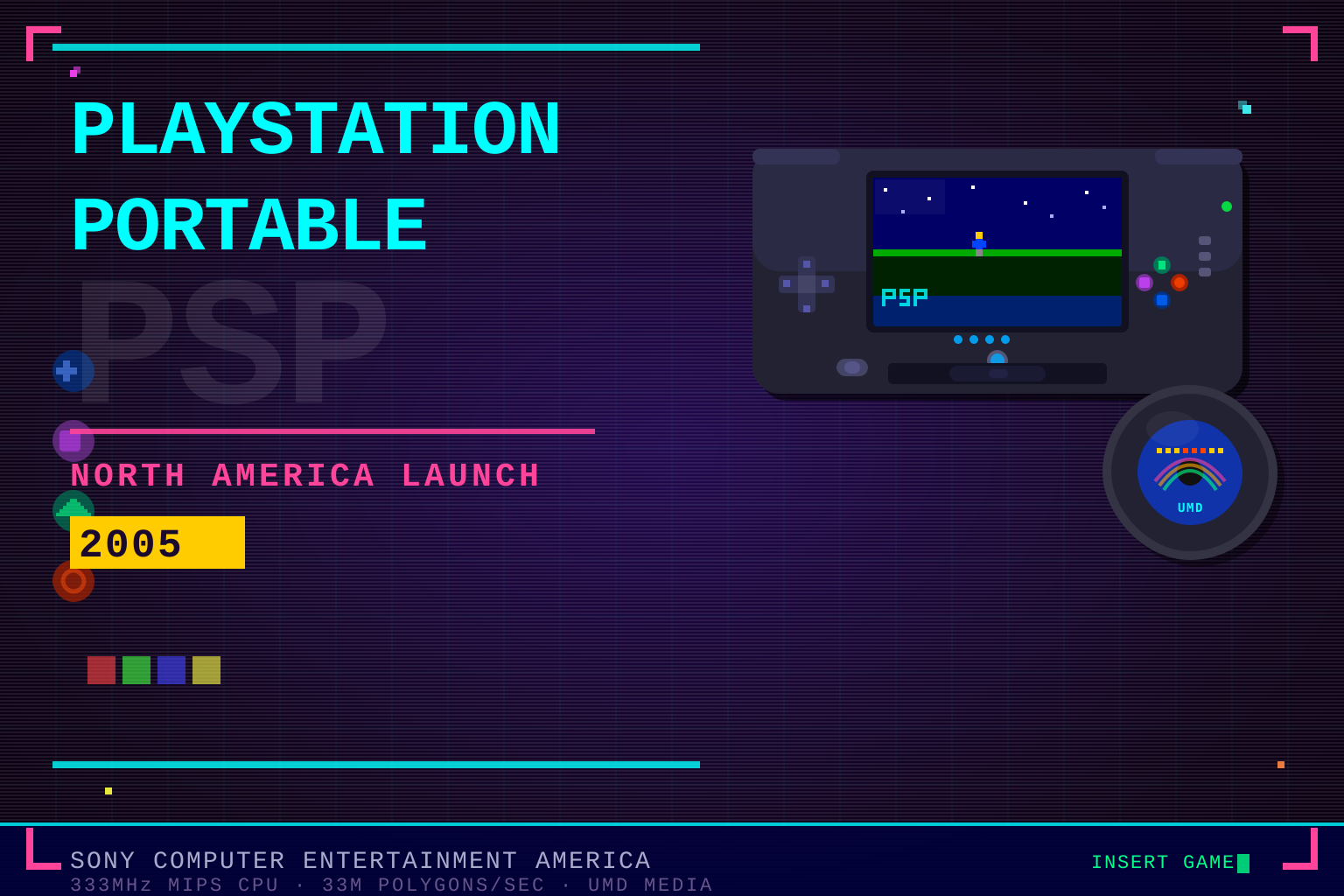
Key figures: Sony Computer Entertainment America; Ken Kutaragi, CEO of Sony Computer Entertainment; Kaz Hirai, President of Sony Computer Entertainment America.
Background
Nintendo had dominated the handheld gaming market almost without interruption since the original Game Boy’s launch in 1989. By 2004, the Game Boy Advance held roughly 95 percent of global handheld sales. Attempts to challenge Nintendo — including Sega’s Game Gear (1990), Atari’s Lynx (1989), and Nokia’s N-Gage (2003) — had all failed commercially. The N-Gage in particular had been a high-profile stumble: despite Nokia’s massive resources, the device sold fewer than 3 million units globally against Game Boy Advance’s 81 million.
Sony’s entry into handheld gaming grew out of the runaway success of the PlayStation 2, released in 2000, which by late 2004 had sold over 70 million units. Sony Computer Entertainment president Ken Kutaragi conceived of a portable device that would bring console-quality graphics to a handheld form factor while also serving as a multimedia player — effectively a Sony Walkman, Discman, and gaming device combined.
Hardware Specifications
The PSP launched with hardware specifications that significantly exceeded other portable devices of its era:
- CPU: Sony/Toshiba-developed MIPS-based processor running at 1–333 MHz (initially locked at 222 MHz by Sony to conserve battery life)
- GPU: Proprietary graphics processor capable of rendering 33 million polygons per second
- Display: 4.3-inch widescreen TFT LCD at 480 × 272 pixels — substantially larger than any competing handheld screen
- Media format: Universal Media Disc (UMD), a proprietary 60mm optical disc format capable of holding up to 1.8 GB, used for both games and commercial movies
- Wireless: 802.11b Wi-Fi for local multiplayer and internet connectivity
- Battery life: Approximately 4–6 hours for gaming, 4–5 hours for UMD video playback
- Memory: Memory Stick PRO Duo slot for saved games, music, photos, and downloaded content
The 4.3-inch LCD was a deliberate differentiator. Nintendo’s simultaneously launching DS (released November 2004 in North America) featured two screens but each measured only 3 inches diagonally. Sony bet that adult gamers would prefer a cinematic display to dual-screen touch interactivity.
North American Launch
Sony launched the PSP in Japan on December 12, 2004, selling approximately 200,000 units on day one — strong demand that caused shortages across Tokyo retail outlets. The North American launch followed on March 24, 2005.
The retail package offered in North America was a “Value Pack” priced at $249.99 USD, which included:
- PSP hardware unit
- Wrist strap
- Sony earbuds/headphones
- Cloth carrying pouch
- 32 MB Memory Stick PRO Duo
- Battery and AC adapter
- A UMD sampler disc with game demos
Sony reported selling approximately 500,000 units in the first two days of North American availability — a record for handheld gaming at the time. Launch-day lines at retailers including Best Buy, GameStop, and Circuit City drew comparison to console launch events. A standalone “Core” pack at $199.99 (without accessories) followed later.
Seventeen game titles were available at launch, including Twisted Metal: Head-On, Ridge Racer, Spider-Man 2, and Lumines — the latter a puzzle title that became a critical favorite and demonstrated the PSP’s appeal to non-traditional gaming audiences.
The European and Australian (PAL) launch followed on September 1, 2005, completing the worldwide rollout.
Competition with the Nintendo DS
The PSP launched into direct competition with Nintendo’s DS, which had debuted in November 2004. The two consoles represented contrasting design philosophies:
| PSP | Nintendo DS | |
|---|---|---|
| Screen | Single 4.3” widescreen LCD | Dual 3” screens (one touch) |
| Target audience | Teens and adults | Broad, including young children |
| Key differentiator | Multimedia, graphical fidelity | Dual-screen touch innovation |
| Launch price (USD) | $249 | $149 |
| Japan launch sales (day one) | ~200,000 | ~590,000 |
Nintendo’s DS ultimately outsold the PSP by roughly 2:1 lifetime, with the DS family reaching 154 million units against PSP’s 76.4 million. However, the PSP captured a distinct demographic — older gamers who valued its power and multimedia functionality — and comfortably exceeded all previous non-Nintendo handheld challengers. Both devices were commercially successful, a fact that reshaped publisher strategies: major franchises including Grand Theft Auto, God of War, and Final Fantasy all received PSP installments.
Multimedia and UMD Movies
A notable but ultimately unsuccessful feature was UMD movie support. Sony leveraged its ownership of Columbia Pictures and Sony Pictures to release dozens of films on UMD beginning at the PSP launch. Titles including Spider-Man 2, Hellboy, and Resident Evil: Apocalypse were available at $24.99 each. However, the format failed commercially: UMD discs could not be played on any device other than the PSP, offered no advantage over DVD at home, and the movie library shrank rapidly as studios pulled support by 2006–2007. The UMD movie experiment is frequently cited as an example of a proprietary format failing to gain sufficient ecosystem adoption — a contrast with Sony’s successful Blu-ray push the same year (announced February 2005).
The PSP’s music and photo playback features, by contrast, were well received. The device could play MP3 and AAC files from Memory Stick, positioning it as a competitor to the Apple iPod for commuters who already owned the device for gaming. This multimedia positioning proved more durable than UMD movies. The Sony BMG rootkit scandal of October 2005 — in which Sony’s music division secretly installed copy-protection software on users’ computers via audio CDs — cast a shadow over Sony’s digital media ambitions in the latter half of 2005, though the PSP itself was not involved.
Legacy
Over its decade-long production run (2004–2014), the PSP sold 76.4 million units worldwide across four hardware revisions (PSP-1000, PSP-2000 “Slim & Lite,” PSP-3000, and PSP Go). It proved that a non-Nintendo handheld could achieve meaningful commercial scale and demonstrated that gaming hardware could successfully serve as a convergent entertainment device. Many design decisions — the widescreen display, Wi-Fi connectivity, downloadable content via the PlayStation Network — anticipated features that became standard across the gaming industry.
The PSP’s 2005 North American launch also intensified industry competition in a year that would see Microsoft launch the Xbox 360 in November, beginning the seventh console generation and forcing all platform holders to sharpen their hardware and software strategies simultaneously across both home and portable markets.