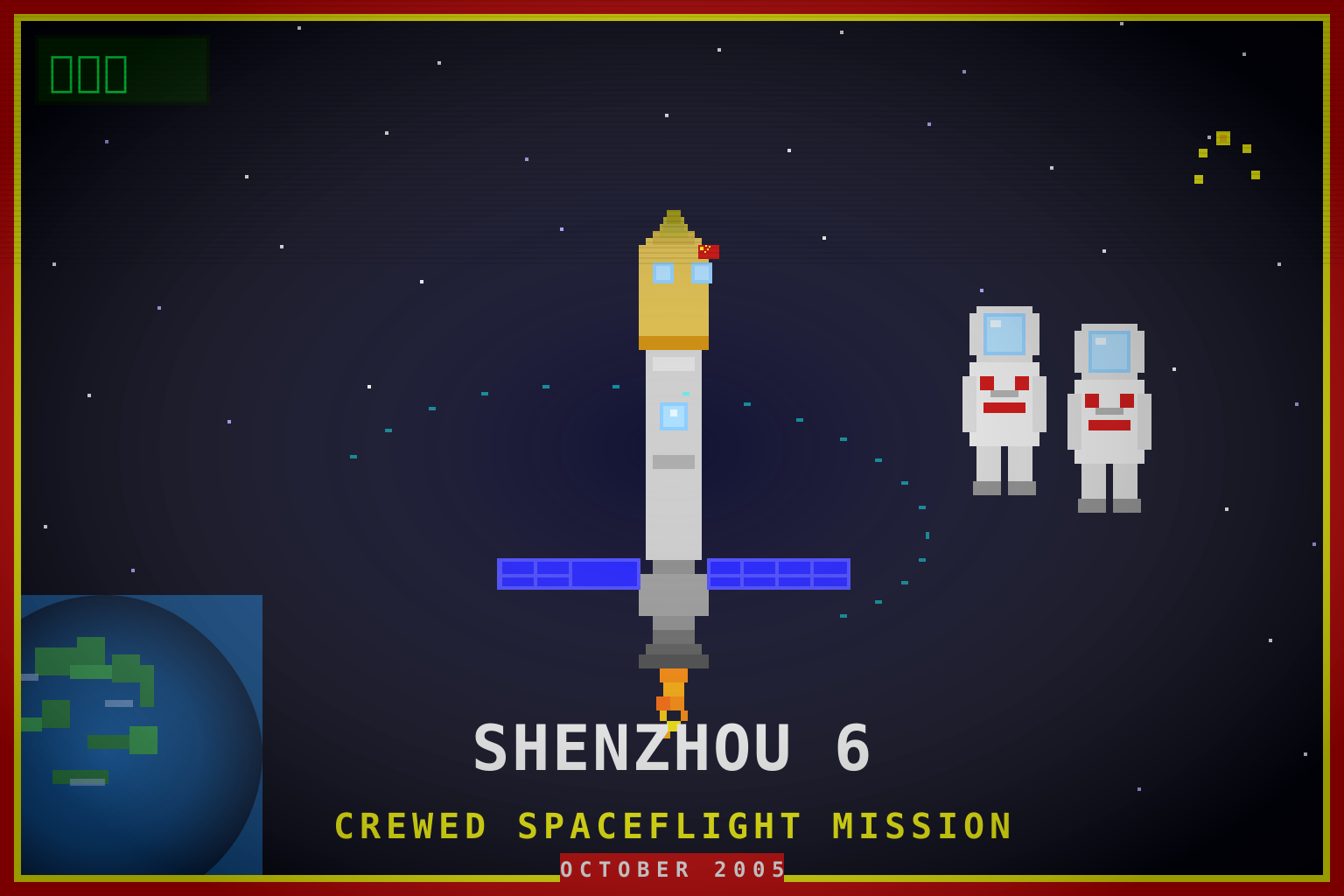
Key figures: Fei Junlong (mission commander, People’s Liberation Army Air Force colonel); Nie Haisheng (flight engineer, People’s Liberation Army Air Force lieutenant colonel); China National Space Administration (CNSA); China Manned Space Agency (CMSA).
Background
China’s crewed space program — officially the Project 921 program — had achieved a pivotal breakthrough on October 15, 2003, when Yang Liwei orbited Earth for 21 hours and 22 minutes aboard Shenzhou 5, making China the third nation (after the Soviet Union and the United States) to independently launch a human into space. That mission had been a single-person, single-day flight designed primarily to prove the technology worked.
Shenzhou 6 represented the program’s next ambition: a multi-person crew on a multi-day mission that would thoroughly test the spacecraft’s life support systems, crew procedures, and habitability. The two-year gap between Shenzhou 5 and Shenzhou 6 reflected extensive post-flight analysis and preparation. The crew of two was selected from six finalists announced in September 2005; Fei Junlong and Nie Haisheng were named publicly only on launch day.
2005 was a notable year for human spaceflight internationally. NASA’s STS-114 Discovery mission in July 2005 had marked the Space Shuttle’s return to flight after the 2003 Columbia disaster, demonstrating that both space powers were rebuilding operational capabilities simultaneously. China’s Shenzhou 6 launch reinforced the emergence of a three-actor landscape in human spaceflight.
Mission Profile
Launch: October 12, 2005, at 09:00:03 Beijing Time (01:00:03 UTC) from Launch Complex 921 at Jiuquan Satellite Launch Center, Gansu province, northwestern China. The Long March 2F rocket — a two-stage, liquid-fueled vehicle developed specifically for the Shenzhou program — lifted the spacecraft into orbit within approximately 10 minutes of liftoff.
Orbital parameters: The spacecraft achieved a low Earth orbit with an apogee of approximately 343 km and a perigee of approximately 200 km, inclined at 42.4 degrees to the equator. Over the mission the orbit was adjusted to a near-circular 343 km altitude.
Duration: 4 days, 19 hours, 32 minutes, and 23 seconds — completing 76 orbits of Earth.
Landing: October 16, 2005, at approximately 20:32 Beijing Time (12:32 UTC) in the Siziwang Banner grasslands of Inner Mongolia Autonomous Region, the designated primary recovery zone for the Shenzhou program. Recovery teams using helicopters and ground vehicles located the capsule within minutes of touchdown.
Key Milestones and Experiments
Access to the Orbital Module
The most significant technical advance over Shenzhou 5 was the astronauts’ active use of the orbital module — the forward section of the spacecraft separated from the re-entry capsule by a hatch. On Shenzhou 5, Yang Liwei had remained in the descent module for the entire mission; on Shenzhou 6, both Fei and Nie passed through the inter-module hatch, becoming the first Chinese taikonauts to physically move between compartments of their spacecraft.
This access provided: a toilet (the descent capsule had none), additional living space reducing psychological stress on a five-day mission, and the ability to conduct experiments in a dedicated area rather than the cramped command space.
Experiments Conducted
Chinese space officials disclosed only a partial list of experiments at the time:
- Microgravity fluid dynamics: Observations of liquid behavior in the orbital module, relevant to future life-support system design.
- Structural dynamics: Measurements of how the spacecraft’s frame responded to crew movement — data needed to design future, larger vehicles such as a space station.
- Biomedical monitoring: Continuous tracking of both crew members’ cardiovascular and respiratory data during activities of varying exertion, building a physiological database for Chinese long-duration spaceflight planning.
- Earth observation: The crew photographed agricultural and geological features of China and neighboring regions using handheld cameras.
The crew also broadcast live from orbit, speaking directly to Chinese President Hu Jintao and Premier Wen Jiabao from the spacecraft — a politically choreographed moment televised nationwide and watched by an estimated 800 million viewers in China.
Crew Routine
Unlike short-duration missions where astronauts work continuously, the five-day Shenzhou 6 flight required a formal daily schedule including sleeping periods. The crew used sleeping bags anchored in the orbital module and consumed a variety of pre-packaged Chinese foods — reportedly including shrimp, pork, and vegetables — representing the first time Chinese taikonauts required a multi-day food supply in orbit. They wore lighter “activity suits” inside the spacecraft rather than the full pressure suits worn during launch and re-entry, a detail that signaled growing operational confidence.
Significance
Advancing China’s Space Program
Shenzhou 6 demonstrated reliable human spaceflight capability at the system level: two crew members could be supported safely for nearly five days, modules could be occupied, and recovery could be executed with precision. This validated the next phase of the program, which would involve orbital rendezvous (Shenzhou 8/9/10, 2011–2012) and eventually the Tiangong space stations.
Geopolitical Context
China conducted Shenzhou 6 entirely independently, without partnership with either NASA or Roscosmos. This autonomy was a deliberate policy stance: U.S. export control regulations (specifically the International Traffic in Arms Regulations, ITAR) effectively prohibited substantive NASA-CNSA cooperation, reinforcing Chinese investment in indigenous capability. The mission, timed just two months after NASA’s post-Columbia return to flight, underscored that the human spaceflight landscape was no longer a bilateral U.S.-Russia dynamic.
The mission also occurred against a backdrop of intense 2005 space science activity: Huygens had landed on Titan in January, Deep Impact had struck comet Tempel 1 in July, and Eris had been discovered beyond Pluto — making 2005 one of the most active years in space exploration of the decade. China’s crewed mission placed it firmly within that global year of achievement.
Path to a Space Station
Shenzhou 6 was explicitly presented by Chinese officials as preparation for more complex missions. General Xu Caihou of the Central Military Commission stated publicly that the next goals included spacewalks, orbital docking, and a space laboratory — goals realized with Shenzhou 7 (2008, first Chinese spacewalk) and Tiangong-1 (2011, first Chinese space station module). The 76-orbit Shenzhou 6 mission was the foundation on which those achievements rested.
Crew Biographies
Fei Junlong (费俊龙), born May 5, 1965, in Kunshan, Jiangsu. A decorated military pilot with more than 1,790 hours of flight time across 10 aircraft types before his selection as a taikonaut. He later commanded Shenzhou 15 in 2022–2023, becoming one of the few people to have flown in both the early and mature phases of the Chinese space program.
Nie Haisheng (聂海胜), born September 13, 1964, in Zaoyang, Hubei. Also a military pilot with extensive flight experience. He returned to space as commander of Shenzhou 10 in 2013 and of Shenzhou 12 in 2021, making him one of China’s most experienced taikonauts and a three-time space traveler.