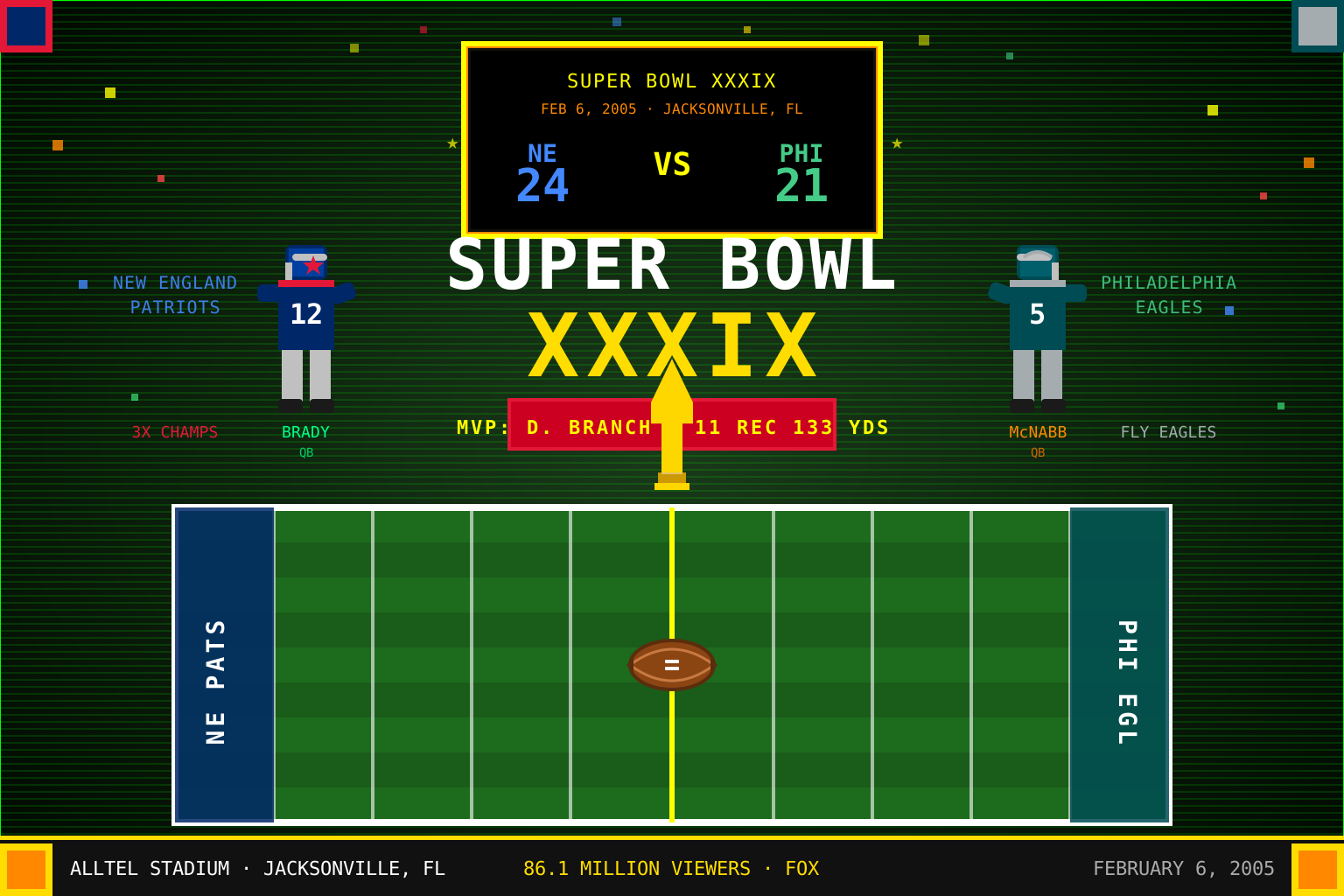
Key figures: Tom Brady (Patriots quarterback), Bill Belichick (Patriots head coach), Andy Reid (Eagles head coach), Donovan McNabb (Eagles quarterback), Deion Branch (Patriots wide receiver, game MVP), Terrell Owens (Eagles wide receiver)
Summary
Super Bowl XXXIX took place on February 6, 2005, at Alltel Stadium in Jacksonville, Florida, between the New England Patriots and the Philadelphia Eagles. The Patriots won 24–21, marking their second consecutive Super Bowl victory and their third title in four seasons, solidifying their emergence as the dominant franchise of the early 2000s NFL.
The game featured strong defensive performances from both teams, though the Patriots’ offense, led by quarterback Tom Brady and wide receiver Deion Branch, ultimately prevailed. Branch caught 11 passes for 133 yards and was named the game’s Most Valuable Player (MVP). The Eagles, meanwhile, had reached the Super Bowl for the first time in franchise history at this stage of their era, driven by veteran quarterback Donovan McNabb and a remarkable comeback from wide receiver Terrell Owens — who had suffered a severe fibula fracture and two torn ankle ligaments just nine weeks earlier but insisted on playing, catching 9 passes for 122 yards.
The game drew an estimated 86.1 million average viewers on Fox — down about 4 percent from the previous year — yet still ranked among the most-watched television events in the United States that year. Halftime featured a performance by Paul McCartney, a deliberate booking choice after the controversy surrounding Janet Jackson and Justin Timberlake’s halftime show the previous year (Super Bowl XXXVIII, February 2004) that resulted in the “wardrobe malfunction” incident and a wave of FCC complaints.
Scoring Summary
Per-quarter points scored:
| Quarter | Patriots | Eagles | Notes |
|---|---|---|---|
| 1st | 0 | 0 | Scoreless quarter |
| 2nd | 7 | 7 | McNabb TD pass to L.J. Smith (PHI); Brady TD pass to David Givens (NE) |
| 3rd | 7 | 7 | Brady TD pass to Mike Vrabel (NE); McNabb TD pass to Brian Westbrook (PHI) |
| 4th | 10 | 7 | Corey Dillon TD run and Adam Vinatieri field goal (NE); McNabb TD pass to Greg Lewis (PHI) |
| Final | 24 | 21 |
The Patriots led 24–14 after Vinatieri’s fourth-quarter field goal. McNabb’s 30-yard touchdown pass to Greg Lewis with 1:48 remaining cut the deficit to three points. However, Philadelphia’s final possessions were hampered by what became one of the most-discussed clock-management sequences in Super Bowl history: the Eagles proceeded deliberately on a scoring drive late in the fourth quarter, consuming valuable time with the game still within reach and leaving too little on the clock for a realistic comeback.
Key Individual Performances
Deion Branch (NE, WR — MVP): 11 receptions, 133 yards. His 11 catches tied a Super Bowl record for receptions at the time. Branch was the decisive offensive weapon, consistently finding soft zones in Philadelphia’s secondary.
Tom Brady (NE, QB): 23 of 33 completions, 236 passing yards, 2 touchdowns, 0 interceptions. Brady’s calm, methodical game management — already his signature trait — prevented turnovers in a game where field position was paramount.
Donovan McNabb (PHI, QB): 30 of 51, 357 yards, 3 touchdowns, 3 interceptions. McNabb was the statistically more productive passer but his three interceptions proved costly. Reports surfaced after the game — disputed by McNabb — that he became ill during the fourth quarter, affecting his performance on late drives.
Terrell Owens (PHI, WR): 9 receptions, 122 yards. Playing through what doctors had described as a potentially season-ending injury, Owens’ performance was widely considered one of the gutsiest in Super Bowl history, though it ultimately was not enough to secure a Philadelphia victory.
Dynasty Context
The Patriots’ victory in Super Bowl XXXIX completed a remarkable run: three Super Bowl titles in four years (Super Bowls XXXVI, XXXVIII, and XXXIX, covering the 2001, 2003, and 2004 NFL seasons). Head coach Bill Belichick, in his fifth year leading the franchise, was widely credited with building a “team-first” organizational culture that could absorb player turnover without losing competitive edge. General manager Scott Pioli’s salary-cap management, combined with Brady’s cost-controlled contract, allowed the Patriots to maintain roster depth across the organization.
The Eagles, by contrast, had lost the NFC Championship Game in three consecutive years (January 2002, 2003, and 2004) before finally breaking through to the Super Bowl in January 2005. Their loss was particularly painful given the franchise’s long championship drought — their last NFL title had come in 1960, before the Super Bowl era.
Halftime Show and Cultural Context
McCartney’s halftime performance was deliberately conservative after the previous year’s controversy. He played a 12-minute medley including “Drive My Car,” “Get Back,” “Live and Let Die,” and “Hey Jude,” drawing on his Beatles and Wings catalog. The performance was broadly praised for its professionalism and largely removed the halftime show from its preceding media controversy.
The game occurred against a backdrop of intense national interest in the NFL’s competitive balance. The Patriots’ dynasty raised renewed debate about salary cap rules and whether sustained dominance was desirable or problematic for league parity. Commissioner Roger Goodell’s predecessor Paul Tagliabue, presiding over his final full season, had positioned the NFL’s revenue sharing model as the structural guarantor of competitive balance.
Super Bowl XXXIX intersected with 2005’s broader cultural landscape: the digital music revolution was transforming entertainment economics at the same moment the NFL was negotiating new broadcast contracts worth billions. The London 2012 Olympic bid later in 2005 reflected the same era’s global appetite for large-scale live sporting spectacles, a market the NFL was beginning to tap with its own International Series plans.
Significance
The Patriots’ victory in Super Bowl XXXIX established New England as the dominant NFL franchise of the early 2000s. By winning back-to-back championships (2003 and 2004 seasons) and three in four years overall, the Patriots demonstrated the sustainability of their coaching and roster-building model under Bill Belichick and Scott Pioli. No team had won three Super Bowls in four years since the Dallas Cowboys accomplished the feat in 1992, 1993, and 1995.
The game also reflected the broader narrative of the 2004 NFL season: the rise of a well-coached, defensively-oriented franchise that emphasized discipline and fundamentals over flashy superstar-driven play. The Eagles’ loss, despite their historic first Super Bowl appearance in franchise memory, underscored the psychological and tactical difficulty of winning at the highest level. McNabb’s late-game struggles and the Eagles’ clock-management failures became case studies in coaching theory and quarterback performance under pressure.
The 2005 Super Bowl was a watershed moment signaling an era of Patriots dominance that would extend well into the following decade, with the franchise appearing in Super Bowls again in 2007, 2011, 2014, 2016, 2018, and 2019.
Sources
- Super Bowl XXXIX — Wikipedia
- Patriots 24-21 Eagles (Feb 6, 2005) Final Score — ESPN
- Super Bowl XXXIX Game Summary — Pro Football Reference