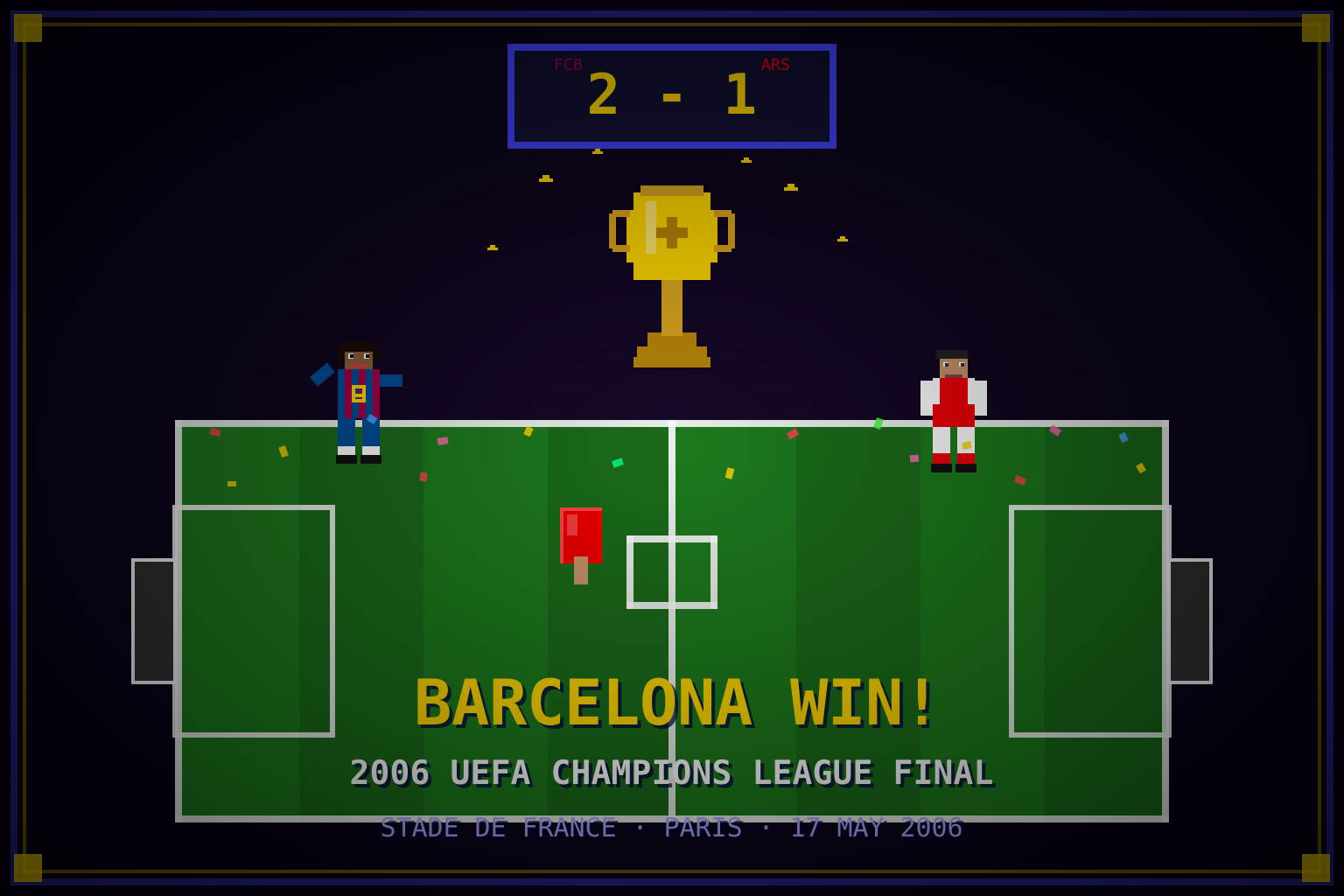
Key figures — Barcelona: coach Frank Rijkaard, Ronaldinho, Samuel Eto’o, Ludovic Giuly, Victor Valdés; Arsenal: coach Arsène Wenger, Jens Lehmann (goalkeeper, sent off), Sol Campbell, Robert Pires, Thierry Henry, substitutes Freddie Ljungberg and Henrik Larsson (Barcelona).
Summary
The 2006 UEFA Champions League Final was played on May 17, 2006, at Stade de France in Saint-Denis, Paris, before an attendance of 79,610 spectators. Barcelona FC defeated Arsenal FC 2–1 to claim the club’s second European Cup title. The match was the culmination of the 2005–06 UEFA Champions League and one of the most dramatic finals of the modern era.
Arsenal goalkeeper Jens Lehmann became the first player sent off in a Champions League Final when he was red-carded in the 18th minute for bringing down Samuel Eto’o just outside the penalty area. Arsenal played the remaining 72 minutes with 10 men. Despite the numerical disadvantage, Arsenal took the lead in the 37th minute through a Sol Campbell header from a Thierry Henry free kick — the first and only goal Campbell scored in the Champions League.
Barcelona dominated possession but struggled to break through Arsenal’s disciplined defensive shape throughout the first half and most of the second. Manager Frank Rijkaard introduced Swedish substitute Henrik Larsson in the 61st minute. Larsson — then 34 years old and in his final season at Barcelona — transformed the match, setting up both Barcelona goals in a decisive spell late in the game. Samuel Eto’o equalized in the 76th minute from Larsson’s lay-off, and Juliano Belletti scored the winner in the 80th minute after a one-two with Larsson, shooting through goalkeeper Manuel Almunia’s legs. Arsenal’s season ended without a major trophy.
The Red Card and Its Consequences
The Lehmann red card reshaped the entire contest, and its handling was itself contentious. Lehmann fouled Eto’o just outside Arsenal’s penalty area as the striker bore down on goal, and Barcelona’s Ludovic Giuly turned the loose ball into the empty net. Referee Terje Hauge of Norway, however, had already stopped play to penalise the foul and dismiss Lehmann, so Giuly’s goal was disallowed and Barcelona awarded only a free kick. Had Hauge instead played the advantage and let Giuly’s goal stand, Barcelona would have led 1–0 with Lehmann — no longer the denier of a clear chance — remaining on the pitch. Hauge later acknowledged that he should have allowed play to continue, and the episode fed wider discussion about applying the advantage rule to goalkeeping fouls.
To replace the dismissed Lehmann, Arsenal manager Arsène Wenger withdrew Robert Pires — regarded as the team’s most creative midfielder — for substitute goalkeeper Manuel Almunia. Pires’s removal cost Arsenal their primary source of attacking creativity at a moment when they needed to press their advantage.
Barcelona’s European Resurgence
Barcelona’s victory at Paris completed a remarkable 2005–06 domestic and European double. The club had won La Liga with a record 82 points and reached the Champions League Final after defeating Chelsea, Benfica, and AC Milan across the knockout rounds. The squad that Rijkaard assembled — built around Ronaldinho’s playmaking and Eto’o’s finishing — represented arguably the best club side in the world at that moment.
Ronaldinho, who won the FIFA World Player of the Year award in both 2004 and 2005, was in the final year of his peak form. Though he did not score in the final, his ability to occupy Arsenal’s remaining defenders created the space for Larsson and Belletti. The victory validated Barcelona’s roughly €24 million investment in Eto’o from Mallorca in 2004, as the Cameroonian striker had scored 24 league goals that season.
For Arsenal, the 2006 Champions League run was the club’s first appearance in a European Cup final and its deepest run in the competition. It remained the closest Arsenal came to winning the trophy: the club continued to reach the knockout rounds for several seasons but did not advance beyond them, and after 2016–17 fell out of the Champions League altogether for several years.
Legacy
The 2006 final has been analyzed extensively as a study in tactical adaptation under pressure. Rijkaard’s willingness to send on a 34-year-old substitute at a critical moment — over more celebrated options — and Larsson’s direct impact within minutes of entering the field became textbook examples of squad depth and game management. Football analysts have frequently cited Larsson’s match-turning contribution off the bench as among the most consequential substitutions in Champions League history.
The match also marked the last major European trophy for Barcelona under Rijkaard, who left the club in 2008 following a decline in league performance. His successor Pep Guardiola led Barcelona to a historic treble (La Liga, Copa del Rey, Champions League) in 2008–09 with a rebuilt squad centered on Xavi Hernández, Andrés Iniesta, and Lionel Messi — continuing the dominance that the 2006 triumph had signaled.
The final was one of several defining moments of a crowded 2006 sporting year, coming weeks before the 2006 FIFA World Cup in Germany — the tournament in which Zinedine Zidane ended his career — and months after the 2006 Winter Olympics in Turin.
Sources
- Wikipedia: “2006 UEFA Champions League Final”
- UEFA Official Match Report: 2006 Champions League Final, Stade de France, May 17, 2006
- The Guardian (May 18, 2006): Match report and Larsson analysis — “Larsson the super-sub lifts Barcelona”