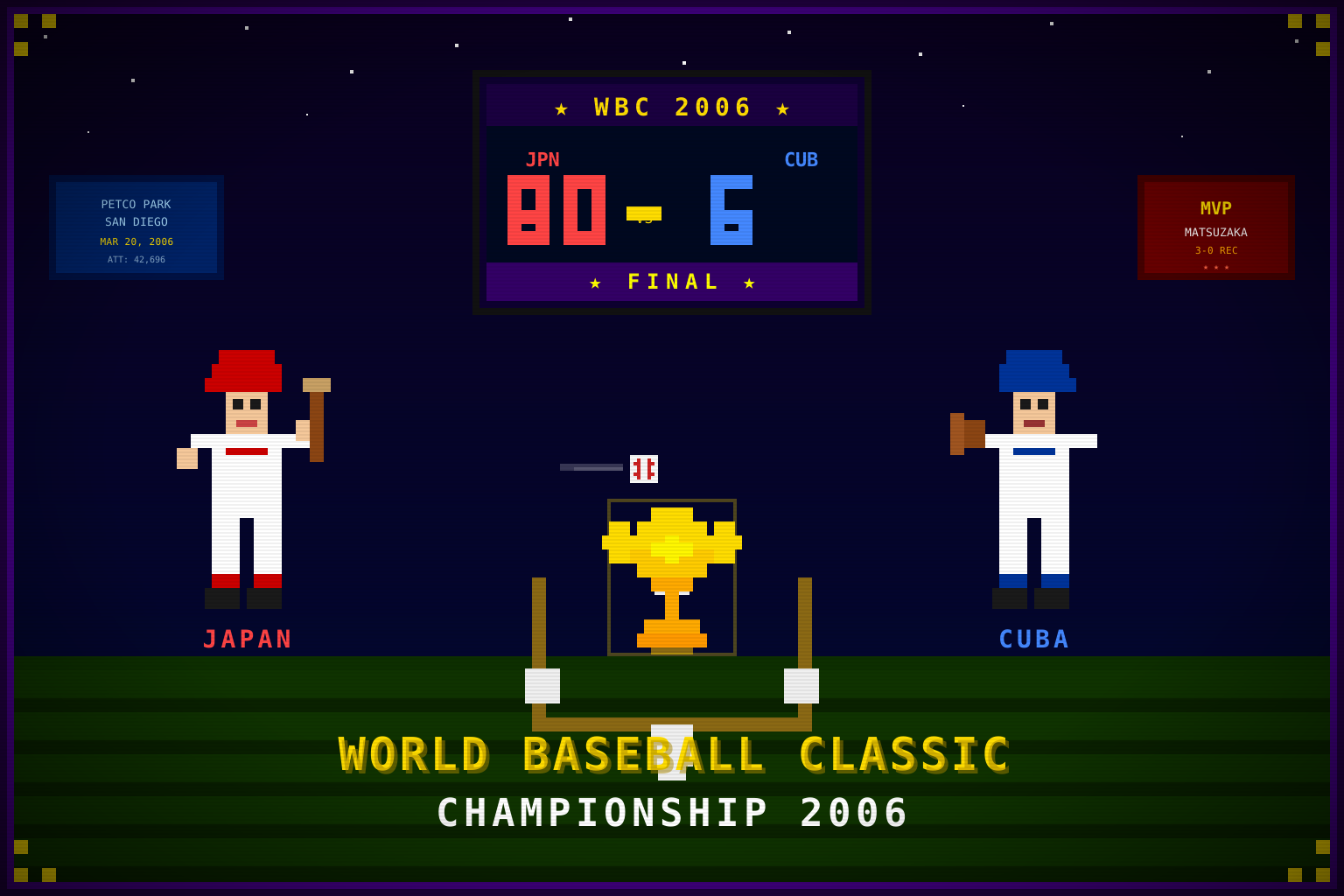
Key figures — Japan national team (managed by Sadaharu Oh), Daisuke Matsuzaka (tournament MVP), Cuba national team, USA, South Korea, Puerto Rico; WBC organized jointly by Major League Baseball and the Major League Baseball Players Association.
Summary
The 2006 World Baseball Classic was the inaugural edition of a new international baseball championship, held from March 3–20, 2006, across four countries. Sixteen national teams were divided into four first-round pools: Pool A in Tokyo, Japan; Pool B in Orlando, Florida; Pool C in Scottsdale, Arizona; and Pool D in San Juan, Puerto Rico. Teams played round-robin pool play in the first two rounds before advancing to single-elimination semifinals and a final, all held at Petco Park in San Diego, California.
Japan defeated Cuba 10–6 in the final on March 20, 2006, at Petco Park in San Diego, claiming the inaugural championship before a crowd of 42,696 spectators. Japan’s right-hander Daisuke Matsuzaka was named tournament Most Valuable Player after compiling a 3–0 record across the tournament. He would sign with the Boston Red Sox the following year after the Red Sox won his negotiating rights with a then-record posting bid of $51.1 million.
Cuba’s team — composed entirely of non-MLB players due to U.S. embargo restrictions — reached the final by advancing from its second-round pool and defeating the Dominican Republic 3–1 in the semifinal. The Dominican Republic, despite boasting one of the most talent-rich rosters, was eliminated in the second round.
Tournament Format and Controversy
The WBC featured 16 nations in four first-round pools, with the top two from each pool advancing to a second round also contested as round-robin pool play. A scoring controversy arose in the USA–Japan second-round game on March 12: umpire Bob Davidson, on a U.S. appeal, ruled that a Japanese base runner had left third base too early on a sacrifice fly and reversed what would have been a go-ahead run. The United States won the game 4–3, and the disputed call became a point of tension between American and Japanese baseball officials.
The United States, despite fielding a roster of active MLB All-Stars including Derek Jeter, Alex Rodriguez, and Roger Clemens, was eliminated in the second round — a result that surprised organizers and highlighted how evenly baseball talent had spread globally. South Korea emerged as the tournament’s surprise, winning all six of its games in the first two rounds — including two victories over Japan — before losing to Japan in the semifinal.
Japan’s Path to the Championship
| Round | Opponent | Result |
|---|---|---|
| Pool A (Round 1) | China | W 18–2 |
| Pool A (Round 1) | Chinese Taipei | W 14–3 |
| Pool A (Round 1) | South Korea | L 2–3 |
| Second round | United States | L 3–4 (disputed) |
| Second round | Mexico | W 6–1 |
| Second round | South Korea | L 1–2 |
| Semifinal | South Korea | W 6–0 |
| Final | Cuba | W 10–6 |
Japan finished the second round 1–2 and advanced only after Mexico defeated the United States on the final day, breaking a three-way tie in Japan’s favor. The team then won its last two games decisively — a 6–0 semifinal over South Korea (its first win over the Koreans after two earlier losses) and the 10–6 final over Cuba. Manager Sadaharu Oh — the all-time professional home-run record holder with 868 career home runs in Japanese baseball — guided a squad combining veteran NPB stars with returnees from MLB rosters.
Significance
The 2006 World Baseball Classic was the first international baseball tournament sanctioned by Major League Baseball and featuring active MLB players, distinguishing it from Olympic baseball, which had been contested with rosters drawn primarily from non-MLB professionals. The tournament drew a combined attendance of 737,112 fans across all venues and an estimated global television audience in the tens of millions, validating the commercial and sporting case for a periodic international competition. It took its place among the marquee sporting events of 2006, a year that also featured the 2006 FIFA World Cup in Germany and the 2006 Winter Olympics in Turin.
Japan’s victory in the inaugural tournament launched a quadrennial tradition. Japan would go on to win the 2009 Classic as well, cementing its status as the dominant international baseball nation of that era. The WBC elevated the international profile of the sport at a moment when baseball was losing ground to soccer and American football in global popularity surveys, and demonstrated that national pride could draw elite players who typically competed only within professional league structures.
The tournament also marked the formal end of the Olympic era for baseball: the sport was voted off the 2012 Olympic program by the IOC in July 2005 (a decision reversed only for the 2020 Tokyo Olympics, in a 2016 vote), making the WBC effectively the sport’s premier world championship going forward.
Sources
- Wikipedia: “2006 World Baseball Classic”
- Wikipedia: “2006 World Baseball Classic championship round”
- Baseball Reference: “2006 World Baseball Classic”