Key figures: Abu Musab al-Zarqawi (leader of al-Qaeda in Iraq); Ibrahim al-Jaafari (Prime Minister of Iraq at the time of the bombing); Nouri al-Maliki (Prime Minister from May 2006); Grand Ayatollah Ali al-Sistani (senior Shia religious authority); Muqtada al-Sadr (Shia cleric and militia leader)
Summary
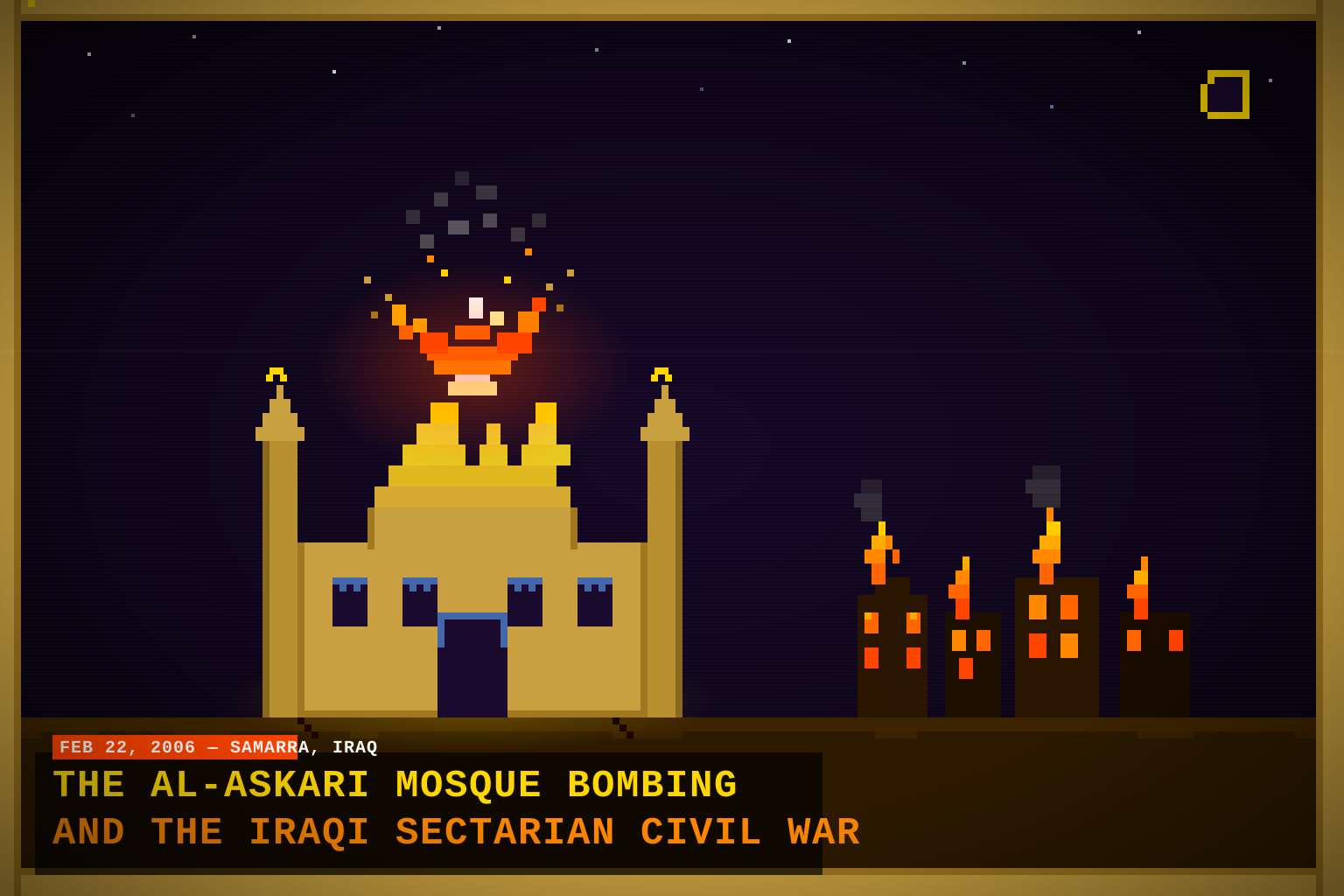
On the morning of February 22, 2006, at approximately 6:44 a.m., attackers destroyed the golden dome of the al-Askari Shrine in Samarra, north of Baghdad—one of the holiest sites in Shia Islam. A group of men dressed as Iraqi security forces entered the shrine before dawn, bound the guards, planted explosives, and detonated two bombs that collapsed the celebrated golden dome and severely damaged the structure. No one was killed in the blast itself, but the destruction of the shrine set off a wave of reprisal killings across Iraq.
The shrine houses the tombs of the tenth and eleventh Shia Imams, Ali al-Hadi and Hasan al-Askari, and adjoins the site associated with the occultation of the twelfth Imam, Muhammad al-Mahdi. Its desecration was received by many Shia Iraqis as an assault on the faith itself. Within hours, Shia crowds attacked Sunni mosques; the Association of Muslim Scholars reported roughly 168 Sunni mosques attacked in the two days that followed, along with the killing of Sunni clerics and worshippers. Over the following days sectarian killings escalated sharply: authorities recovered more than a hundred bodies the next day, and widely cited estimates place the death toll from the immediate reprisals in the many hundreds to well over a thousand.
No group claimed direct responsibility, but the attack was widely attributed to al-Qaeda in Iraq (AQI), the Sunni jihadist network led by Abu Musab al-Zarqawi, whose stated strategy was to provoke a Shia–Sunni civil war that would collapse the U.S.-backed political process. The bombing is generally regarded as the event that tipped Iraq’s simmering communal tensions into open sectarian civil war.
Background
By early 2006 Iraq was nearly three years into the U.S.-led occupation that followed the March 2003 invasion. A transitional government under Prime Minister Ibrahim al-Jaafari was in office, and the December 2005 parliamentary elections had produced a Shia-led bloc but no durable governing coalition. An insurgency dominated by Sunni Arab groups—including al-Qaeda in Iraq—had waged a campaign of bombings and assassinations, while Shia militias such as the Mahdi Army and the Badr Organization had grown in strength and increasingly operated as death squads.
Zarqawi’s network had for months pursued a deliberate strategy of attacking Shia civilians, pilgrims, and religious sites in order to goad the Shia majority into retaliation and unravel any prospect of a shared national government. The al-Askari Shrine, revered across the Shia world and located in a predominantly Sunni city, was a target chosen for maximum sectarian effect.
The attack
Accounts indicate that between five and seven men wearing the uniforms of Iraqi special forces entered the al-Askari compound in the pre-dawn hours, overpowered and tied up the small guard detail, and placed explosives beneath the dome. The two explosions destroyed the shrine’s landmark golden dome and roughly three-quarters of the surrounding structure, leaving a gaping hole where the gilded cupola had stood. Because the attack occurred before the shrine filled with worshippers, there were no fatalities in the explosion.
Images of the shattered dome circulated immediately across Iraqi and international media, carrying an emotional charge far beyond the physical damage. For many Shia the destruction was not merely an act of terrorism but a profound religious violation demanding a response.
Sectarian violence and civil war
The reprisals were swift and widespread. Shia mobs and militiamen attacked Sunni mosques, clerics, and neighborhoods across Baghdad and the mixed provinces of central Iraq. The Association of Muslim Scholars, a leading Sunni body, reported roughly 168 mosques attacked and dozens of its members killed or abducted in the days after the bombing. The Iraqi government imposed daytime curfews in Baghdad and surrounding provinces in an attempt to halt the violence.
The bombing accelerated a cycle of tit-for-tat killings—car bombings, mortar attacks, and the discovery of bound and tortured bodies—that hardened Baghdad’s mixed neighborhoods into segregated Sunni and Shia enclaves and drove mass internal displacement. Estimates of the sectarian violence over the whole of 2006 run into the tens of thousands of deaths; a United Nations tally recorded roughly 34,000 Iraqi civilians killed in 2006, making it the deadliest year of the war to that point. Many analysts and later official assessments identified the Samarra bombing as the turning point after which Iraq’s conflict is best described as a sectarian civil war.
Religious and political leaders sought to contain the bloodshed. Grand Ayatollah Ali al-Sistani, the most senior Shia cleric in Iraq, called for calm and forbade attacks on Sunnis and their mosques, while cautioning that the state must protect holy sites. Muqtada al-Sadr likewise urged restraint and said his followers should help guard Sunni mosques—though elements of his Mahdi Army were among those blamed for reprisal killings. The instability contributed to the collapse of Jaafari’s premiership; Nouri al-Maliki formed a new government in May 2006. Zarqawi, the man most associated with the strategy behind the attack, was killed in a U.S. airstrike on June 7, 2006.
Aftermath and reconstruction
A second attack on June 13, 2007 destroyed the shrine’s two surviving ten-story minarets, reigniting sectarian tensions the following year. Reconstruction of the badly damaged complex proceeded slowly amid the continuing conflict; the rebuilt golden dome was completed and the shrine reopened in April 2009, with further restoration of the minarets and interior continuing thereafter.
Significance
The al-Askari Mosque bombing was one of the most consequential single acts of the Iraq War. Though it killed no one directly, it functioned as a detonator for the sectarian civil war that defined 2006—the war’s bloodiest year—reshaping Baghdad along sectarian lines, displacing hundreds of thousands of Iraqis, and demonstrating how an attack on a symbol could inflict far greater harm than an attack on people.
It vindicated, in the short term, Zarqawi’s strategy of provoking communal war, and the deteriorating security situation it helped create became a central factor in the U.S. decision to launch the troop “surge” of 2007. The bombing endures as a case study in how the destruction of sacred sites can be weaponized to fracture a society along religious lines.