Key figures: Steve Jobs (Apple CEO and chief architect of the iTunes strategy), the four major record labels (Universal, Sony BMG, Warner, EMI) who negotiated the $0.99 pricing model
Summary
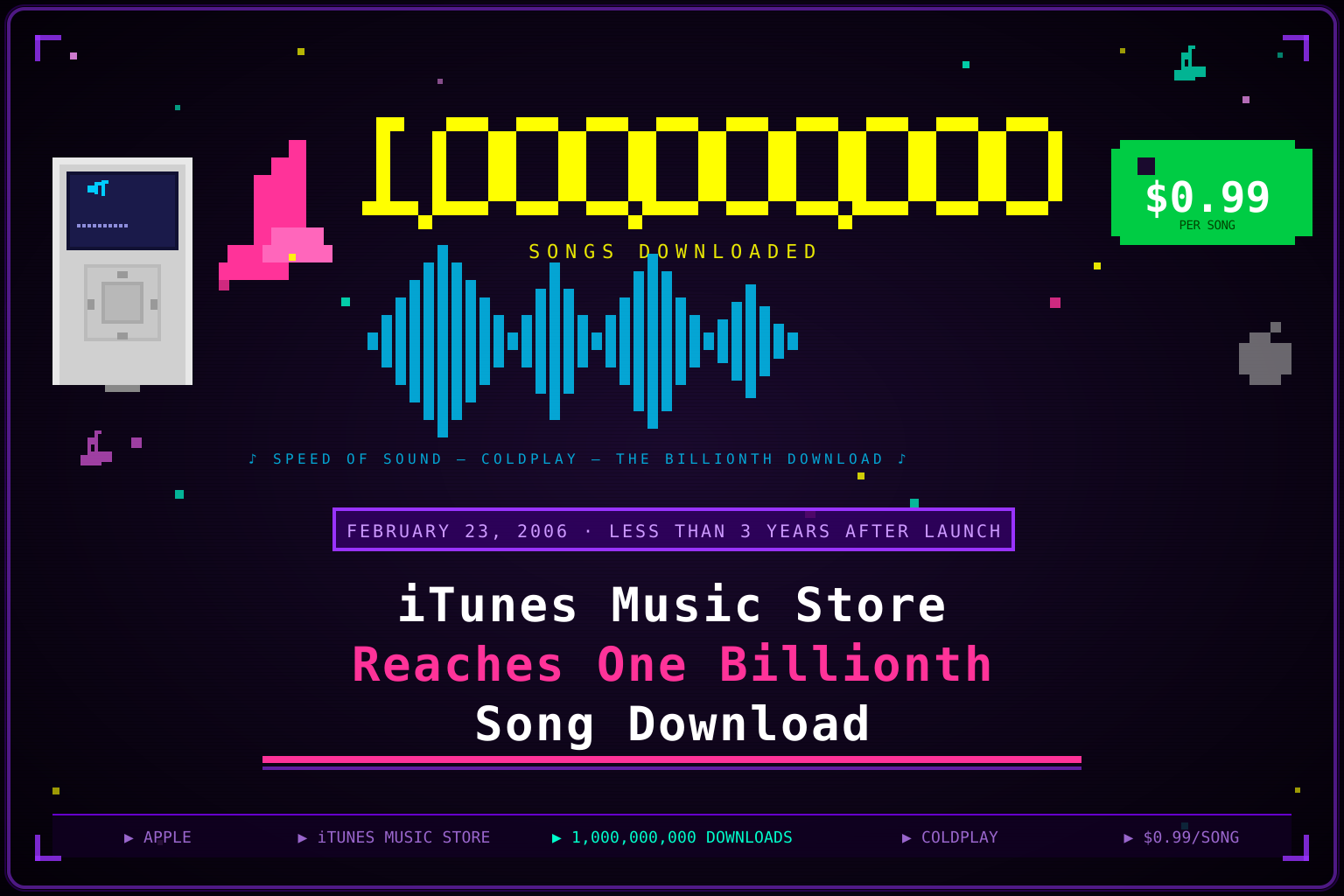
On February 23, 2006, the iTunes Music Store achieved a historic milestone: the sale of its one billionth song download. The achievement came in less than three years after the iTunes Music Store’s launch on April 28, 2003 — a rate of growth that caught industry analysts and record labels off guard. The billionth track was “Speed of Sound” by Coldplay, purchased by Alex Ostrovsky of West Bloomfield, Michigan. Apple marked the occasion with a promotional prize: Ostrovsky received a 20-inch iMac, ten fifth-generation iPods, and a $10,000 iTunes gift card, and Apple established a scholarship in his name at the Juilliard School of Music.
The iTunes Music Store’s rapid growth to one billion downloads validated a specific business model — per-track purchases at a flat $0.99 per song — that Steve Jobs had negotiated with the major labels by arguing that a cheap, legal, convenient alternative to peer-to-peer file-sharing networks would grow the industry’s revenue rather than cannibalize it. By February 2006, the evidence supported that thesis: iTunes was generating hundreds of millions of dollars annually, and the major labels, which had initially resisted digital distribution, were locked into the iTunes ecosystem as the dominant legal channel.
The Competitive Landscape iTunes Displaced
When iTunes launched in April 2003, it entered a market dominated by illegal file-sharing. Peer-to-peer networks including Kazaa (which at its peak in 2003 hosted over 100 million users) and LimeWire offered millions of songs for free, albeit with significant malware risks and inconsistent audio quality. Legal alternatives — Pressplay, Musicnet — had failed to gain traction due to subscription lock-in, limited catalogues, and DRM restrictions so onerous that downloaded tracks could not be burned to CD. iTunes succeeded partly by negotiating relatively permissive DRM (five authorised computers, unlimited CD burning) and by pricing individual songs low enough to compete psychologically with the perceived “cost” of piracy.
By February 2006, iTunes operated in 22 countries with a catalogue of over 2 million songs — a number that seemed vast in 2006 but would look modest against Spotify’s 80 million-plus tracks by 2023.
The iPod Flywheel
The iTunes milestone cannot be separated from the simultaneous explosion in iPod sales. Apple sold its millionth iPod in 2003 and announced the three-millionth in May 2004; cumulative sales passed 10 million by the end of 2004 and reached roughly 42 million by the end of 2005, with more than 14 million units sold in the 2005 holiday quarter alone. The iPod-iTunes feedback loop — buy an iPod, stock it through iTunes; discover iTunes, want a better iPod — was Apple’s most successful hardware-software integration prior to the iPhone and represented a new model for consumer electronics companies seeking recurring revenue from hardware users.
Significance
Validation of the Legal Digital Music Market
The billionth download represented conclusive proof, in units sold, that consumers would pay for digital music under the right conditions: convenient discovery, fair pricing, and sufficient catalogue depth. Record labels, which had fought digital distribution through litigation (the RIAA had filed over 20,000 lawsuits against individual file-sharers by 2006), began to accept that legal retail channels could generate sustainable revenue. Within two years of the milestone, all four major labels had removed DRM from at least some iTunes catalogue content, acknowledging that the lock-in mechanism was a competitive liability rather than a protection.
Apple’s Pivot to Services and Ecosystem
iTunes’ success was the first major demonstration that Apple could generate durable revenue from software and services — not just from hardware margins. The iTunes-iPod ecosystem created a closed, proprietary loop: Apple’s software drove hardware sales, and hardware ownership drove software engagement. This template was carried forward into the iTunes-iPhone-App Store ecosystem (2007–08) and eventually into Apple Music, Apple TV+, and the broader Apple services business that by 2023 generated over $85 billion annually. The 2006 milestone was the earliest large-scale proof that this model could scale.
Structural Shift Away from Physical Media
By February 2006, CD sales were already declining from their 2000 peak of approximately 942.5 million units (according to RIAA data). The iTunes milestone accelerated industry acceptance that the album — as a physical, twelve-track retail unit — was no longer the primary format for music consumption. The transition moved from individual track purchases (the iTunes model) to streaming subscriptions (Spotify launched in 2008, Apple Music in 2015), but iTunes’ $0.99 single was the intermediate form that demonstrated consumer willingness to pay for access to individual songs rather than album bundles.
Precursor to the Streaming Transition
Streaming services like Spotify (2008) and Apple Music (2015) would later surpass the per-track purchase model in revenue and users, but the iTunes Music Store’s success was the necessary prerequisite. It proved: (1) consumers would pay rather than pirate when the experience was sufficiently frictionless; (2) the major labels could negotiate digital licensing at scale; and (3) technology companies, not traditional music retailers, would own the distribution layer of the industry. Each of these premises was foundational to the streaming era’s economics.
Related
- Twitter launches — another 2006 milestone in the consolidation of the internet as a consumer media platform
- Google acquires YouTube — the $1.65 billion YouTube acquisition in the same year reflected the same logic: digital distribution of media through internet platforms
- The Web 2.0 revolution — the broader context of platform and user-generated media in which iTunes operated
- Facebook launches the News Feed — another 2006 feature launch that reshaped how digital content was distributed and consumed