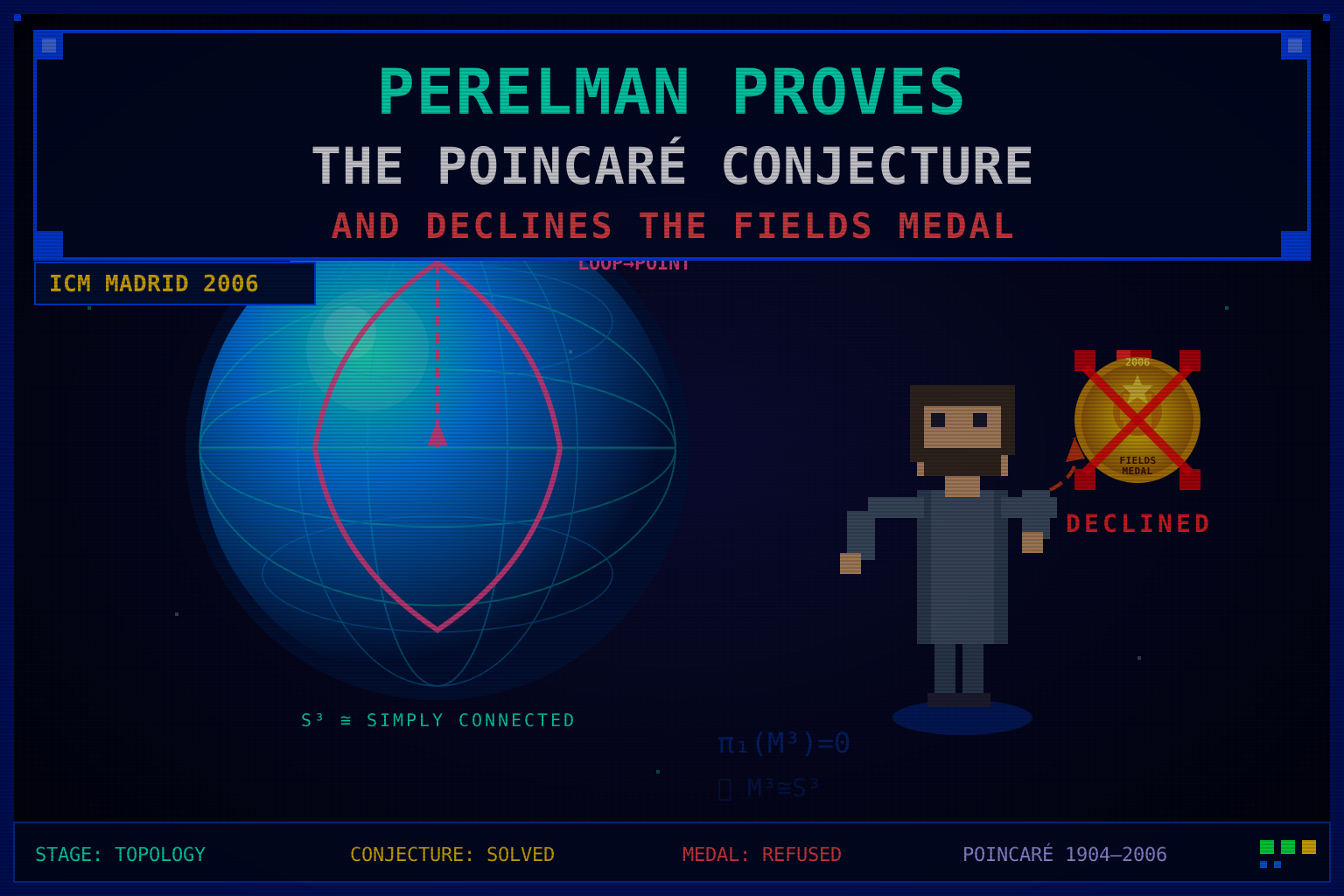
Key figures — Grigori Perelman (Russian mathematician); Henri Poincaré (who posed the conjecture in 1904); Richard S. Hamilton (originator of the Ricci flow program); John M. Ball (president of the International Mathematical Union); fellow 2006 Fields laureates Andrei Okounkov, Terence Tao, and Wendelin Werner.
Summary
On August 22, 2006, at the opening ceremony of the International Congress of Mathematicians (ICM) in Madrid, the International Mathematical Union (IMU) awarded four Fields Medals — the discipline’s highest honour, often described as the “Nobel Prize of mathematics.” One of the recipients was the Russian mathematician Grigori Perelman, cited for his work resolving the Poincaré conjecture, a problem in topology that had stood unsolved since Henri Poincaré posed it in 1904. Perelman did not attend the ceremony and declined the medal, becoming the first mathematician ever to refuse the award since its establishment in 1936.
Perelman’s proof, distributed in three terse preprints posted to the arXiv repository between November 2002 and July 2003, completed a program conceived by the American mathematician Richard S. Hamilton using a geometric technique called Ricci flow. Over the following three years, independent teams of mathematicians verified and expanded Perelman’s arguments, confirming that he had proved not only the Poincaré conjecture but the more general geometrization conjecture of William Thurston. The Poincaré conjecture was one of the seven Millennium Prize Problems designated by the Clay Mathematics Institute in 2000, each carrying a US$1 million reward — making it the first, and to date only, of those problems to be solved.
The Problem: Poincaré’s Question, 1904
The Poincaré conjecture concerns the classification of three-dimensional manifolds — spaces that look locally like ordinary three-dimensional space. Henri Poincaré, one of the founders of topology, asked in 1904 whether every closed three-dimensional manifold on which every loop can be continuously contracted to a point (a property called being “simply connected”) must be topologically equivalent to the three-dimensional sphere. Informally, the conjecture holds that the 3-sphere is the only “hole-free” closed three-dimensional shape.
The analogous statements in other dimensions had already been settled: Stephen Smale proved the conjecture for dimensions five and higher in 1961, and Michael Freedman proved the four-dimensional case in 1982 — both efforts recognized with Fields Medals of their own. Paradoxically, the original three-dimensional case proved the most stubborn, resisting proof for nearly a century and acquiring a reputation as one of mathematics’ most formidable open problems.
Hamilton’s Program and Ricci Flow
The path to a solution ran through Ricci flow, a technique introduced by Richard Hamilton in the 1980s. Ricci flow deforms the geometry (the “metric”) of a manifold over time in a way loosely analogous to how heat diffuses through a material, smoothing out irregularities in curvature. Hamilton showed that under favourable conditions the flow could reshape a manifold toward a recognizable standard form, and in 1999 he outlined a program suggesting that Ricci flow might resolve both the Poincaré and geometrization conjectures.
The obstacle was that the flow could develop singularities — points where curvature becomes infinite and the process appears to break down. Hamilton was unable to control all of these singularities in three dimensions, and his program stalled. Perelman’s decisive contribution was a rigorous method for analyzing and managing these singularities through a controlled procedure known as “Ricci flow with surgery,” together with new estimates that ruled out pathological behaviour. This allowed the flow to be continued past the singular moments and carried to completion.
Perelman’s Proof and Its Verification
Rather than submit his work to a peer-reviewed journal, Perelman posted three preprints to the arXiv — in November 2002, March 2003, and July 2003 — running to only a few dozen pages and written in a highly compressed style that left many steps for readers to reconstruct. In 2003 he toured universities in the United States, including MIT, Princeton, and Stony Brook, lecturing on the results before largely withdrawing from public mathematical life.
Because the preprints were so condensed, the mathematical community undertook a multi-year effort to check them in full detail. Between 2006 and 2008, three independent expositions filled in the arguments: Bruce Kleiner and John Lott; Huai-Dong Cao and Xi-Ping Zhu; and John Morgan and Gang Tian. Their consensus confirmed that Perelman’s work was complete and correct, establishing both the Poincaré and geometrization conjectures. The verification process itself became a subject of controversy over the proper attribution of credit, but the essential result — that Perelman had solved the problem — was not disputed.
Declining the Honours
Perelman’s refusal of the Fields Medal was without precedent. IMU president John Ball travelled to Saint Petersburg and, over two days, tried to persuade him to accept, but Perelman declined. He is widely reported to have regarded the prize as irrelevant to the work itself, remarking that if a proof is correct, no other recognition is needed, and telling one interviewer, “I’m not interested in money or fame; I don’t want to be on display like an animal in a zoo.” He also expressed disaffection with what he saw as ethical lapses and unfair credit distribution within the profession.
In March 2010 the Clay Mathematics Institute announced that Perelman had earned the US$1 million Millennium Prize for the Poincaré conjecture. He declined that award as well, in July 2010, stating that he considered the recognition unfair because it did not adequately credit Hamilton, whose program his proof had completed. By then Perelman had withdrawn almost entirely from mathematics and public life, living quietly in Saint Petersburg, where he was born on June 13, 1966.
Significance
The resolution of the Poincaré conjecture was the most celebrated event in pure mathematics of the 2000s. It closed a problem that had defined three-dimensional topology for a century, validated Hamilton’s Ricci flow as one of the most powerful tools in modern geometry, and remains the only Millennium Prize Problem to have been solved. The Ricci flow methods Perelman refined have since found application across geometric analysis.
Perelman’s twin refusals — of the Fields Medal in 2006 and the Millennium Prize in 2010 — made him a singular figure in the public imagination, an archetype of the disinterested genius indifferent to reward. His story drew unusual mainstream attention to abstract mathematics and prompted lasting discussion about how the discipline recognizes and attributes discovery.
The 2006 award ceremony sat within a notable year for the sciences, arriving two days before the International Astronomical Union’s contentious vote in Prague to reclassify Pluto as a dwarf planet — two late-August decisions by international scientific bodies that each, in very different fields, redrew a long-settled boundary.
Sources
- Wikipedia: “Grigori Perelman”
- Britannica: “Grigori Perelman”
- Science (Sept. 15, 2006): “Perelman Declines Math’s Top Prize; Three Others Honored in Madrid”
- International Mathematical Union — 2006 Fields Medal citations, International Congress of Mathematicians, Madrid