Key figures: Warren Buffett (chairman and CEO of Berkshire Hathaway); Bill Gates and Melinda French Gates (co-chairs of the Bill & Melinda Gates Foundation); Carol Loomis (Fortune editor-at-large who reported the pledge); Susan Thompson Buffett (Buffett’s late wife, d. 2004); Howard G. Buffett, Susan A. Buffett, and Peter Buffett (his children)
Summary
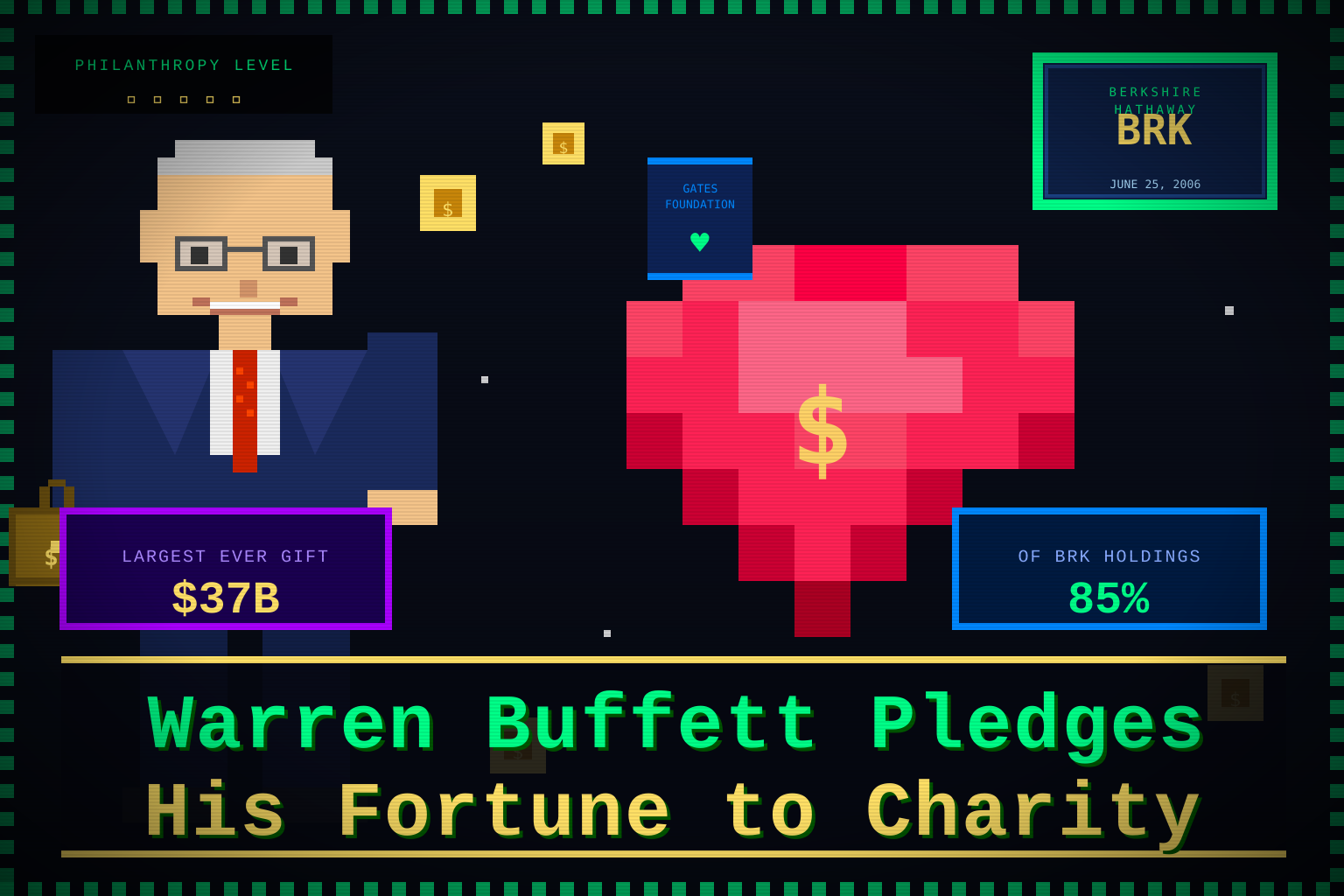
On June 25, 2006, the investor Warren Buffett announced that he would gradually give away about 85 percent of his Berkshire Hathaway holdings — valued at approximately $37 billion at the time — to five philanthropic foundations. The pledge, disclosed in an exclusive article by Fortune editor-at-large Carol Loomis and formalized at a June 26 event at the New York Public Library, was the largest charitable gift in American history to that point. The bulk of the gift — the great majority of the pledged shares — was directed to the Bill & Melinda Gates Foundation, then already the world’s largest private foundation, roughly doubling its giving capacity. The remainder went to four Buffett family foundations. The announcement reframed Buffett’s public identity from that of the world’s most successful investor to one of history’s most consequential philanthropists, and it linked the fortunes of two of the era’s wealthiest Americans to a single global health and development agenda.
The Pledge
Buffett committed to donate about 10 million Class B–equivalent Berkshire Hathaway shares to the Gates Foundation and additional shares to four family foundations, together amounting to roughly 85 percent of his net worth. Rather than transfer the stock in a single block, Buffett structured the gift as an annually declining series of contributions: the first installment, delivered in July 2006, was 602,500 Class B shares to the Gates Foundation, with the number of shares to be reduced by 5 percent each year thereafter. Because the gifts were denominated in shares rather than dollars, their cash value would rise or fall with Berkshire’s stock price.
The recipients were:
- The Bill & Melinda Gates Foundation, which received the largest share — worth roughly $30–31 billion at the time of the announcement.
- The Susan Thompson Buffett Foundation, named for Buffett’s first wife, who had died in 2004.
- The Howard G. Buffett Foundation, the Sherwood Foundation (led by his daughter, Susan A. Buffett), and the NoVo Foundation (led by his son, Peter Buffett) — the three foundations run by his children.
Buffett attached conditions to the Gates gift: each year’s donation had to be spent, along with an equal amount from the foundation’s own resources, within the year it was received, and both Bill and Melinda Gates had to remain active in the foundation’s work for the pledge to continue.
Background and Motivation
Buffett had long signaled that he intended to give away nearly all of his wealth, but he had originally planned for the bulk of it to be distributed by the Susan Thompson Buffett Foundation after his death, with his wife overseeing the effort. Her death in 2004 prompted him to reconsider both the timing and the mechanism. Rather than build out a large philanthropic organization of his own, Buffett chose to channel most of his giving through an existing institution whose scale, management, and priorities he admired.
Buffett and Bill Gates had been close friends since 1991, and Buffett had served as a trustee of the Gates Foundation. In explaining his decision, Buffett said he believed in finding people already skilled at a task rather than learning it himself — applying to philanthropy the same logic of delegating to able managers that governed his investing. The gift came just weeks after Gates announced, on June 15, 2006, that he would transition out of a full-time role at Microsoft by 2008 to concentrate on the foundation’s work.
Significance
The pledge was, at the time, the single largest act of charitable giving on record, and it dramatically enlarged the resources available for the Gates Foundation’s priorities in global health, infectious disease, and education. Combined with the Gateses’ own endowment, Buffett’s contribution helped make the foundation a dominant force in global public health, comparable in some areas to the budgets of United Nations agencies.
The announcement also carried symbolic weight. By giving during his lifetime, through an outside institution, and by tying the gift to measurable annual spending, Buffett offered a widely discussed model for large-scale philanthropy that emphasized effectiveness over the perpetual accumulation of endowment. Four years later, in 2010, Buffett and the Gateses would launch The Giving Pledge, a public campaign encouraging the world’s wealthiest individuals to commit the majority of their wealth to charity — an initiative that grew directly out of the ideas behind the 2006 gift. Buffett’s decision stood in deliberate contrast to dynastic wealth transfer; he had repeatedly argued that leaving vast fortunes to one’s children was neither fair nor socially useful.
Sources
- Wikipedia: Warren Buffett — Biography, philanthropy, and the 2006 pledge.
- Wikipedia: The Giving Pledge — The 2010 campaign that grew out of the 2006 gift.
- NPR: Buffett Promises Fortune to Gates Foundation — Contemporary reporting on the pledge and its annual-gift structure.
- The Giving Pledge: Warren Buffett — Buffett’s own account of his giving commitment.
</content> </invoke>