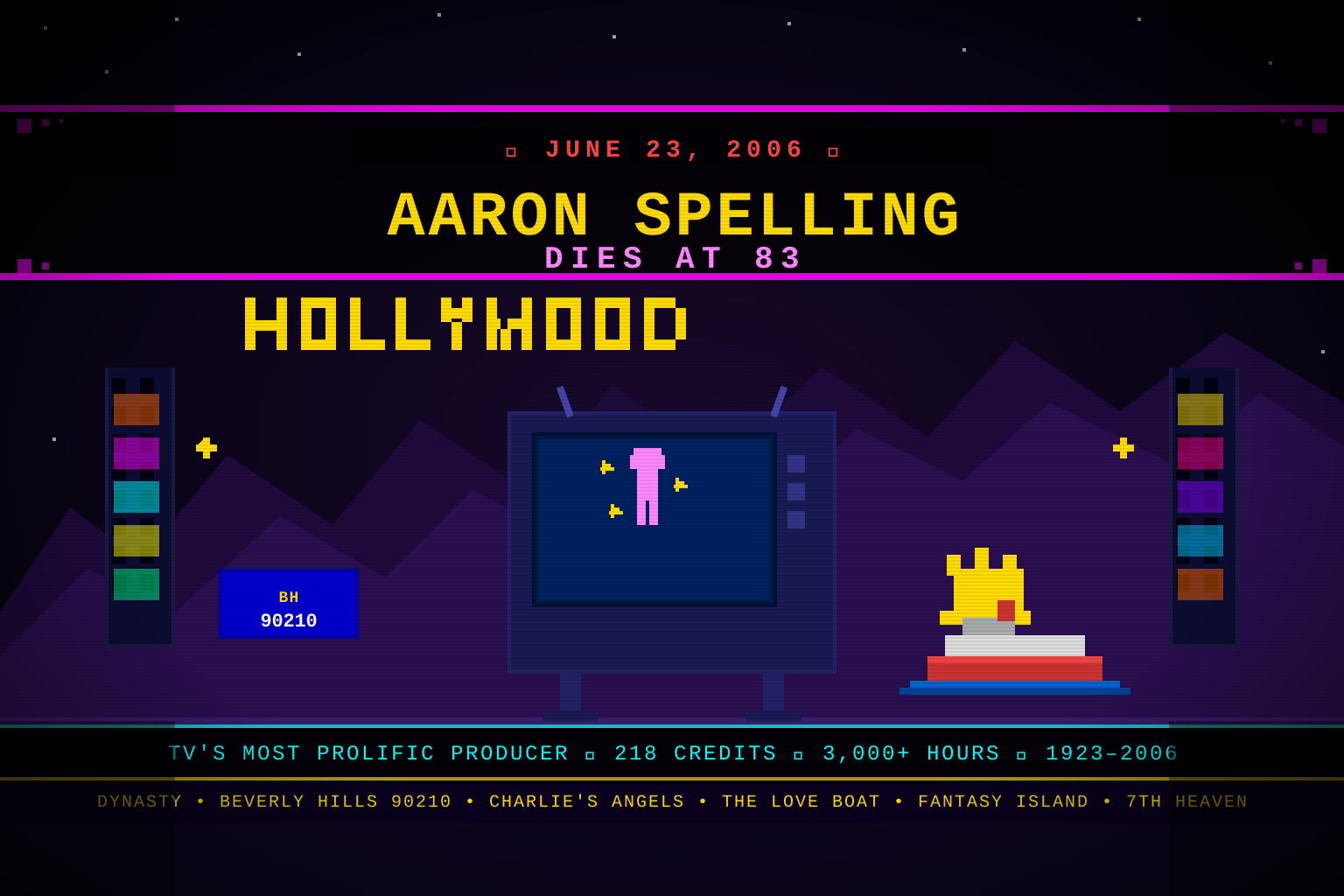
Category: People
Key figures: Aaron Spelling (producer, 1923–2006), Candy Spelling (wife), Tori Spelling (daughter), Randy Spelling (son)
Summary
Aaron Spelling, the most prolific television producer in American television history, died on June 23, 2006, at age 83 from complications of a stroke suffered on June 18, 2006, at his Holmby Hills mansion in Los Angeles. Spelling’s extraordinary career spanned nearly six decades and produced an estimated 3,000+ hours of television across 218 producer and executive-producer credits — more than any other individual in television history, a record recognized by the Guinness Book of Records.
Spelling’s production empire created some of the defining television franchises of the late 20th century, including the soap-opera spectacle Dynasty (1981–1989), the teen-oriented cultural phenomenon Beverly Hills, 90210 (1990–2000), the action-adventure series Charlie’s Angels (1976–1981), the romantic shipboard comedy-drama The Love Boat (1977–1986), the fantasy anthology Fantasy Island (1977–1984), the serialized melodrama Melrose Place (1992–1999), and the long-running family drama 7th Heaven (1996–2007). Beyond his television output, Spelling also produced numerous made-for-TV movies and theatrical films, cementing his status as Hollywood’s most commercially successful and prolific producer.
Early Life and Career Beginnings
Background
Aaron Spelling was born on April 22, 1923, in Dallas, Texas, the son of Russian Jewish immigrant parents, David and Pearl (née Wald) Spelling. Growing up in poverty during the Depression, Spelling later recalled that his childhood desire to escape hardship through storytelling drove him toward entertainment. He served in the United States Army Air Forces during World War II, experiencing front-line service that he credited with shaping his understanding of human drama.
After the war, Spelling enrolled at Southern Methodist University (SMU) in Dallas, where he studied theater and graduated in 1949. He then moved to Hollywood in the early 1950s, initially pursuing acting — he appeared in small roles in films such as Vicki (1953) and television dramas of the era — before discovering that his talents lay in writing and production.
Transition to Production
Spelling co-wrote and produced Burke’s Law (1963–1966), a detective drama starring Gene Barry, which introduced elements of the glamorous, celebrity-guest-studded format he would later perfect. He then co-created The Mod Squad (1968–1973) with Danny Thomas, a groundbreaking crime drama that cast three young counterculture protagonists — a runaway heiress, a young Black man from Watts, and a white suburban dropout — as undercover police informants. The Mod Squad was one of the first U.S. network dramas to feature a racially integrated main cast and was nominated for multiple Emmy Awards during its five-year run.
Key Productions
Spelling Entertainment
In 1972, Spelling formed Spelling–Goldberg Productions in partnership with Leonard Goldberg, then operating through ABC. The partnership produced some of the defining television dramas of the 1970s:
- Starsky & Hutch (1975–1979) — buddy-cop action drama that became a global hit
- Charlie’s Angels (1976–1981) — crime drama featuring three female private investigators, averaging over 50 million viewers per episode at its 1977 peak
- The Love Boat (1977–1986) — romantic anthology set aboard a Pacific Princess cruise ship, airing in over 90 countries and introducing the celebrity guest-star format at scale
In 1986 Spelling reorganized as Spelling Entertainment, which later went public and was eventually absorbed into Viacom, which acquired its remaining public shares by 1999. The corporate trajectory illustrated both the scale of Spelling’s output and the consolidation pressures reshaping television production by the late 1990s.
Dynasty (1981–1989)
Dynasty, premiering on ABC on January 12, 1981, became Spelling’s signature achievement in prestige melodrama. At its height in the 1984–1985 season, the show — starring John Forsythe as patriarch Blake Carrington and Joan Collins as the scheming Alexis — averaged 25 million viewers per episode in the United States and drew estimated global audiences of 100 million across 60 countries, making it one of the most-watched television programs in the world. The series ran for nine seasons and 220 episodes, earning 27 Primetime Emmy nominations and producing a spin-off (The Colbys, 1985–1987). The 1985 “Moldavian Massacre” cliffhanger — in which nearly the entire cast was gunned down at a royal wedding — remains one of the most-watched summer cliffhangers in television history.
Beverly Hills, 90210 (1990–2000)
Launched on Fox on October 4, 1990, Beverly Hills, 90210 shifted Spelling’s focus toward the emerging youth demographic that cable was just beginning to fragment. The show ran for ten seasons and 293 episodes, becoming the longest-running series on the Fox network. At its peak in 1993, it drew approximately 20 million viewers per episode. It launched the careers of Jason Priestley, Shannen Doherty, Ian Ziering, and Jennie Garth, and became a cultural touchstone of 1990s adolescent experience across the English-speaking world. A reboot (BH90210) aired on Fox in 2019, testifying to the franchise’s durability nearly three decades after its debut.
7th Heaven (1996–2007)
7th Heaven, which premiered on The WB on August 26, 1996, became Spelling’s longest-running individual series — 11 seasons and 243 episodes — and the longest-running series in The WB’s history. Though less critically celebrated than his earlier work, the family drama starring Stephen Collins and Catherine Hicks was one of The WB’s anchor franchises and consistently drew audiences of 6–8 million viewers through its middle seasons, demonstrating Spelling’s ability to adapt to the emerging network landscape of the 1990s.
Personal Life and Legacy
Family
Spelling was married twice: first to actress Carolyn Jones (later famous as Morticia Addams in The Addams Family) from 1953 to 1964, and then to Candy Marer (later known as Candy Spelling) in 1968. With Candy, he had two children: actress Tori Spelling (born May 16, 1973) and Randy Spelling (born October 9, 1978). Tori Spelling’s own entertainment career — including her role in Beverly Hills, 90210 and subsequent reality television work — became a subject of public fascination and occasionally strained family dynamics that the tabloid press documented extensively.
The Manor
Spelling accumulated substantial wealth across his career, culminating in the construction of “The Manor”, a 56,500-square-foot (5,249 m²) Holmby Hills mansion completed in 1991 that was, at the time, the largest single-family home in Los Angeles County. The estate included a bowling alley, ice skating rink, doll museum, wine cellar, and parking for 100 cars. Spelling’s estate was estimated at approximately $500 million at his death. Candy Spelling sold The Manor to heiress Petra Ecclestone in 2011 for a reported $85 million, the largest residential real estate transaction in Los Angeles history at that time.
2006 Context: A Year of Entertainment Losses
Spelling’s death in June 2006 was one of several significant losses in the American entertainment industry that year. Director Robert Altman died in November 2006, and Steve Irwin died in September. The clustering of these losses in a single year prompted widespread reflection on a generation of entertainment figures who had shaped 20th-century popular culture in distinctly different ways. Altman had crafted auteur cinema that challenged Hollywood convention; Spelling had mastered the industrial production of escapist television at a scale no individual producer had previously achieved or has since matched.
Significance
Aaron Spelling’s 2006 death marked the end of an era in American television production. His legacy — over 3,000 hours of content reaching hundreds of millions of viewers worldwide — represents an unparalleled commercial and cultural footprint in the medium. Spelling proved that television could be a vehicle for lavish, character-driven narratives aimed at mass audiences, and his shows’ longevity (many ran seven or more seasons) demonstrated the durability of well-crafted, star-driven melodrama.
In the early 2000s, when prestige television began its ascent through the HBO model — serious drama, limited series, auteur showrunners — Spelling’s passing symbolized a shift away from the studio-era mass-market producer toward the writer-led, anthology-focused model that would come to define television’s “Golden Age.” Yet the cultural phenomena Spelling created — Dynasty, Beverly Hills, 90210, Melrose Place — remain touchstones of their era and continue to influence television production, casting, and narrative design decades later. Dynasty was rebooted on The CW in 2017, running for five seasons; Melrose Place was rebooted briefly on The CW in 2009; both attest to the enduring brand recognition of franchises he created.
Sources
- Wikipedia: Aaron Spelling — biography, production credits, career overview, and legacy.
- NPR: Aaron Spelling Leaves a Lasting TV Dynasty — death announcement and career assessment.
- Al Jazeera: US TV producer Spelling dies — obituary and production history.
- The New York Times: Aaron Spelling, TV’s Hit Maker, Dies at 83 — detailed career retrospective.
- Guinness World Records: Most Prolific Television Producer — recognition of Spelling’s 218 credits.