Category: Arts & Culture Key figures: Michael Moore (director/producer); Harvey Weinstein (distributor); Donna Smith, Linda Peeno (featured subjects); Roger Mahony (Cardinal of Los Angeles); Tony Benn (British politician interviewed)
Summary
Michael Moore’s Sicko premiered at the Cannes Film Festival on May 19, 2007, and was released theatrically in the United States on June 22, 2007. The 123-minute documentary investigated the U.S. healthcare system, contrasting America’s for-profit insurance model with the universal systems in Canada, the United Kingdom, France, and Cuba. Produced on a budget of $9 million by The Weinstein Company and distributed through Lionsgate, the film combined Moore’s signature investigative approach with interviews with healthcare workers, patients, and policymakers across five nations.
The film opened on 441 screens in its wide-release weekend of June 29, 2007, earning $4.5 million — the second-highest documentary opening weekend in U.S. history at that point, behind Moore’s own Fahrenheit 9/11 ($23.9 million opening weekend in 2004). Sicko eventually grossed $36 million globally on its $9 million production budget, demonstrating sustained public appetite for healthcare policy discourse in a theatrical setting.
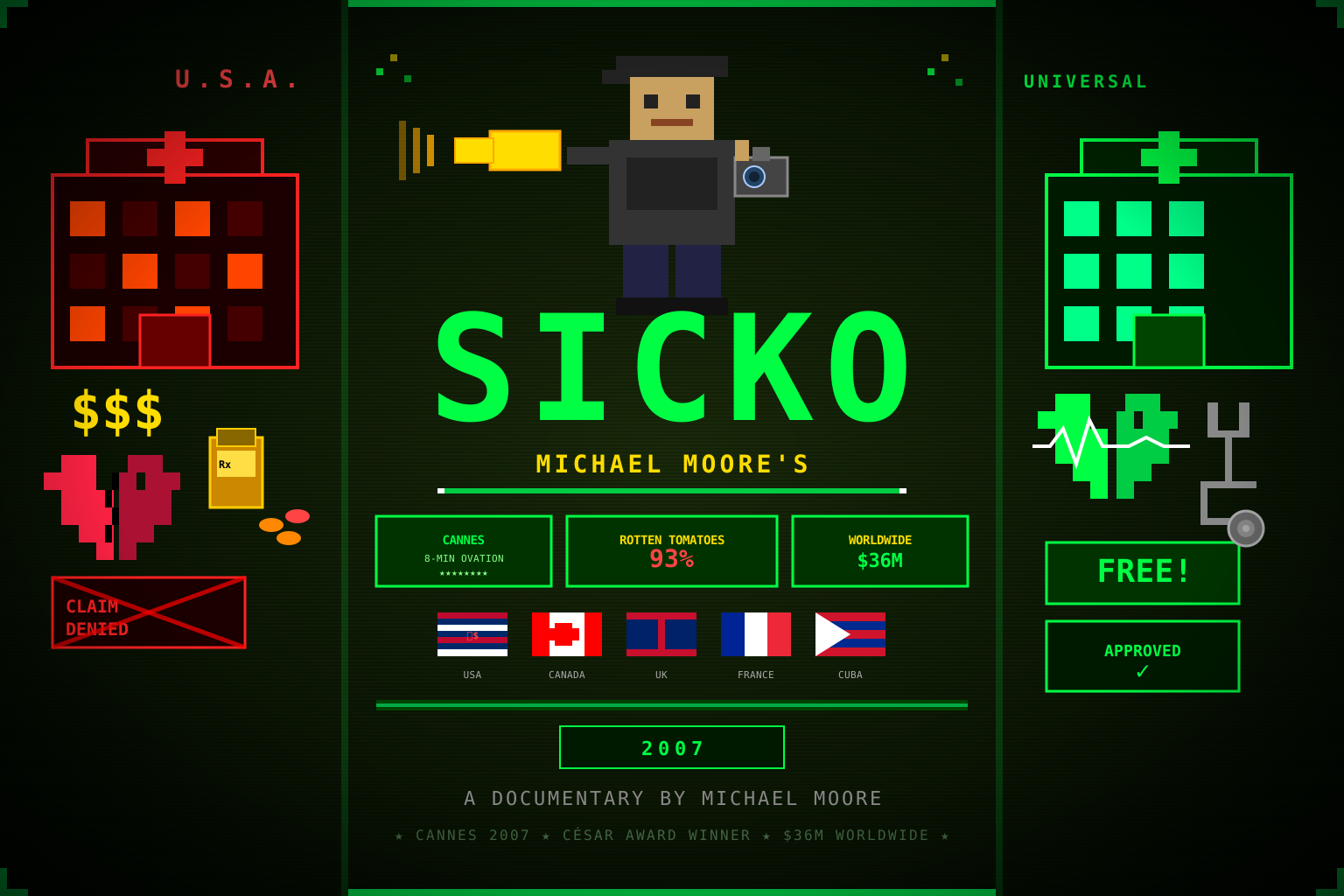
Sicko received an 8-minute standing ovation at its Cannes premiere on May 19, 2007. It achieved strong critical reception — 93% positive on Rotten Tomatoes and a score of 74/100 on Metacritic — and won the César Award (French Cinema Award) for Best Foreign Documentary in 2008.
Background & Production
Moore’s Prior Work
Sicko arrived at the peak of Michael Moore’s cultural prominence. His previous documentary, Fahrenheit 9/11 (2004), had grossed $222 million worldwide, making it the highest-grossing documentary in history up to that point and winning the Palme d’Or at Cannes in 2004 — the first documentary to win Cannes’ top prize since 1956. Bowling for Columbine (2002) had won the Academy Award for Best Documentary Feature. This track record gave Sicko pre-release credibility and a built-in audience for politically engaged cinema.
Moore had been publicly working on a healthcare documentary since at least 2004. He solicited stories directly from the public via his website, receiving tens of thousands of submissions from Americans dealing with insurance denials, medical debt, and inadequate coverage. From these submissions he selected a core group of subjects whose experiences formed the film’s narrative backbone.
Research and Key Subjects
Among the film’s featured subjects was Linda Peeno, a former medical reviewer for Humana who testified before Congress in 1996 that she had denied a man a heart transplant — a decision she stated saved Humana approximately $500,000 and contributed to the man’s death. Peeno’s congressional testimony, aired in the film, provided one of its most striking moments of institutional accountability.
The film also featured the story of Donna Smith, a woman whose medical debt had forced her and her husband to move in with their adult children after accumulating bills their insurance would not cover, and Rick Torres and Adrian Campbell, two Ground Zero rescue workers who received healthcare treatment through Cuba’s public health system after being unable to afford comparable care in the United States.
Cuba Sequence and Treasury Department Investigation
The film’s most controversial segment involved Moore transporting a group of 9/11 first responders to Cuba, where they were treated at a Cuban hospital. The sequence drew international attention and a formal response from the U.S. government: the U.S. Treasury Department opened an investigation into Moore and his production company in July 2007 under the Trading With the Enemy Act, on the grounds that the Cuba trip constituted illegal commerce with the Cuban government. Moore had reportedly deposited documents related to the film with a Canadian law firm to protect them in the event of a government seizure of evidence, a claim reported by media outlets before the film’s release.
The Treasury investigation became part of the film’s promotional narrative and its broader critique: Moore noted in interviews that the U.S. government was more concerned with his trip to Cuba than with the healthcare failures the trip was meant to expose. The investigation was ultimately dropped without charges.
Reception and Cultural Impact
Critical Response and Awards
Sicko was widely praised by critics. Roger Ebert gave the film four stars, writing that it was “a compelling and outrageous documentary” that achieved its polemical purpose without sacrificing human storytelling. Peter Travers of Rolling Stone called it Moore’s best and most focused film. Critics who had expressed reservations about Moore’s polemical style noted that Sicko relied more extensively on direct interviews than his previous work, giving it a more testimonial quality.
The film received the following awards and nominations:
- César Award for Best Foreign Documentary (France, 2008)
- Nominated for the Independent Spirit Award for Best Documentary
- Screened at Cannes Film Festival 2007 (Out of Competition, Special Screening)
Political Response and Congressional Testimony
Sicko attracted substantial political engagement. In July 2007, Moore testified before the Senate Commerce Committee in a hearing on healthcare reform titled “Consumer’s Rights: Health Care in America.” Republican and Democratic legislators alike invited Moore to discuss the film’s findings, with Senator Hillary Clinton (D-NY), at the time the frontrunner for the 2008 Democratic presidential nomination, crediting the film for refocusing attention on healthcare as a political priority.
The film’s release coincided with the early stages of the 2008 presidential primary campaign, during which healthcare reform emerged as a central domestic policy issue for Democratic candidates. Senator Barack Obama, Senator Hillary Clinton, and former Senator John Edwards all proposed major healthcare reforms, and the debate over universal coverage versus market-based approaches echoed the contrasts Moore had drawn in Sicko. The film’s framing — comparing American outcomes unfavorably to those of Canada, France, the UK, and Cuba — supplied talking points and counterarguments for healthcare advocates on both sides through 2008 and beyond.
Legacy and the ACA
The healthcare debate Sicko amplified continued to develop through the Obama administration. The Affordable Care Act (ACA), signed by President Obama on March 23, 2010, did not establish a single-payer system of the kind Sicko had celebrated, but it dramatically expanded Medicaid eligibility and created insurance marketplaces offering subsidized private plans — a compromise that reflected the political boundaries the film had helped illuminate. Healthcare advocates frequently cited Sicko as the cultural text that brought the term “universal healthcare” into mainstream American conversation, even as the law ultimately stopped short of the systems Moore had documented.
Significance
Sicko represented the convergence of documentary filmmaking and direct political advocacy in the early social-media era: it premiered on May 19, 2007 — the same summer the iPhone launched on June 29, 2007 — and benefited from online sharing of its trailer and clips via YouTube, which had itself only recently been acquired by Google in October 2006. The film demonstrated that a theatrical documentary could serve as a political organizing event, generating coverage far beyond conventional box-office metrics.
The film’s structural contrast of American insurance outcomes with those of other wealthy democracies entered the vocabulary of healthcare reform advocacy, providing arguments that would be repeated through the passage of the ACA and beyond. It arrived in the same year as the IPCC Fourth Assessment Report (released February 2007), which similarly used systematic evidence-gathering to argue for systemic change against an incumbent policy environment resistant to reform.
Sicko also underscored the commercial potential of theatrical documentaries: its roughly $36 million worldwide gross on a $9 million production budget made it one of the higher-grossing documentaries of the period, contributing to continued studio — and, later, streaming-platform — interest in the genre over the following decade.
Sources
- Sicko — Wikipedia
- Sicko — Rotten Tomatoes
- Michael Moore — Wikipedia
- Fahrenheit 9/11 — Wikipedia — production and box-office context for Moore’s prior work.
- Linda Peeno — Wikipedia — background on the former Humana medical reviewer featured in the film.
- César Award for Best Foreign Film — Wikipedia — confirms 2008 César award for the documentary.