Summary
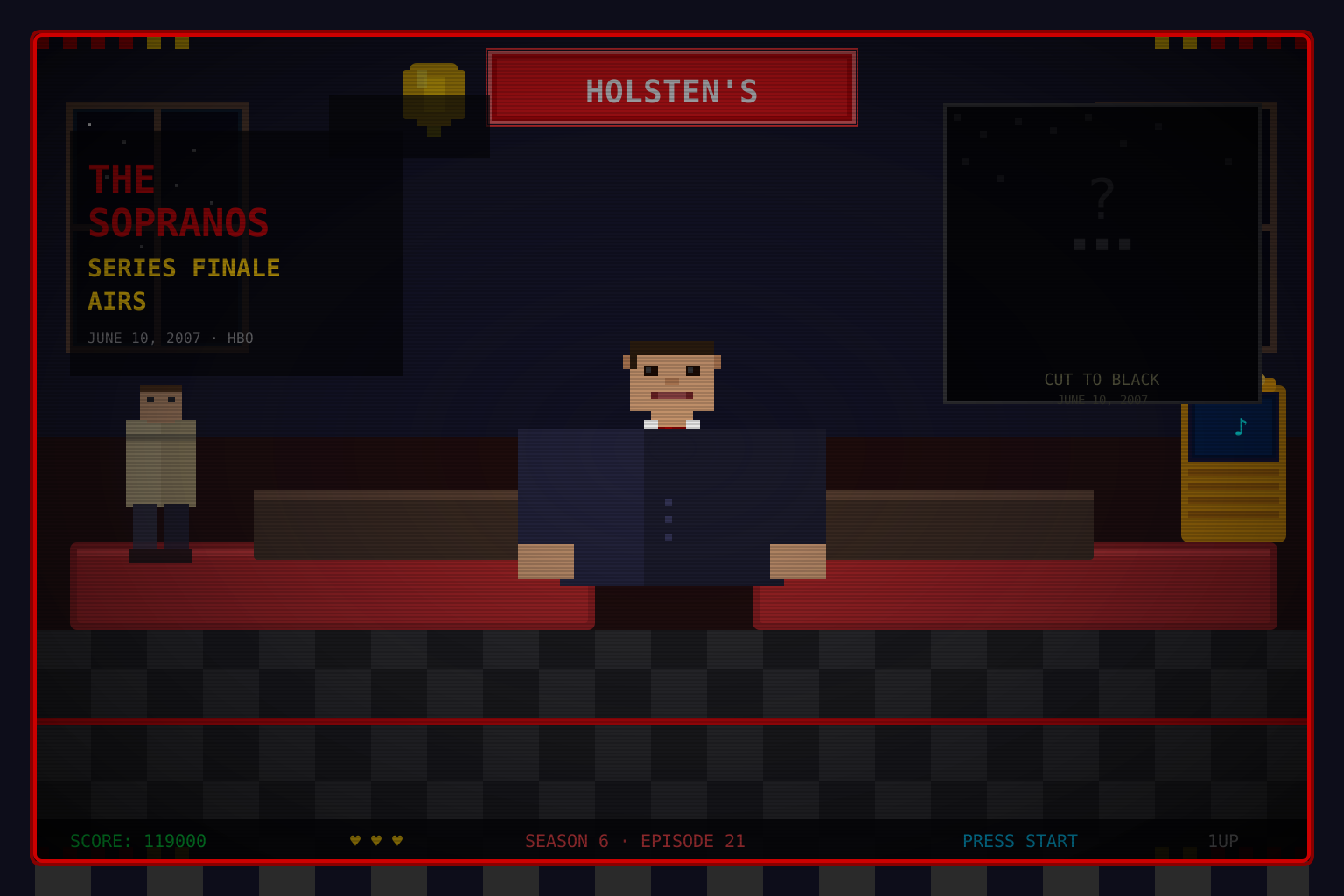
On June 10, 2007, the HBO drama series The Sopranos aired its final episode, “Made in America,” directed and written by series creator David Chase. The episode drew 11.9 million viewers—a 49% increase from the previous episode—as audiences awaited the conclusion of a series that had redefined television drama. The finale’s ending became instantly iconic and divisive: Tony Soprano sits in Holsten’s diner in Bloomfield, New Jersey, with his family; his wife Carmela and son A.J. arrive one by one; as daughter Meadow approaches from outside, an ominous bell rings repeatedly with each person who enters, while a man in a Members Only jacket heads to the restroom. Suddenly, the screen cuts to black for approximately ten seconds, accompanied by silence, leaving Tony’s ultimate fate entirely ambiguous. Many viewers initially believed their cable had malfunctioned. The cut-to-black sparked years of debate about whether Tony was killed in that moment or whether the ending symbolizes the constant, inescapable threat of death that defines his existence—a creative choice that transformed how television drama approached narrative closure.
Series Background
The Sopranos premiered on HBO on January 10, 1999, and ran for six seasons over eight years. Creator David Chase conceived the show as a meditation on therapy, identity, and violence filtered through the conventions of the gangster genre. The series starred James Gandolfini as Tony Soprano, a New Jersey mob boss who enters psychotherapy—with Dr. Jennifer Melfi (Lorraine Bracco)—while managing both his criminal organization and his suburban family. The show was groundbreaking from its first season: it attracted HBO’s largest audience to that point, won the Emmy Award for Outstanding Drama Series four times (2004, 2007, and in its final season), and earned 111 Emmy nominations across its run, winning 21. By its conclusion in 2007, it had generated an estimated $3 billion in revenue for HBO through subscriptions, DVD sales, and licensing. The final two seasons (Season 6, split into two parts) aired from March 2006 to June 2007 and raised viewership progressively toward the finale.
The Final Episode
“Made in America” ran 53 minutes and was filmed in 2006. The episode resolves several of the season’s ongoing plotlines—Phil Leotardo, head of the rival New York family, is killed by Tony’s crew; the FBI closes in on Tony—while leaving Tony’s personal fate unresolved. The script was closely guarded during production; HBO barred critics from reviewing it in advance. The iconic diner scene was filmed at Holsten’s Brookdale Confectionery in Bloomfield, New Jersey, a real restaurant that became a pilgrimage site for fans after the episode aired. Chase later stated in a 2021 interview with the filmmaker Alexandre Rockwell that Tony Soprano was indeed killed in the final moment—the camera’s sudden shift to Tony’s point-of-view (black screen, silence) representing the experience of death itself—though Chase subsequently characterized the statement as ambiguous.
The Debate About Tony’s Fate
The ten-second cut-to-black triggered one of television’s longest-running interpretive debates. Theorists pointing to Tony’s death cited the episode’s visual grammar: every entrance into the diner is shown from Tony’s POV (head-up), until the last cut goes to black from Tony’s perspective when the man in the Members Only jacket emerges from the restroom. The “Members Only” jacket is a recurring motif in the series, worn by Eugene Pontecorvo (who killed himself) and associated with death. Analysts noting the deliberate editing patterns—three cuts from Tony’s POV to the arriving family member, then a cut to black—argue it follows the established convention of sudden death cutting off awareness. Defenders of pure ambiguity—including Chase’s own earlier statements—argue that the black screen is precisely what Tony experiences every day: uncertainty, vigilance, the possibility that any moment could be his last, without resolution. The debate generated multiple academic papers and a book-length analysis (The Sopranos on the Couch, among others). As of 2024, the scene remains among the most analyzed minutes in television history.
Significance
The Sopranos finale was revolutionary for several reasons. First, it rejected the television industry’s traditional expectation of narrative closure and moral reckoning. By ending with ambiguity rather than a clear resolution, the episode demonstrated that prestige television could embrace uncertainty, thematic complexity, and viewer discomfort as artistic strengths. This became generative: within years, shows like Mad Men (final season, 2015), Breaking Bad (2013), and Succession (2023) adopted ambiguous or unconventional endings, making the refusal of tidy closure a hallmark of prestige drama. Second, the finale cemented HBO’s position as the architect of “prestige television”—a term that entered common usage largely because of The Sopranos. The show demonstrated that cable drama could match cinema in sophistication and moral ambiguity. David Chase won the Emmy for Outstanding Writing for a Drama Series for “Made in America” at the 59th Primetime Emmy Awards in 2007. The series was also a commercial catalyst: from 1999 to 2007 it helped lift HBO’s total subscriber base from roughly 25 million to 40 million, proving that premium cable drama could drive subscription revenue in ways network programming could not—a model replicated by every major streaming platform that followed. The finale’s influence extended into the television industry’s labor disputes as well: the writers who had made The Sopranos possible would go on strike just five months later in November 2007 (see: Writers’ Guild Strike of 2007), partly to secure residuals from the DVD and digital formats through which The Sopranos had generated enormous wealth.
Cultural Context
The finale aired in a year of remarkable creative ambition in American storytelling. The same autumn, No Country for Old Men—another work defined by its refusal of conventional narrative closure—won the Palme d’Or at Cannes and went on to win the Academy Award for Best Picture (see: No Country for Old Men). The pairing of Chase’s cut-to-black and the Coen Brothers’ similar refusal to show Llewelyn Moss’s death on screen suggested a broader cultural moment in which acclaimed American narrative art was interrogating what audiences were owed at the end of a story. Music, too, marked the finale: Journey’s “Don’t Stop Believin’“—which plays over the diner scene’s final seconds before the cut—re-entered the Billboard Hot 100 for the first time since 1982, peaking at No. 4 in June 2007, driven entirely by the episode’s cultural momentum.