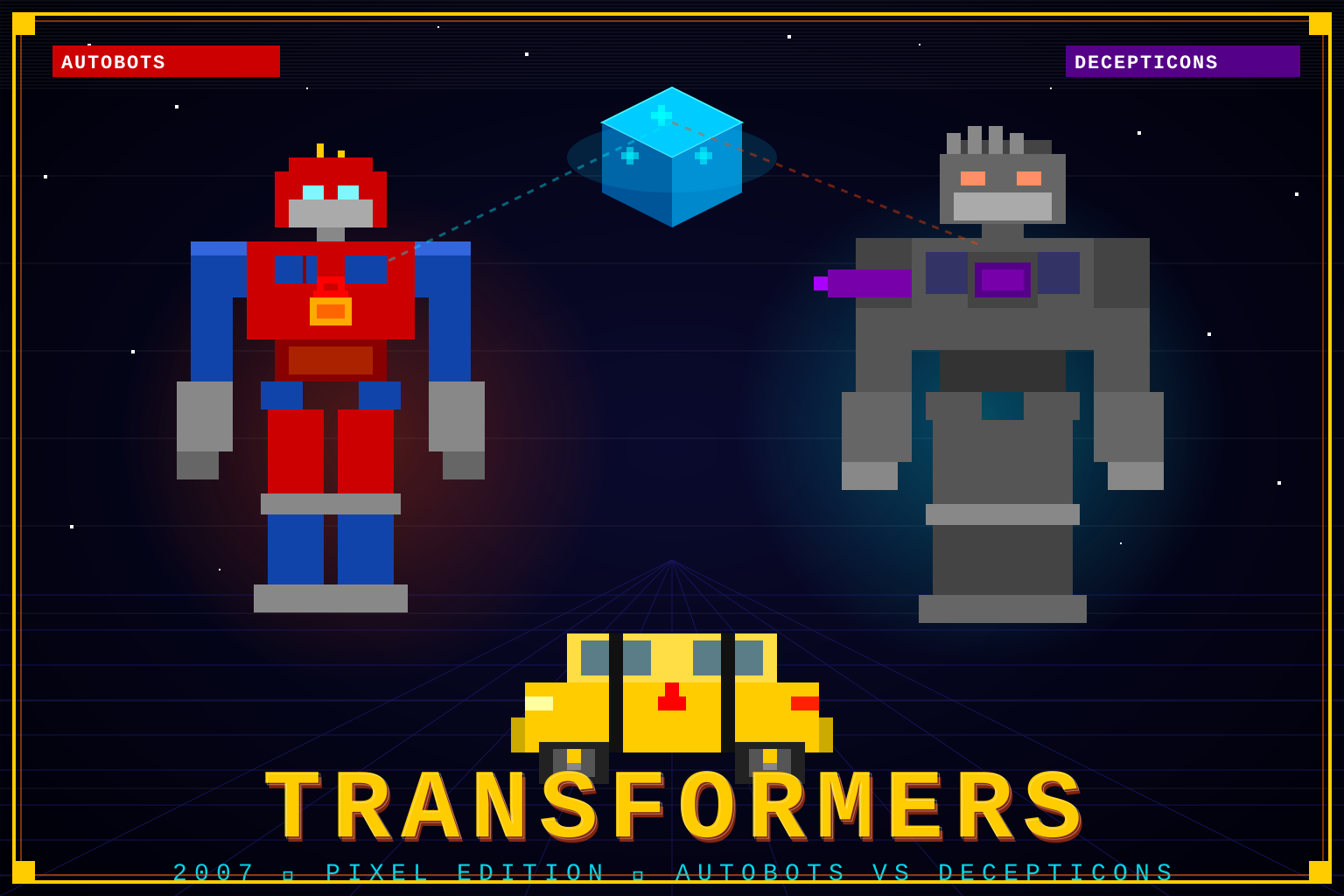
Category: Arts & Culture Key figures: Michael Bay (director); Shia LaBeouf (Sam Witwicky); Megan Fox (Mikaela Banes); Jon Voight (Secretary of Defense John Keller); John Turturro (Agent Simmons, Sector Seven); Josh Duhamel (Capt. William Lennox); Tyrese Gibson (Tech Sgt. Epps); Peter Cullen (voice of Optimus Prime); Hugo Weaving (voice of Megatron); Steve Jablonsky (composer)
Summary
Michael Bay’s Transformers premiered on July 3, 2007, in North America following a June 28 international release, launching the first live-action feature film adaptation of the Hasbro toy and animated franchise. The film starred Shia LaBeouf as Sam Witwicky, a teenage boy who inherits a 1987 Chevrolet Camaro that is secretly Bumblebee, a robot alien disguised as an automobile. The narrative centers on the arrival of the Autobots and Decepticons—two factions of sentient machines from the planet Cybertron—to Earth, drawn by the search for the AllSpark, a powerful cube. The 144-minute film combined practical effects, digital animation, and location shooting across California, Qatar, and Hoover Dam to create a spectacle centered on transforming vehicles and combat sequences.
Produced by Paramount Pictures and DreamWorks Pictures on a budget of $150–$170 million, Transformers grossed $709.7 million worldwide. Its $319.2 million domestic total made it the third-highest-grossing film of 2007 at the North American box office (behind Spider-Man 3 and Shrek the Third) and the highest-grossing live-action toy adaptation made to that point. Opening on a Tuesday, the film earned $70.5 million over its first three-day weekend and roughly $155 million across its first week—then a record opening week for a non-sequel. Its commercial success was unexpected among industry observers, many of whom had doubted whether a toy-based action film could achieve mainstream appeal beyond nostalgia-driven adult audiences.
Production & Development
The Transformers franchise had originated as a toy line co-developed by Hasbro and the Japanese company Takara Tomy in 1984, accompanied by an animated series that ran from 1984 to 1987. The property had remained dormant in live-action cinema until 2005, when executive producer Steven Spielberg and director Michael Bay partnered with Hasbro to develop a feature film. Bay had built a reputation for large-scale action cinema with Bad Boys (1995), Armageddon (1998), and Pearl Harbor (2001), and brought that sensibility to Transformers: the film emphasized pyrotechnics, vehicle stunts, and rapid editing over introspective character development.
The special effects were overseen by Industrial Light & Magic (ILM), the George Lucas-founded visual-effects company that had pioneered digital animation in the 1990s and 2000s. ILM created the robot designs and transformation sequences using a combination of motion-capture technology and traditional computer animation. The key technical innovation was the parametric animation of the robot transformations—each robot’s conversion from vehicle to humanoid form was choreographed to appear mechanical and physically plausible within the film’s stylized action grammar. The level of detail in the robots’ designs required render times of 5–10 hours per frame for complex sequences, pushing render-farm capacity at the time.
Shia LaBeouf was cast as the protagonist Sam Witwicky following his breakout role as Louis Stevens on the Disney Channel series Even Stevens (2000–2003) and his starring turn in Holes (2003), the Disney adaptation of Louis Sachar’s novel. At 21 years old during filming, LaBeouf brought a youthful everyman quality to the role that resonated with the film’s target demographic of teenage and young-adult audiences. Australian actress Megan Fox, cast as Mikaela Banes, the female lead, was a relatively unknown actress at the time of filming, brought into the project by Bay; her presence in the film and the male gaze-oriented cinematography became a point of later critical discussion and contributed to the film’s complex legacy regarding gender representation.
John Turturro played Agent Simmons, a sardonic, off-kilter operative from “Sector Seven,” a secret government agency that had long known about the Transformers. Turturro’s comedic performance was a notable counterweight to the film’s otherwise bombastic tone, offering one of the few character-driven moments in a narrative dominated by spectacle. Veterans Jon Voight and Josh Duhamel represented the military contingent, with Duhamel’s Captain Lennox and Tyrese Gibson’s Tech Sergeant Epps forming an action-movie buddy-pair that would recur across several sequels.
Reception & Box Office
Transformers opened in more than 4,000 theaters in North America on July 3, 2007, earning $70.5 million over its first three-day weekend (Friday–Sunday) and about $155 million across its first six-and-a-half days, including the July 4 holiday—a debut that exceeded most industry expectations for a toy-based action film and set a first-week record for a non-sequel. It opened at the top of the domestic box office ahead of holdovers like Ratatouille and Live Free or Die Hard before Harry Potter and the Order of the Phoenix—which opened July 11—claimed the top spot the following weekend.
Critical reception was mixed. The film received a 57% “rotten” rating on Rotten Tomatoes, with critics praising the visual spectacle and action sequences but criticizing the screenplay, plot coherence, and character development. Reviewers who disliked the film generally faulted it for substituting noise and technical spectacle for wit and narrative coherence. Audiences, however, skewed more favorably, and positive word-of-mouth from action-film enthusiasts sustained its theatrical run through August and into September 2007.
The film’s global box office reached $709.7 million by the end of its theatrical run, ranking among the highest-grossing films of 2007 worldwide and standing as the highest-grossing film in which Shia LaBeouf had starred to that point. That return on the $150–170 million production budget (not including marketing costs) was substantial, particularly for a July release that faced direct competition from established franchises like Pirates of the Caribbean: At World’s End and The Bourne Ultimatum.
Soundtrack & Score
The film’s musical identity was shaped by two distinct layers: an orchestral score by composer Steve Jablonsky and a curated rock-music soundtrack anchored by Linkin Park. Jablonsky, a collaborator of Hans Zimmer at Remote Control Productions, composed an original orchestral score that underscored the Autobots as heroic figures through bold brass and string themes while deploying more dissonant, mechanical textures for the Decepticons. His theme for Optimus Prime—a sweeping, slow-building motif for strings and brass—became one of the most recognizable pieces of film-score composition associated with blockbuster action cinema in the late 2000s and remained in use across all five Bay-directed Transformers films.
Linkin Park contributed the song “What I’ve Done,” from their album Minutes to Midnight (May 2007), which was licensed as the film’s closing credits track and received significant commercial radio play in summer 2007. “What I’ve Done” reached number 5 on the Billboard Hot 100 and was nominated for a Grammy Award for Best Rock Song. The Linkin Park–Transformers partnership typified a common Hollywood practice of synchronizing action tentpoles with established rock or pop acts to capture radio airplay as a marketing vehicle beyond the theatrical advertising campaign. The soundtrack album, released July 3, 2007 by Reprise Records, also featured tracks from Goo Goo Dolls, Smashing Pumpkins, HIM, and Mutemath.
Cultural & Franchise Impact
Transformers succeeded in demonstrating the viability of live-action adaptations of toy franchises and animated properties—a finding that would shape Hollywood strategy in the subsequent decade. The film’s commercial success led Paramount to greenlight Transformers: Revenge of the Fallen (2009), Dark of the Moon (2011), Age of Extinction (2014), and The Last Knight (2017), creating an ongoing film series that would generate over $5 billion in global box office revenue by 2023.
The film’s visual language—combining practical location photography with extensive digital animation, rapid editing, and explosion-heavy action sequences—became a template for subsequent large-budget action tentpoles. Directors and studios observed that audiences would sustain interest in narratively simple plots if the action set-pieces delivered sufficient spectacle. This observation influenced the production of subsequent franchise films like Iron Man (2008), Avatar (2009), and the later installments of The Fast and the Furious franchise.
Michael Bay’s auteurial imprint on Transformers—characterized by kinetic camera movement, extreme close-ups during combat, overlapping dialogue, and rapid scene transitions—defined the film’s visual identity and became both celebrated and controversial among critics and audiences. Some viewers embraced the aesthetic as exhilarating spectacle; others critiqued it as inducing motion sickness and obfuscating spatial relationships during action sequences. The debate over Bay’s directorial style became a focal point in discussions of cinema aesthetics in the 2010s, with Transformers serving as the primary exemplum of high-budget action filmmaking that prioritized visual intensity over narrative or thematic coherence.
Megan Fox’s casting and the male-gaze cinematography of her character also generated scholarly and critical discussion about gender representation in blockbuster cinema, particularly regarding how female characters in action franchises were frequently defined by their physical appearance and romantic availability to the male protagonist rather than by agency or character development. This critique, while not articulated with full force in 2007, would resurface in later assessments of the Transformers franchise’s legacy.
Significance
Transformers represented a turning point in Hollywood’s relationship with intellectual property derived from non-cinematic sources—toys, video games, and animated series. Prior to 2007, live-action toy adaptations had been rare and largely unsuccessful (with the exception of the G.I. Joe animated film in 1987, which did not receive theatrical release). Transformers proved that properties with name recognition among multiple generations of consumers could sustain theatrical franchises.
The film’s success occurred within a broader 2007 context of technological advancement in visual effects: the year also saw the iPhone launch on June 29, which would transform digital media consumption and distribution within a decade; YouTube’s continued growth as a platform for distributing film trailers and clips; and Blu-ray vs. HD-DVD format competition for high-definition home video. Transformers demonstrated that the theatrical exhibition of digitally complex action cinema remained commercially viable even as home-viewing technologies were advancing.
The film also reflected Hollywood’s intensifying emphasis on franchise-building: by developing Transformers as the first installment of an intended multi-film series with an overarching mythology, Paramount was adopting a strategy—soon epitomized by Marvel Studios’ interconnected “cinematic universe,” which began with Iron Man (2008)—that would dominate studio decision-making through the 2010s and beyond.
The summer of 2007 was one of the most competitive box-office seasons on record. Transformers shared a crowded summer with Harry Potter and the Order of the Phoenix (July 11), The Bourne Ultimatum (August), and Ratatouille, each of which grossed more than $200 million domestically; the July 21 release of the final novel, Harry Potter and the Deathly Hallows, made the same weeks a landmark in publishing as well. Simultaneously, the Writers Guild of America strike was beginning to cast a shadow over Hollywood production pipelines, though Transformers—already shot and in post-production—was unaffected. Year-end awards competition was dominated by the Coen Brothers’ No Country for Old Men, which presented a stark artistic contrast to Transformers: where Bay’s film celebrated maximalist spectacle, the Coens’ stripped-back thriller demonstrated that austere character-driven cinema could also find commercial footing in the same multiplex ecosystem.
Sources
- Transformers (2007 film) — Wikipedia
- Transformers — Rotten Tomatoes
- Transformers — Box Office Mojo
- Michael Bay — Wikipedia
- Shia LaBeouf — Wikipedia
- 2007 in film — Wikipedia — context for 2007 box office performance and rankings
- Steve Jablonsky — Wikipedia — biographical and compositional details for the Transformers score
- Linkin Park “What I’ve Done” — Wikipedia — chart performance and Grammy nomination
- Industrial Light & Magic — Wikipedia — context for ILM’s digital animation work on the film