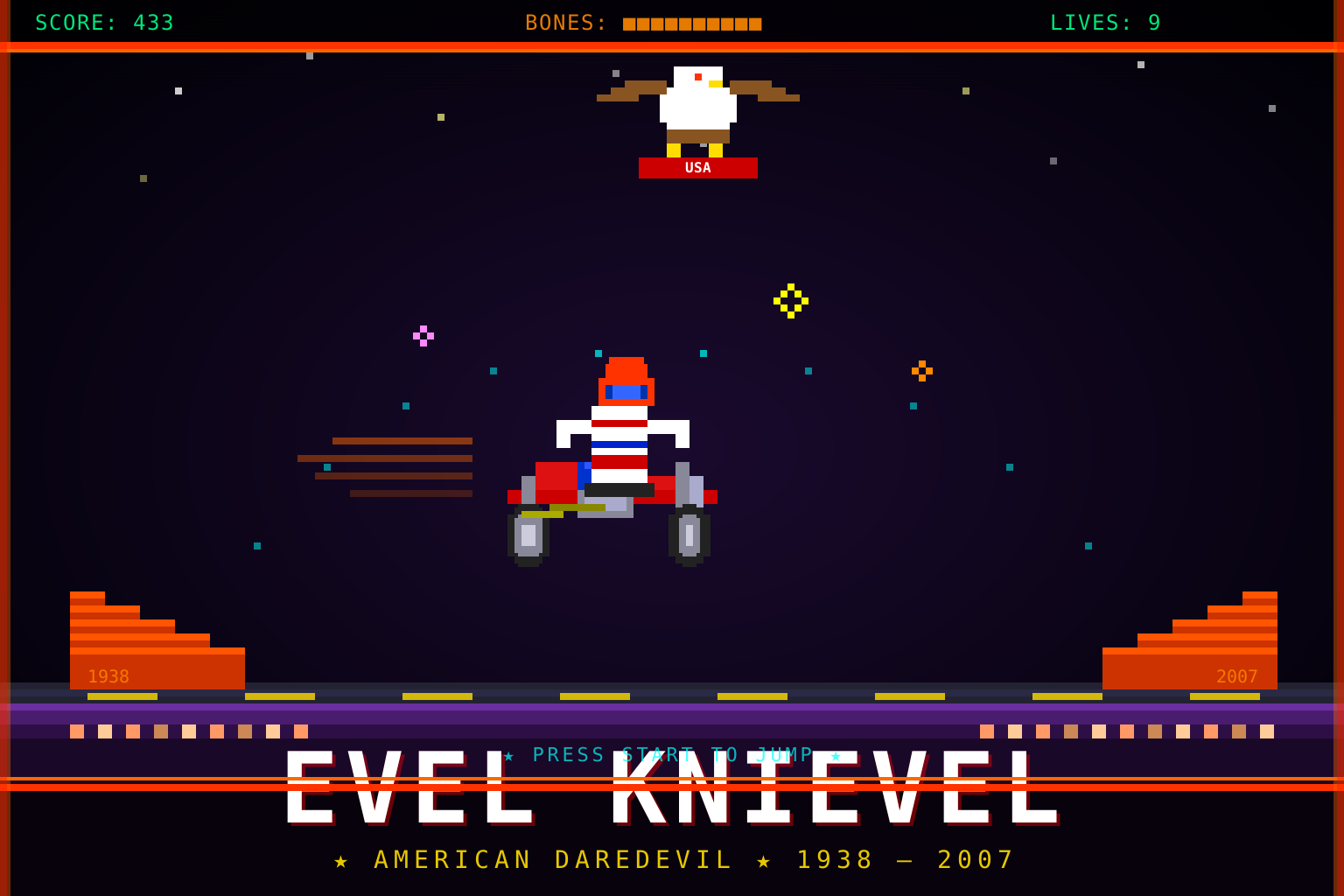
Category: People
Key figures: Evel Knievel (Robert Craig Knievel Jr., born October 17, 1938); Robbie Knievel (son, fellow stunt performer); Jay Sarno (Caesars Palace owner who commissioned the 1967 fountain jump); Doug Danger (among his proteges in extreme sports)
Summary
Evel Knievel, born Robert Craig Knievel Jr. on October 17, 1938, in Butte, Montana, was an iconic American stunt performer and daredevil who became a household name through his death-defying motorcycle jumps and fearless pursuit of extreme spectacle. On November 30, 2007, Knievel died in Clearwater, Florida, at age 69 from complications of diabetes and idiopathic pulmonary fibrosis — a progressive lung disease. His passing marked the end of a four-decade career that redefined American popular entertainment and established the template for modern extreme sports celebrity.
Knievel holds the Guinness World Record for surviving the most bone fractures in a lifetime — 433 documented fractures across his performing career. He attempted more than 75 ramp-to-ramp motorcycle jumps before live and television audiences, propelling him to a level of celebrity that transcended sport and entered American mythology.
Early Life and Career
Knievel was born in Butte, Montana, and raised primarily by his paternal grandparents after his parents separated when he was young. He was a natural athlete — a competitive ice hockey player and ski jumper in high school — but also accumulated a juvenile police record for petty theft. He worked variously as a copper miner, insurance salesman, and semi-professional hockey player before discovering stunt riding in the early 1960s.
He formed the Evel Knievel’s Motorcycle Daredevils troupe around 1965 and began touring small venues. The nickname “Evel” emerged as a wordplay on the name “Knievel” and the word “evil”; he embraced it fully, developing a patriotic red-white-and-blue costume that became his visual signature and reinforced his all-American daredevil persona. His early act featured comparatively modest jumps — over cars and trucks — but he constantly escalated the scale of his performances to sustain audience interest.
Notable Stunts
Caesars Palace Fountain Jump (December 31, 1967)
Knievel’s first nationally recognized jump — and his most famous crash — took place on New Year’s Eve 1967 at Caesars Palace in Las Vegas, where casino owner Jay Sarno commissioned him to jump the iconic fountain complex on a modified Triumph motorcycle. The jump was filmed by a camera crew that included a young John Derek. Knievel cleared the fountain but lost control on landing; the resulting crash left him in a coma for 29 days and hospitalized for weeks with fractures to his hips, legs, wrists, and skull. ABC’s Wide World of Sports broadcast the footage months later, and the spectacular crash — rather than a successful landing — made Knievel a household name.
Snake River Canyon Jump (September 8, 1974)
Knievel’s most ambitious and most publicized stunt was the attempted crossing of the Snake River Canyon near Twin Falls, Idaho, using a steam-powered rocket motorcycle called the Skycycle X-2. The event, promoted as a pay-per-view spectacle by promoter Bob Arum, drew approximately 35,000 spectators to the canyon rim and was closed-circuit broadcast in theaters across North America. The Skycycle’s parachute deployed prematurely on launch; Knievel drifted down to the canyon floor, narrowly missing the Snake River, and survived with minor injuries. Though widely regarded as a failure, the stunt grossed an estimated $6 million from closed-circuit sales alone and demonstrated that Knievel could command a national pay-per-view audience years before the concept was mainstream.
Wembley Stadium and Chicago White Sox Park (1975)
On May 26, 1975, Knievel performed before approximately 90,000 spectators at Wembley Stadium in London, jumping 13 buses. He landed the jump but crashed on the exit ramp, fracturing his pelvis and both hands; he walked to the microphone and announced his retirement — a retirement he did not keep. The Wembley jump, broadcast in the United Kingdom and replayed in the United States, extended his celebrity internationally.
Cultural Impact
At his peak in the mid-1970s, Knievel was one of the most licensed celebrity names in America. The Evel Knievel Stunt Cycle toy, produced by Ideal Toy Company from 1973 onward, became one of the best-selling toys of the decade — with an estimated 12 million units sold by the late 1970s. The toy line expanded to include a Scramble Van, a Canyon Evel Knievel set themed to the Snake River stunt, and numerous accessories. The brand demonstrated that a stunt performer — not a traditional athlete, actor, or musician — could command the kind of merchandise licensing usually reserved for the biggest entertainment properties.
ABC’s Wide World of Sports featured Knievel’s jumps repeatedly throughout the 1970s, and his appearances reliably drew among the highest ratings the program ever recorded. He was the subject of two theatrical films: Evel Knievel (1971), a biographical film starring George Hamilton, and Viva Knievel! (1977), in which he played himself.
In 2007, shortly before his death, Knievel filed a lawsuit against rapper Kanye West over the music video for “Touch the Sky,” which featured imagery and a storyline closely paralleling the 1974 Snake River Canyon jump. The lawsuit was settled out of court — a final indication of the cultural durability of his brand nearly three decades after his peak performing years. (See also: Kanye West’s Graduation released.)
Final Years and Death
Knievel’s later decades were marked by declining health. He underwent a liver transplant in 1999, attributing his liver failure to years of heavy drinking and the physical toll of his injuries. In the years before his death he converted to Christianity, being baptized in a public ceremony in 2007 — a conversion he attributed in interviews to the influence of Robert H. Schuller, the televangelist.
He died on November 30, 2007, in Clearwater, Florida. The cause of death was reported as complications of diabetes combined with idiopathic pulmonary fibrosis. He was 69 years old. His death came just weeks after he had settled the lawsuit against Kanye West, and while he was still making public appearances to discuss his legacy.
Knievel was survived by his son Robbie Knievel, who had carried on the family stunt-performing tradition, completing jumps his father never successfully landed, including a Caesars Palace fountain jump in 1989.
Significance
Knievel’s death at 69 marked the end of an era in American entertainment and provoked widespread reflection on the nature of celebrity, risk, and spectacle:
-
The daredevil as celebrity template: Knievel’s career proved that individual extreme risk-taking, if staged and marketed effectively, could generate mass-media celebrity on par with conventional sports stars. His model predates — and arguably enabled — the extreme sports industry and stunt-driven digital content culture.
-
Injury record: His 433 documented bone fractures — recognized by the Guinness Book of World Records — stand as a quantified testament to the physical cost of his career. Medical professionals studying trauma injuries have cited his case in studies of cumulative bone fracture recovery.
-
Merchandising innovation: The Evel Knievel toy line demonstrated that a non-fiction performer could anchor a major product franchise, helping establish the commercial logic later used for extreme sports brands and action sports athletes.
-
Pay-per-view pioneer: The 1974 Snake River Canyon stunt was among the earliest large-scale pay-per-view live events in U.S. entertainment history, preceding boxing’s adoption of the format. It demonstrated a viable alternative revenue model for live spectacle outside broadcast television.
-
Cultural longevity: The 2007 Kanye West lawsuit showed that Knievel’s imagery retained enough cultural currency to be worth legally protecting more than 30 years after his peak — a measure of the depth of his imprint on American popular memory.
Sources
- Evel Knievel — Wikipedia — comprehensive biography including career milestones, stunt chronology, injury records, and cultural impact.
- Evel Knievel — Encyclopædia Britannica — authoritative career biography.
- Motorcycle Hall of Fame — Evel Knievel inductee — recognition of Knievel’s influence on motorcycle culture (inducted 1999).
- Evel Knievel obituary — The New York Times (November 30, 2007) — contemporary obituary with career assessment and family comment.
- Snake River Canyon jump — Wide World of Sports historical archive context via ESPN — pay-per-view attendance, gross revenue, and production detail.