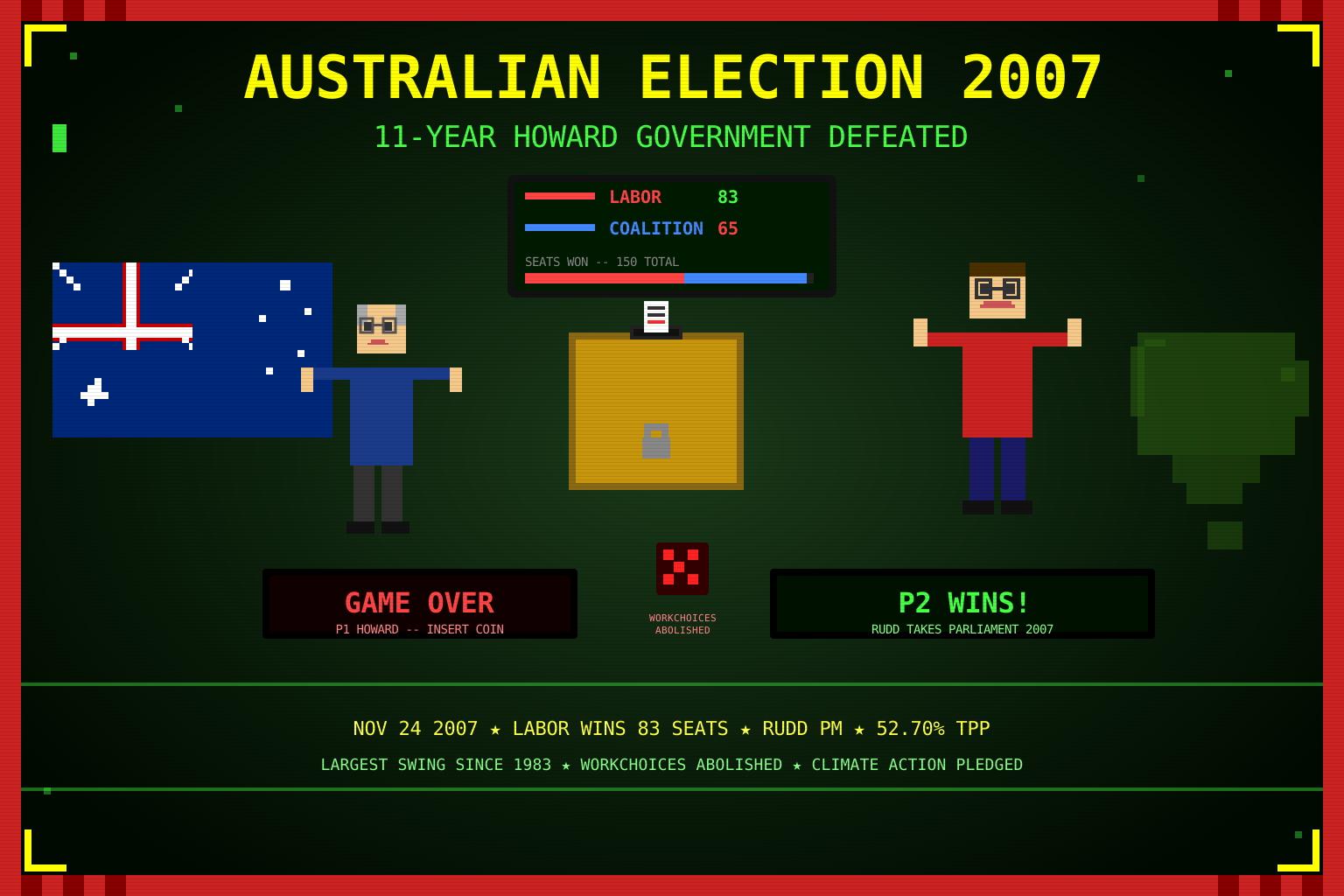
Key figures: Kevin Rudd (Labor Party leader, incoming Prime Minister); John Howard (outgoing Liberal Prime Minister, 1996–2007); Maxine McKew (Labor candidate, Bennelong); Peter Costello (Liberal Treasurer and deputy leader); Julia Gillard (Labor Deputy Leader)
Summary
On November 24, 2007, Australian voters delivered a decisive defeat to Prime Minister John Howard’s Liberal-National Coalition government, propelling Labor leader Kevin Rudd to power in a landslide election. Labor won 83 of 150 House of Representatives seats compared to the Coalition’s 65, capturing a 52.70 percent two-party-preferred vote — a 5.44-point swing against the government, the largest swing since Bob Hawke’s 1983 victory. Rudd’s victory ended the Coalition’s 11-year, 8-month tenure in power, the longest continuous coalition government since the Menzies era.
Campaign context: WorkChoices and climate change
The election was fought primarily on two domestic issues. The Howard government’s WorkChoices industrial relations legislation — enacted in 2006 and allowing employers greater flexibility to offer individual contracts below award conditions — proved deeply unpopular with middle-income workers and trade unions, who organized a sustained “Your Rights at Work” campaign throughout 2007. Labor pledged to abolish WorkChoices entirely. Climate change, largely absent from the 2004 election, emerged as a major issue in 2007 driven by growing scientific consensus (the IPCC Fourth Assessment Report was released in January 2007) and Australia’s role in global negotiations; Howard refused to ratify the Kyoto Protocol, while Rudd made ratification a first-term commitment. Al Gore and the IPCC’s joint Nobel Peace Prize in October 2007 further elevated climate as an electoral issue in the weeks before the vote.
Howard’s defeat in Bennelong
Howard’s personal defeat was particularly dramatic: the sitting Prime Minister became only the second in Australian Federation history to lose his own seat, after Stanley Bruce in 1929. He lost the seat of Bennelong in Sydney — held by various Liberal MPs since 1955 — to Labor’s Maxine McKew, a former ABC political journalist and television host, by an estimated 5.5 percentage points on a swing of approximately 4.4 points. McKew’s profile as a recognizable media figure and her energetic local campaign contributed to the result in what had been considered a safe Conservative stronghold. Howard conceded defeat on election night and announced his resignation as Liberal leader; Peter Costello, his long-serving Treasurer, declined to seek the party leadership and subsequently announced he would leave parliament, triggering further Liberal instability.
Rudd’s profile and Labor’s campaign
Kevin Rudd, a Queensland-based former diplomat and public servant who had served as Shadow Foreign Minister, became Labor leader in December 2006, replacing the more left-leaning Kim Beazley. Rudd positioned Labor as economically conservative on fiscal management while differentiating on climate, education funding, and industrial relations — a “me too” strategy on economic management that neutralized Coalition attacks. He was the third Labor leader since World War II to lead the party from opposition to government victory, following Gough Whitlam (1972) and Bob Hawke (1983). Julia Gillard, Rudd’s deputy, would later succeed him as Prime Minister in 2010.
Significance
The 2007 Australian election represented a watershed moment in Australian politics, ending the Howard era and ushering in the first Labor government since Paul Keating lost to Howard in March 1996. Howard’s defeat — including the loss of his own seat — was historically significant, cementing perceptions of electoral fatigue and the public’s desire for change after more than a decade. The scale of the swing demonstrated that electoral outcomes were not determined solely by economic performance; voters could reject long-serving governments when they perceived policy failings, even absent economic hardship.
Immediate policy consequences
Rudd was sworn in as Prime Minister on December 3, 2007, just nine days after the election. His first official act in office was to instruct Australia’s delegation to the Bali Climate Conference (December 3–14, 2007) to sign the Kyoto Protocol — a move that reversed the Howard government’s decade-long position and repositioned Australia within international climate negotiations. The new government subsequently began the process of dismantling WorkChoices, replacing it with the Fair Work Act enacted in 2009.
The election also reflected Australia’s increasing engagement with global climate politics at a critical juncture: the Bali conference was intended to set the framework for a post-Kyoto agreement, and Australia’s ratification, along with the change of government’s tone, was seen as an important signal heading into negotiations that would culminate (inconclusively) at Copenhagen in 2009.
Comparative context in 2007
The Australian result was part of a broader 2007 pattern of established governments facing electoral accountability across Anglophone democracies. Gordon Brown had succeeded Tony Blair as UK Prime Minister in June 2007, though Brown inherited power rather than winning an election. Nancy Pelosi had become Speaker of the US House in January 2007 following Democrats’ midterm gains under the second Bush administration. Australia’s election added to a sense of political realignment across English-speaking democratic nations in the middle of the decade.
Sources
- Wikipedia contributors. “2007 Australian Federal Election.” Wikipedia, The Free Encyclopedia. Accessed via https://en.wikipedia.org/wiki/2007_Australian_federal_election
- Australian Electoral Commission. Official election results and historical analyses. https://results.aec.gov.au/
- Megalogenis, George. The Australian Moment. Penguin Books Australia, 2012. (analysis of 2007 electoral context)
- Gartrell, Tim. Labor Campaign Director accounts of the 2007 campaign strategy (various interviews, 2008).