Category: People
Key figures: Serena Williams, Maria Sharapova, Justine Henin, Venus Williams, Shahar Pe’er, Nicole Vaidišová, Nadia Petrova
Summary
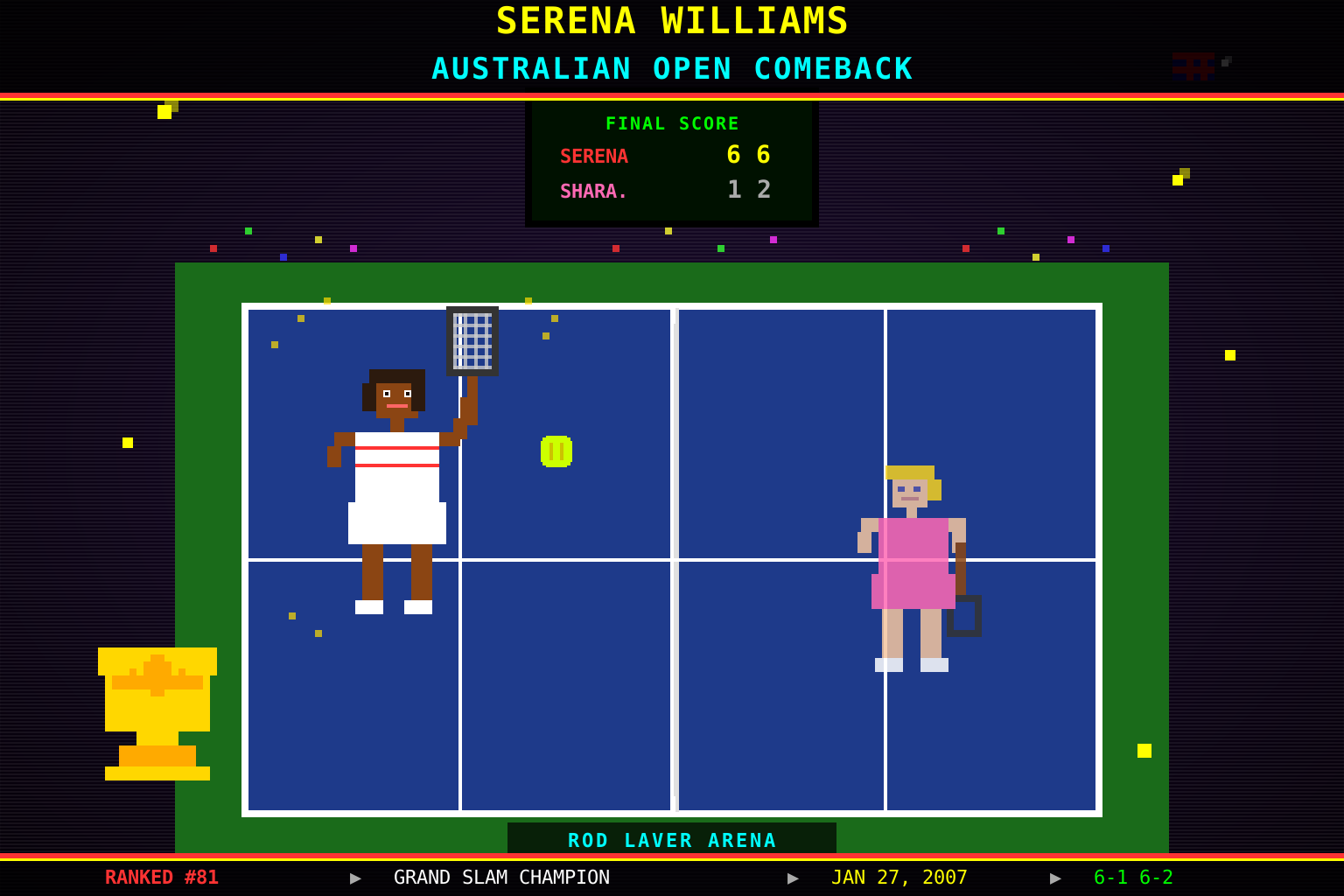
On January 27, 2007, Serena Williams captured the Australian Open singles title, defeating top-seeded Maria Sharapova 6–1, 6–2 in a commanding final at Rod Laver Arena in Melbourne. The result was remarkable for Williams’s status: she entered the tournament unseeded and ranked No. 81 in the world—the lowest ranking of any Grand Slam singles champion since Christine O’Neil won the 1978 Australian Open unseeded. It was Williams’s eighth Grand Slam singles title and her third Australian Open crown, achieved after an injury-hit 2006 in which her ranking fell as low as No. 139. En route to the title she saved match points against Shahar Pe’er in the quarterfinals and came through a semifinal against Nicole Vaidišová before overwhelming Sharapova, then the world No. 2, in the final. Williams played the tournament in the shadow of the loss of her older sister Yetunde Price, who was killed in Compton, California, on September 14, 2003.
After the Australian Open, Williams’s ranking climbed quickly. In late March and early April she won the Sony Ericsson Open in Miami, defeating world No. 1 Justine Henin 0–6, 7–5, 6–3 after losing the opening set to love. She lost to Henin in the quarterfinals of each of the year’s three remaining Grand Slam tournaments—the French Open, Wimbledon, and the US Open—but finished 2007 ranked No. 7 in the world and as the top-ranked American woman for the first time since 2003.
Career Background and the 2006 Interruption
By the mid-2000s Serena Williams had won seven Grand Slam singles titles and had held the world No. 1 ranking. A series of setbacks then disrupted her career: left-knee surgery in 2003, the murder of her older sister Yetunde Price in September 2003, and recurring injuries that limited her schedule. Williams won the 2005 Australian Open but played sparingly afterward, and in 2006 a combination of injury, illness, and grief held her to a handful of tournaments. Her ranking fell to a career low of No. 139 late in 2006, and she had not contested a Grand Slam tournament since the 2006 Australian Open.
Because her ranking had fallen out of the top 32, Williams entered the 2007 Australian Open unseeded, meaning she could be drawn against seeded players from the opening rounds. The tournament was her first Grand Slam appearance in a year and her most prominent event since her decline.
Tournament Path: January 2007
Williams’s route to the title required her to beat several seeded opponents despite her low ranking:
| Round | Opponent | Score |
|---|---|---|
| 1R | Mara Santangelo (Italy) | 6–2, 6–1 |
| 2R | Anne Kremer (Luxembourg) | 7–6(4), 6–2 |
| 3R | Nadia Petrova (Russia, No. 5 seed) | 1–6, 7–5, 6–3 |
| 4R | Jelena Janković (Serbia, No. 11 seed) | 6–3, 6–2 |
| QF | Shahar Pe’er (Israel, No. 16 seed) | 3–6, 6–2, 8–6 |
| SF | Nicole Vaidišová (Czech Republic, No. 10 seed) | 7–6(5), 6–4 |
| F | Maria Sharapova (Russia, No. 1 seed) | 6–1, 6–2 |
The third-round match against Petrova was an early scare: Williams lost the opening set 1–6 before recovering to win in three. The turning point of the tournament came in the quarterfinal against Pe’er, in which Williams dropped the first set 3–6, fell behind in the third, and saved match points before closing out the deciding set 8–6. She then defeated Vaidišová in a semifinal that turned on a first-set tiebreak. The final against Sharapova was one-sided, with Williams needing a little over an hour to complete the 6–1, 6–2 win.
2007 Season After Melbourne
Williams’s Australian Open title launched the most productive stretch of her post-comeback career:
- Sony Ericsson Open, Miami (April 2007): Williams defeated Justine Henin in the final 0–6, 7–5, 6–3, one of the most dramatic comebacks of her career. She lost the first set to love and trailed in the second before winning the final two sets; Henin served for the match in the second set before Williams broke back.
- French Open (May–June 2007): Williams lost to Henin in the quarterfinals. Henin went on to win the title without dropping a set.
- Wimbledon (June–July 2007): Williams lost to Henin in the quarterfinals after being hampered by a leg injury during the match.
- US Open (August–September 2007): Williams again lost to Henin in the quarterfinals, confirming Henin’s dominance of the Grand Slam events that season.
Williams finished 2007 ranked No. 7 in the world—a rise of well over 100 places from her late-2006 low of No. 139—and was the top-ranked American woman for the first time since 2003, ahead of her sister Venus.
Recognition
Williams received the Laureus World Sports Award for Comeback of the Year, presented in 2008 for her 2007 season; the award recognized her return from outside the top 100 to a Grand Slam title. The unseeded achievement drew comparison with Christine O’Neil, whose 1978 Australian Open title—also won in Melbourne—had been the last time a woman won a Grand Slam singles event unseeded, twenty-nine years earlier.
Significance
Serena Williams’s 2007 Australian Open victory is one of the most celebrated comeback performances in modern tennis. After a 2006 disrupted by injury and by grief over her sister’s murder, her return as an unseeded, No. 81–ranked Grand Slam champion reaffirmed her standing among the sport’s dominant players. The result also framed the Williams–Henin rivalry that shaped women’s tennis in 2007: Henin beat Williams in the quarterfinals of three consecutive Grand Slam tournaments and finished the year as world No. 1 and WTA Player of the Year, while Williams’s Miami victory over Henin showed she remained capable of beating the best on any given day.
The 2007 title proved an early marker of a long second act. Williams went on to win 15 more Grand Slam singles titles, bringing her career total to 23—the most by any player in the Open Era—before she stepped away from professional competition in September 2022. The Australian Open comeback thus occupies a pivotal place in one of the most decorated careers in the history of the sport.
Williams’s triumph came during a January defined by public scrutiny of high-profile figures, including intensifying concern over Steve Jobs’s health after his gaunt appearance at the iPhone unveiling on January 9. Her achievement also prefigured the year’s other contested milestone of individual athletic performance, Barry Bonds’s August 7 home-run record.
Sources
- 2007 Serena Williams tennis season – Wikipedia — full match-by-match season record, including rankings and the Australian Open and Miami results.
- 2007 Australian Open – Women’s singles – Wikipedia — draw, seeds, scores, and the unseeded-champion milestone.
- Serena Williams – Wikipedia — career statistics, Grand Slam tally, and biographical background including Yetunde Price.
- 1978 Australian Open – Women’s singles – Wikipedia — Christine O’Neil as the last unseeded women’s Grand Slam champion before Williams.
- Serena Williams – Laureus World Comeback of the Year — the Laureus award recognizing her 2007 comeback.